


Interstellar Comet 3I/ATLAS Shows Slow Gas Flow and Strong Iron, Nickel Signals
Astronomers using the Hobby-Eberly Telescope in Texas have detected gas extending more than 50,000 miles from the core of interstellar comet 3I/ATLAS. Only the third known interstellar object observed, the comet appears to release gas at roughly half the speed typical of Solar System comets. Its spectrum also contains unusually strong signals from iron and nickel.
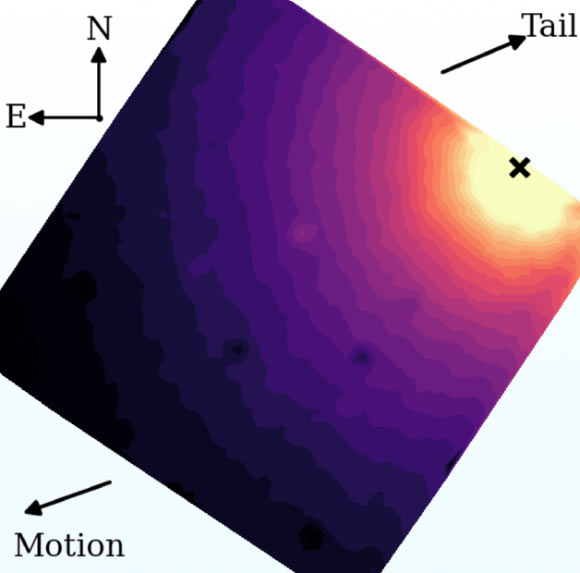
Spatial distribution of cyan around 3I/ATLAS. Image credit: Cochran et al., doi: 10.3847/PSJ/aea086.
What astronomers found in 3I/ATLAS
3I/ATLAS was discovered on July 1, 2025, by the NASA-funded ATLAS survey telescope in Rio Hurtado, Chile. The interstellar comet is also known as C/2025 N1 (ATLAS) and A11pl3Z.
The object arrived from the direction of the constellation Sagittarius. On October 30, 2025, it reached perihelion, the point in its orbit when it passed closest to the Sun.
“By studying 3I/ATLAS, we hope to learn about the conditions of this target’s natal planetary system and its long interstellar journey,” said Dr. Anita Cochran and colleagues at McDonald Observatory.
The researchers observed the comet on December 9, 2025, using the VIRUS Spectrometer on the Hobby-Eberly Telescope. At the time, 3I/ATLAS was approximately 2.03 astronomical units (AU) from the Sun and 1.83 AU from Earth. After passing perihelion, it was moving away from the Sun.
Gas from the interstellar comet is moving unusually slowly
The comet’s spectrum revealed molecules familiar from Solar System comets, including cyanide, tricarbon, methylidyne and dicarbon. However, standard models did not match the way these molecules were distributed around the comet’s nucleus.
The observations fit the data only when the gas was modeled as flowing outward at about half the speed expected for a typical comet at the same distance from the Sun.
One possible explanation is that heavy gases rich in carbon dioxide are slowing the gas as it escapes from the comet.
Strong iron and nickel emissions set 3I/ATLAS apart
The spectrum also revealed very strong emission lines from neutral iron and nickel. The researchers suggest that these signals may come directly from the atomic nucleus in the form of metallic material.
“The presence of very strong iron and nickel lines in the spectrum of 3I/ATLAS is an important difference from Solar System comets,” the researchers said.
They added that 3I/ATLAS was unusual because it was so rich in iron and nickel compared with the other known interstellar objects, 1I/’Oumuamua and 2I/Borisov.
“Wandering through the interstellar medium should yield an object with high material strength, with iron and nickel metals on its surface,” the researchers said. However, the surface temperature at the distance from the Sun where 3I/ATLAS was observed is too low to evaporate iron and nickel in metallic form.
What 3I/ATLAS may reveal about other planetary systems
If comets are leftovers from the formation of planetary systems and are frequently ejected from their birth nebulae, many similar objects may wander through the galaxy and occasionally pass through our Solar System.
“Our Sun, like most planetary systems, probably formed in a population of infant star systems,” the researchers said.
Material ejected from young star systems can be influenced by nearby stars. As young stars orbit the center of the galaxy, the debris they release may continue traveling through space without remaining gravitationally attached to its original star.
Unlike comets in our Solar System, which are influenced primarily by the Sun’s gravity and radiation, interstellar comet-like objects can encounter radiation from stars they pass near during their journey.
The team’s paper will appear in The Planetary Science Journal.
_____
Anita L. Cochran et al. 2026. “IFU observations of comet 3I/ATLAS = C/2025 N1 (ATLAS) using the Hobby-Eberly Telescope with the VIRUS instrument.” The Planetary Science Journal 7, 226. doi: 10.3847/PSJ/aea086.
Source: www.sci.news