


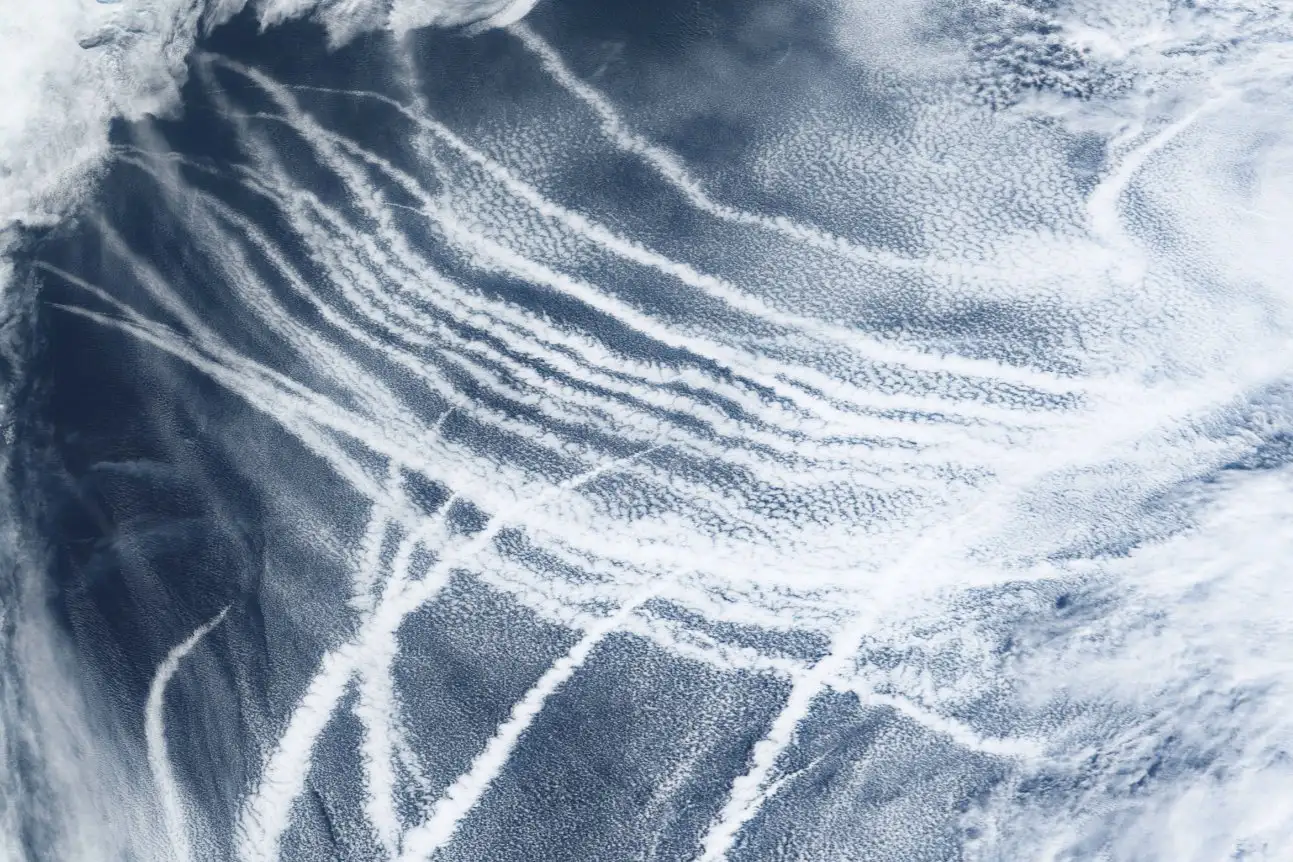

Particles in ship exhaust inadvertently brighten clouds, but similar effects could be harnessed to combat climate change
NASA Earth Observatory
Implementing short-term geoengineering strategies to enhance cloud brightness over the eastern Pacific Ocean could significantly mitigate the adverse impacts of El Niño and potentially save the global economy trillions of dollars. However, altering natural climatic patterns might yield both positive and negative consequences.
El Niño occurs when easterly winds weaken, leading to a shift of warm waters from the western to the central and eastern Pacific, subsequently raising global temperatures and economic losses projected in the trillions.
A current strong El Niño, possibly a “super” El Niño, is underway in the eastern Pacific. Climate models indicate that future warming could be curtailed by a geoengineering concept known as ocean cloud brightening.
This technique involves dispersing fine seawater droplets into the atmosphere beneath low-level stratocumulus clouds, promoting moisture condensation. As the quantity of droplets increases, cloud reflectivity rises, allowing more sunlight to be deflected back into space.
By increasing cloud brightness over the Niño 3.4 region, one could disrupt the feedback cycles responsible for El Niño events. As sea surface temperatures decrease, strengthening trade winds could push warm waters back to the western Pacific, while also allowing cooler waters to rise from the depths of the eastern Pacific, further lowering surface temperatures.
“By brightening ocean clouds, we can effectively halt the cascading effects of El Niño,” says Jessica Wang, a Ph.D. candidate from the University of California, San Diego, involved in this groundbreaking research. “This approach allows us to reverse the cycle.”
Wang’s team drew inspiration from Australia’s devastating 2019-2020 bushfires, which were followed by La Niña, known for its cooling effect. The research highlighted how drifting smoke particles intensified cloud brightness and prolonged the “triple bottom” La Niña phase that began in 2020, lasting for three consecutive winters.
The study analyzed the impact of cloud brightness during the Super El Niño events in 1997-1998 and 2015-2016. Findings demonstrated that dispersing seawater for nine months could significantly lessen the temperature increase in the Niño 3.4 region, reducing it from over 2 degrees Celsius to just above 1 degree Celsius, thus potentially concluding the El Niño event months earlier.
The proposed cloud-brightening initiative would require substantial resources, involving around 2,400 ships and vast amounts of seawater—a feat currently beyond existing nozzle technology. If implemented, the severe El Niño might have downgraded to a moderate variant.
Wang expressed surprise at the success of the initiative, noting that it began in June, coinciding with the evident emergence of El Niño conditions.
Matt Collins, from the University of Exeter in the UK, cautions that these results may not translate well into real-world applications. In reality, as oceans warm, lower cloud formations often dissipate, exacerbating warming through feedback loops.
“More aerosol injection would be necessary in models with stronger cloud feedback,” he asserts. “The experiment seems to have reached its efficacy limit.”
Wang acknowledged potential unforeseen ramifications of this technique, as simulations are limited to a two-year forecast. In both scenarios, La Niña initiated early after El Niño receded, with the 2015-2016 cooling phase being particularly robust. Past occurrences of strong La Niña have previously resulted in decreased rainfall, leading to widespread starvation, as detailed in research findings.
Nonetheless, Wang believes this concept warrants further exploration. Unlike typical geoengineering methods aimed at long-term temperature reduction, this short-term strategy could mitigate risks associated with prolonged aerosol spraying, avoiding the potential of “exit shock,” where accumulated warming suddenly surges.
“This study paves the way for innovative avenues in geoengineering research, targeting climate change and El Niño,” emphasizes Wang. “The approach holds significant promise as it sidesteps long-term risks.”
Topic:
Source: www.newscientist.com