


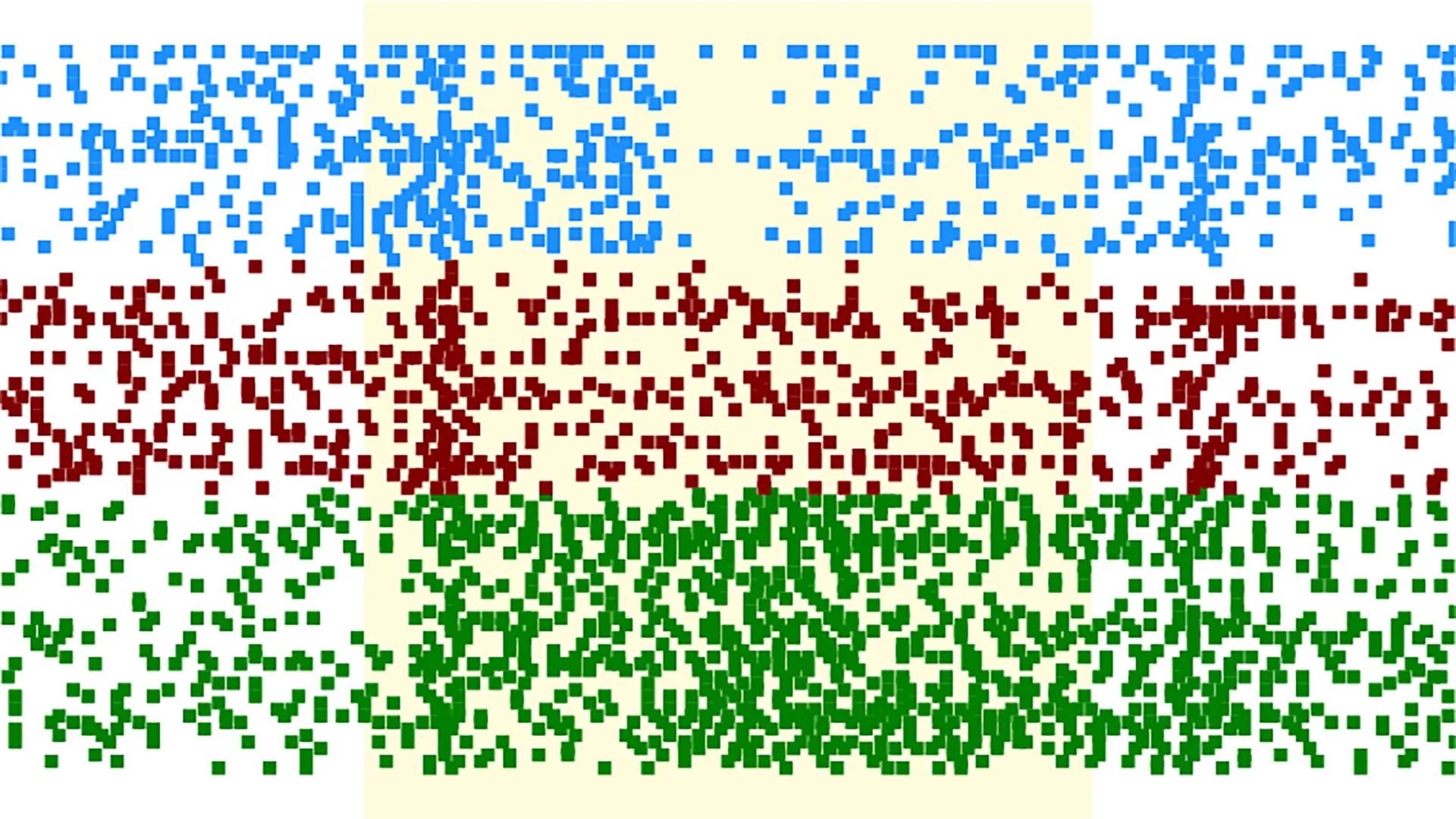
How the Brain Resolves Conflicting Visual Signals Through Neural Consensus
What we see may not immediately make sense. A shadow may momentarily resemble a face, or one object may be mistaken for another. New research suggests that the brain may resolve these visual discrepancies by comparing interpretations from different areas until a more consistent picture emerges.
In a study published in Nature Neuroscience, Mitra Javadzadeh, a Cynthia R. Stebbins Research Fellow at Cold Spring Harbor Laboratory, and colleagues at the University of Cambridge and University College London investigated how two adjacent regions of the visual cortex interact. They found that when activity in the two regions matches, a shared pattern persists. But when the regions produce contradictory patterns, those discrepancies disappear within seconds.
The discovery offers a possible explanation for how the brain combines information from specialized regions into a single, coherent perception.
How Specialized Brain Regions Work Together
Different parts of the brain process different streams of sensory information, yet our experience of the world typically feels integrated rather than fragmented. Understanding how these specialized systems work together is a major challenge in neuroscience.
“We’re trying to understand how we can have such a high level of expertise across these different blocks and still get consistent overall results,” Javadzadeh says.
The researchers focused on two well-known visual processing regions in the brain’s neocortex: the primary visual cortex, or V1, and the lateral medial visual cortex, or LM. Visual processing does not simply move in one direction from one area to the next. Instead, these regions continuously exchange information.
What Happens When Visual Areas Disagree?
To investigate this communication, Javadzadeh and colleagues trained mice to distinguish between two visual patterns tilted in opposite directions. The animals received a reward for recognizing only one of the directions.
During the experiments, the researchers temporarily silenced either V1 or LM and observed how the remaining regions behaved without their regular partners. The team then used these observations to create an artificial neural network model of the V1-LM circuit. The model made it possible to test how the system responds when specific neurons are changed.
The results revealed a striking pattern: competing activity between the two brain regions disappeared quickly, while activity shared by both regions lasted longer.
“Over time, we found that these regional connections implemented a mechanism that we call consensus building,” Javadzadeh explains.
Could the Brain Use Consensus Across the Neocortex?
Although the study examined only two areas involved in vision, the researchers are now investigating whether the same process may operate more broadly throughout the neocortex.
“For example, when what we see and what we hear are contradictory, do we still use the same kind of mechanisms to reconcile the two?” she wonders.
If dynamic consensus proves to be widespread, it could help scientists better understand how the brain combines competing signals to create a stable interpretation of the world. It could also shed light on what happens when different brain regions fail to reach the same conclusion.
The idea may have implications beyond neuroscience. Similar principles could help researchers understand how artificial intelligence systems process conflicting information streams and decide which signals to trust.
“We understand the brain’s individual components, but what is the glue that holds them together?” Javadzadeh asks. “Knowing that ultimately helps us understand how the brain works as a whole.”
Source: www.sciencedaily.com