


Attackers can extract and abuse credentials exposed in public Docker images within seconds, according to a four-month honeypot experiment by Stony Brook University researchers. The fastest misuse of a planted AWS key occurred just 7.86 seconds after an image was published on Docker Hub, while all 100 AWS keys used in the experiment were accessed within 15 minutes.
Researchers monitored 300 honeypot images
Researchers Billy Tsouvalas and Nick Nikiforakis measured how quickly exposed secrets were discovered by publishing 300 honeypot images across eight public container registries.
During the experiment, they embedded AWS, OpenAI and Anthropic API keys, along with decoy SSH and database credentials. A monitoring tool alerted the researchers when a planted key was used, an image was built or run, or a shell was opened.

Source: containerbots.github.io
The researchers announced the experiment, and its results were presented yesterday at the ACM Conference on Computer and Communications Security (CCS).
Planted AWS keys were used within seconds
The honeypot images were pulled more than 75,000 times, and the planted AWS key received more than 140,000 API calls from 5,000 unique IP addresses.
AWS activity ranged from simple checks to determine whether a key was valid to requests that listed available resources and potentially attempted to use them.
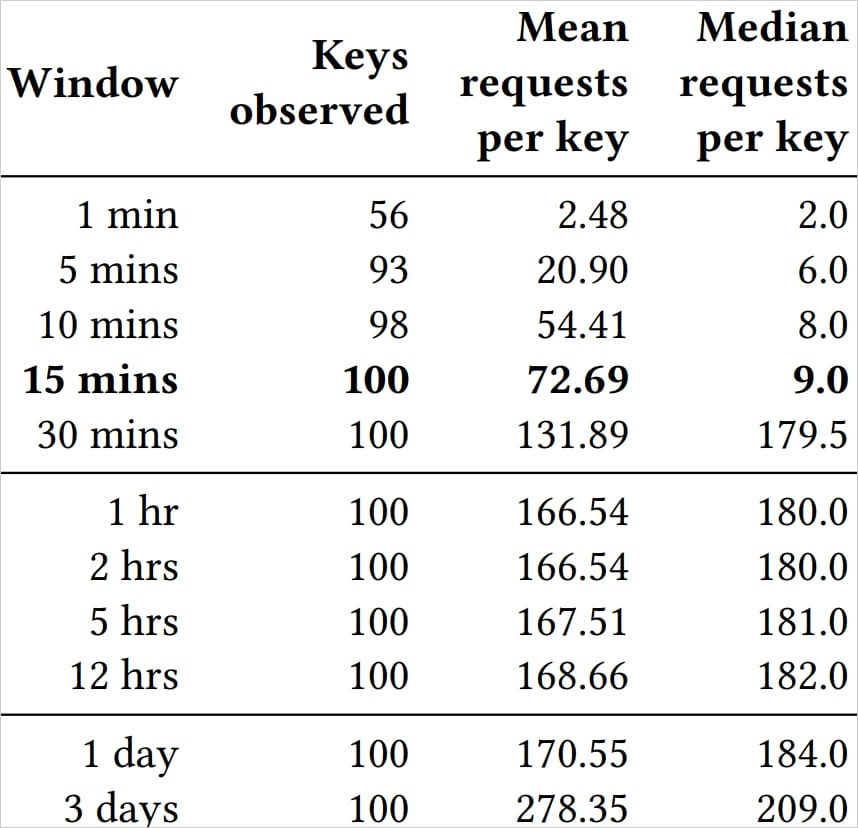
The fastest recorded use of a planted AWS key occurred 7.86 seconds after the image was published on Docker Hub. The median time to the first API call was 51.19 seconds, and every one of the 100 AWS keys was used within 15 minutes.
Source: containerbots.github.io
The exposed OpenAI and Anthropic keys were also quickly hijacked, depleting the balances of the test accounts.
Docker Hub accounted for nearly all AWS activity, although the researchers observed some abuse of AWS keys in Harbor, another registry included in the experiment.
Scanners inspected image contents without running containers
The researchers referred to the automated scanners that interacted with the test images as “ContainerBots.” However, they said the term is a broad description because the scans provided no evidence that all of the activity came from a single operator or that the tools were calibrated by the same group.
Monitoring rarely identified anyone actually running the honeypot containers. Based on that finding, the researchers concluded that scanners generally extracted credentials by inspecting image layers directly.
“The vast majority of scanners that manipulate our images do so through static analysis, such as unpacking image layers or querying registry APIs to extract file system contents, without instantiating a container,” the researchers explained.
Exposing secrets in container images is common in real-world environments, but revoking a compromised key can require substantial work and coordination.
Researchers call for stronger Docker Hub protections
The researchers recommended that Docker Hub scan images for secrets before publication and alert publishers when credentials may be embedded in an image.
They also suggested restricting or rate-limiting access to the Docker Hub public feed for recently published or updated images. Such a measure could make it harder for automated tools to scan new images at scale.
Tsouvalas told BleepingComputer that he reported the findings to Docker in May and provided the full paper. He said the company acknowledged the report but did not provide any further response.
A small experiment conducted in August to determine whether Docker Hub had introduced protections did not show any changes.
Source: www.bleepingcomputer.com