


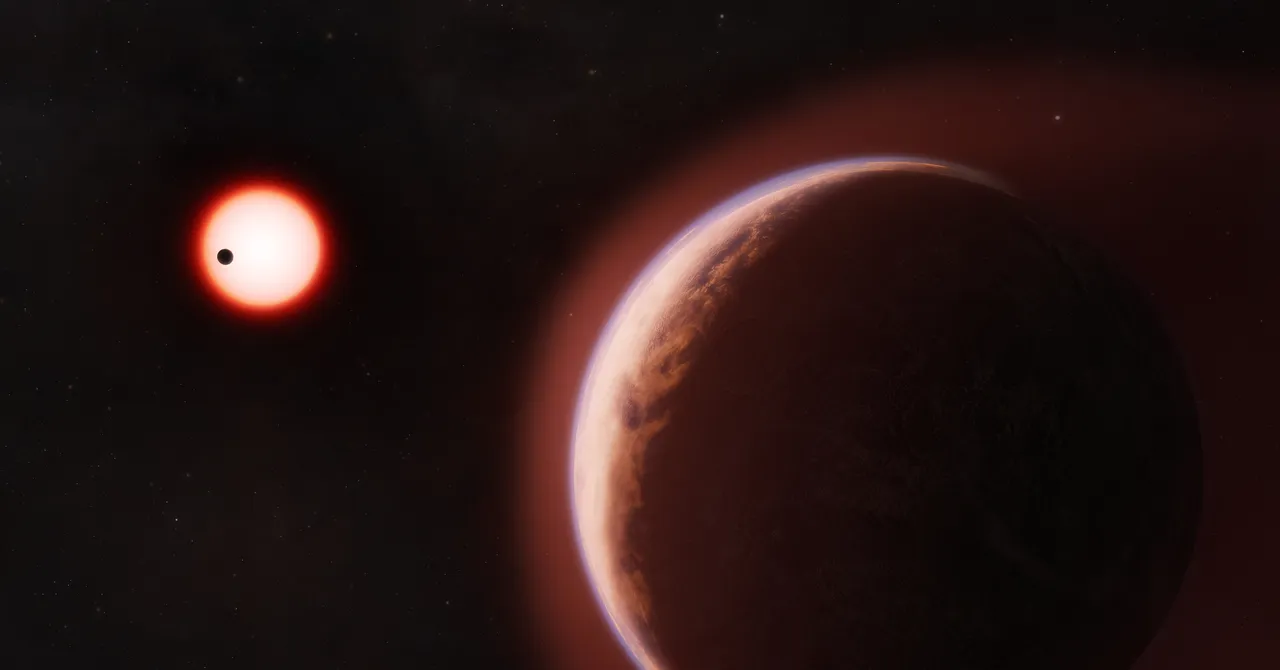
Confirmed by astronomers, a groundbreaking discovery reveals a rocky planet with a significant atmosphere located within the habitable zone for the first time.
Located just 48 light-years away, this exoplanet—an intriguing world beyond our solar system—shows remarkable similarities to Earth, making it one of the most Earth-like planets ever discovered. While they may not be exact duplicates, they belong to the same cosmic family.
Researchers from the Harvard-Smithsonian Center for Astrophysics successfully detected helium traces surrounding LHS 1140 b, an exoplanet orbiting a cool red dwarf star. Earlier studies indicated its rocky composition, sufficient distance from its host star, which allows liquid water to exist on its surface. The findings were published in the journal Science this week.
The presence of an atmosphere is crucial for sustaining life as we understand it on Earth. Our atmosphere ensures that water remains in liquid form and maintains a stable climate by regulating temperature, while simultaneously shielding us from harmful cosmic radiation.
When astronomers search for habitable planets, they typically explore Goldilocks conditions that are just right for sustaining life. LHS 1140 b stands out as the first exoplanet to provide robust evidence that it satisfies all three criteria: being a rocky body, located in a star’s habitable zone, and capable of retaining an atmosphere.
Discovered in 2017, this exoplanet’s new findings stem from observations made in 2024 and 2025. Researchers identified helium leaking from the planet, providing compelling evidence of its atmosphere—one that has likely persisted for over 3 billion years. They first detected helium’s spectral signature and then employed physical models to illustrate how the gas escapes its atmosphere.
However, being situated in the habitable zone does not guarantee the existence of life or an Earth-like environment. In fact, based on the rate of helium escaping, researchers propose that the atmosphere of LHS 1140 b differs significantly from ours. The upper layer, where helium escapes, is the most apparent, while heavier gases like nitrogen, carbon dioxide, and carbon monoxide could be present in the lower layers.
This study has validated the atmospheric detection technique used by the team. Moving forward, scientists will require more advanced instruments to thoroughly examine the planet, fully characterize its atmosphere, and assess the potential for surface seas or other habitability indicators.
“Twenty years ago, we speculated on the existence of other terrestrial planets,” stated Robin Wordsworth, a Harvard professor and study co-author, in a press release. “We have since discovered that they are quite common and found several in the habitable zone. The subsequent question was whether any of them could sustain an atmosphere. Now we know at least one can.”
This article was originally featured in WIRED Spanish and translated from Spanish.
Source: www.wired.com