


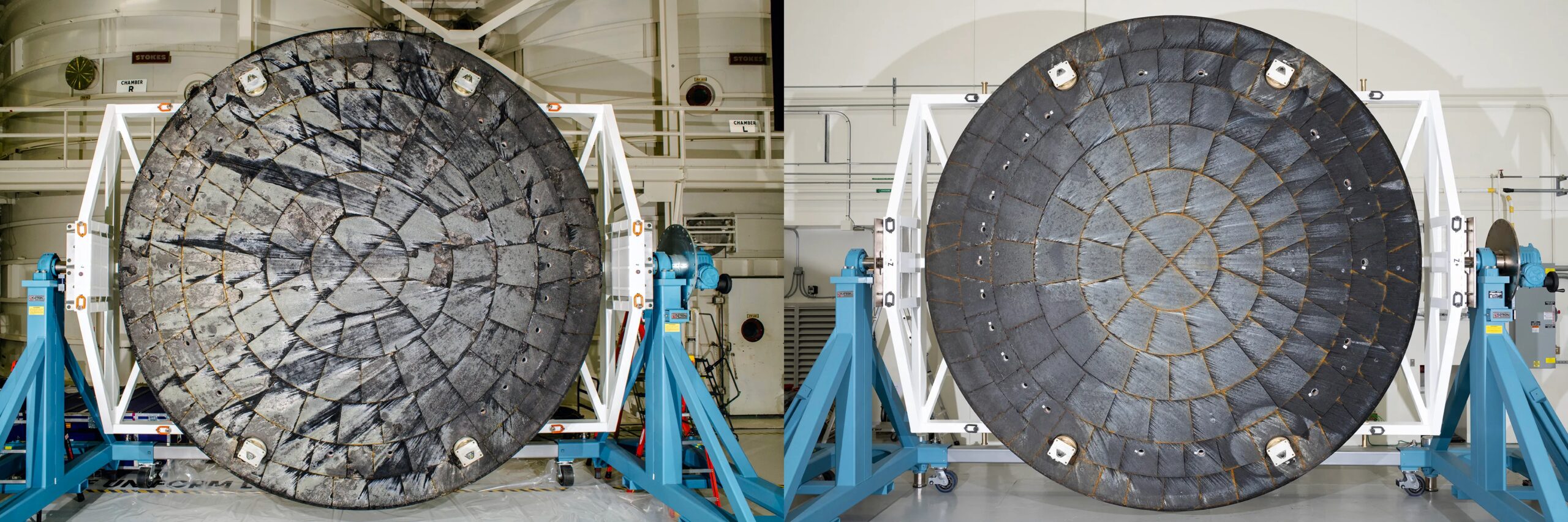
NASA Confirms Artemis II Orion Heat Shield Performed as Expected
NASA’s Artemis II mission successfully carried four astronauts around the Moon and back to Earth, helping lay the foundation for future human missions to the lunar surface. A detailed engineering analysis of the Orion spacecraft’s heat shield has now confirmed initial findings that the system performed as expected.
Orion Heat Shield Protected the Crew During Lunar Reentry
NASA evaluated whether Orion’s thermal protection system could protect the crew and spacecraft during atmospheric reentry. Artemis II was the first mission to carry astronauts aboard Orion.
During its return from the Moon, Orion reached a maximum speed of 39 times the speed of sound. Exterior temperatures climbed to more than 4,000 degrees Fahrenheit, while cabin temperatures remained in the mid-70s Fahrenheit, keeping the four astronauts relatively cool.
Before Artemis II, NASA conducted an extensive analysis of Artemis I heat shield findings and performed arc jet materials testing at NASA’s Ames Research Center in California’s Silicon Valley. Based on that work, NASA modified Orion’s reentry trajectory by reducing the spacecraft’s maximum distance traveled between atmospheric entry and splashdown in the Pacific Ocean.
Pre-mission analysis indicated that limiting the downrange distance could reduce the amount of time the heat shield spent in the temperature range associated with the Artemis I heat shield phenomenon.
Artemis II Splashdown and Heat Shield Inspection
Orion re-entered Earth’s atmosphere with precision, coming within 59 feet of its target entry interface. The spacecraft splashed down safely just 0.59 miles from its anticipated landing site off the coast of San Diego.
Initial inspections of the thermal protection system included diver images taken shortly after splashdown, followed by additional inspections aboard the recovery ship. The heat shield was found to be functioning as expected, with significantly less cracking and charring than the Artemis I heat shield.
After Orion returned to NASA’s Kennedy Space Center in Florida, thermal protection system experts began more detailed inspections. The heat shield consists of 186 unique blocks of an ablative material called Avcoat. NASA then shipped the heat shield to Marshall Space Flight Center in Huntsville, Alabama, where engineers began extracting samples and conducting internal X-ray scans in August.
Artemis II Heat Shield Showed Major Improvement Over Artemis I
A comprehensive post-flight evaluation found that Orion’s aerodynamic and aerothermal performance—including the heat shield and backshell thermal protection system—matched engineering predictions based on pre-flight analysis and ground testing.
The shorter allowable downrange distance during reentry reduced cracking and scorch losses on the Artemis II heat shield by a factor of 10 compared with Artemis I, demonstrating the effectiveness of the trajectory change. Engineers identified only nine charring losses of various sizes on the Artemis II heat shield, compared with 103 on Artemis I.
The analysis also showed that Orion’s heat shield design performed consistently across Artemis I and Artemis II. Engineers observed this consistency in system features such as the seam between the heat shield’s Avcoat blocks and the Avcoat surrounding the heat shield compression pad isolation bolts.
Orion Backshell Thermal Protection System Performed as Expected
Post-flight inspections of Orion’s backshell—the protective cover on the sloped sides of the crew module—also showed expected performance across the entire spacecraft. The backshell contains 1,300 ceramic tiles and is designed to seal and protect penetrations for windows, vents, thrusters and other systems.
Visual inspections confirmed that the backshell performed as designed. The side hatches also appeared as expected, and engineers observed no signs of overheating.
NASA Continues Testing to Support Artemis III and Future Missions
NASA will conduct post-flight laser scans of the heat shield and compare the results with pre-flight measurements. These scans will help identify material depressions, which engineers will compare with analytical predictions.
Engineers are also continuing thermal barrier sampling, material testing and evaluation, and thermal analysis at NASA’s Marshall Space Flight Center. This work will support long-term thermal barrier development, manufacturing operations and future data collection.
The Artemis II performance analysis demonstrates Orion’s robust design, its ability to support astronauts and the value of data gathered during the mission. Following extensive research into the Artemis I heat shield, NASA upgraded the Artemis III heat shield design to improve the uniformity and consistency of the Avcoat blocks.
Engineers installed the Artemis III heat shield on the Orion crew module at NASA’s Kennedy Space Center in early July. The Orion crew and service modules were combined in late July, and the spacecraft successfully powered up for the first time, allowing engineers to confirm that all connection lines between the modules were operating as planned.
Artemis III Preparations Continue
NASA continues to make progress on Artemis III as teams prepare the Orion spacecraft for next year’s mission in low Earth orbit. NASA, along with NASA astronauts Randy Bresnik, Frank Rubio and Andre Douglas and ESA astronaut Luca Parmitano, will launch aboard the Space Launch System rocket and Orion spacecraft.
The mission will join Blue Origin and SpaceX crewed lander test articles to demonstrate the critical systems and operations needed for future lunar landings, beginning with Artemis IV in 2028.
Source: www.nasa.gov