


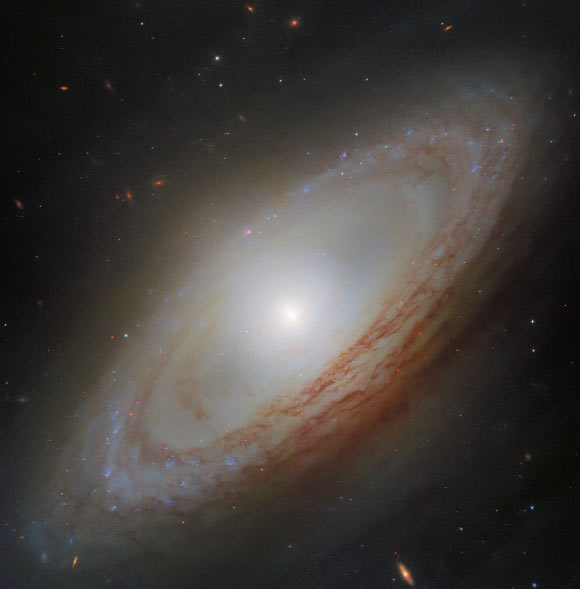
Hubble Reveals a Galaxy Rotating Out of Sync With Its Disk
NGC 4698 is a barred spiral galaxy with a bizarre structure: its central stars and gas rotate perpendicular to the galaxy’s main disk. Astronomers say the unusual configuration may have formed after the galaxy acquired material from outside.
NGC 4698 in the Virgo Cluster
NGC 4698, also known as LEDA 43254, UGC 7970, and IRAS 12458+0845, is located in the constellation Virgo, approximately 55 million light-years from Earth.
The galaxy was discovered on January 18, 1784, by German-British astronomer William Herschel. It is part of the vast Virgo Cluster, the closest large galaxy cluster to the Milky Way.
Like the Milky Way, NGC 4698 is a spiral galaxy with arms that swirl around a thin disk of stars, gas, and dust, according to NASA and Hubble astronomers.
The galaxy’s spiral arms contain clumps of opaque brown dust and numerous small clusters of bright blue stars. Unlike the arms of many spiral galaxies, however, NGC 4698’s arms are mainly visible around the outer edge of the disk rather than winding toward its center.
Instead, the arms appear to float around the galaxy in a ring-like structure.
A Central Bulge at a Right Angle
NGC 4698’s center is dominated by an elongated galactic bulge. Its diffuse, off-white glow comes from stars that are smaller, older, and cooler than the giant blue stars scattered across the galaxy’s outer disk.
These densely packed stars orbit a supermassive black hole containing millions of times the mass of the Sun. The black hole is actively growing as its gravity pulls gas inward.
The most unusual feature of NGC 4698 is the orientation of its central bulge. The bulge extends nearly perpendicular to the galaxy’s main disk, while the stars and gas near the center rotate at a right angle to the rest of the galaxy.
The faint extension is visible in the Hubble image as a ghostly glow of stars appearing above and below the dusty disk.
How Did NGC 4698 Become “Out of Sync”?
NGC 4698 is one of the few known spiral galaxies with a bulge extending at right angles from its disk. Astronomers believe the unusual structure may be connected to gas acquired from outside the galaxy and small mergers that occurred in the past.
If NGC 4698 captured gas from an external source, that material could have formed a new disk of gas and stars at an angle to the galaxy’s original disk. Over time, this process may have produced the galaxy’s perpendicular central rotation.
Observations also suggest that NGC 4698 may have experienced a small-scale merger. Short tails of hydrogen flowing from one side of the galaxy provide evidence that such an encounter could have occurred.
These clues support the idea that NGC 4698’s strange, out-of-sync structure was shaped not only by its internal evolution but also by material and interactions from beyond the galaxy itself.
Source: www.sci.news