


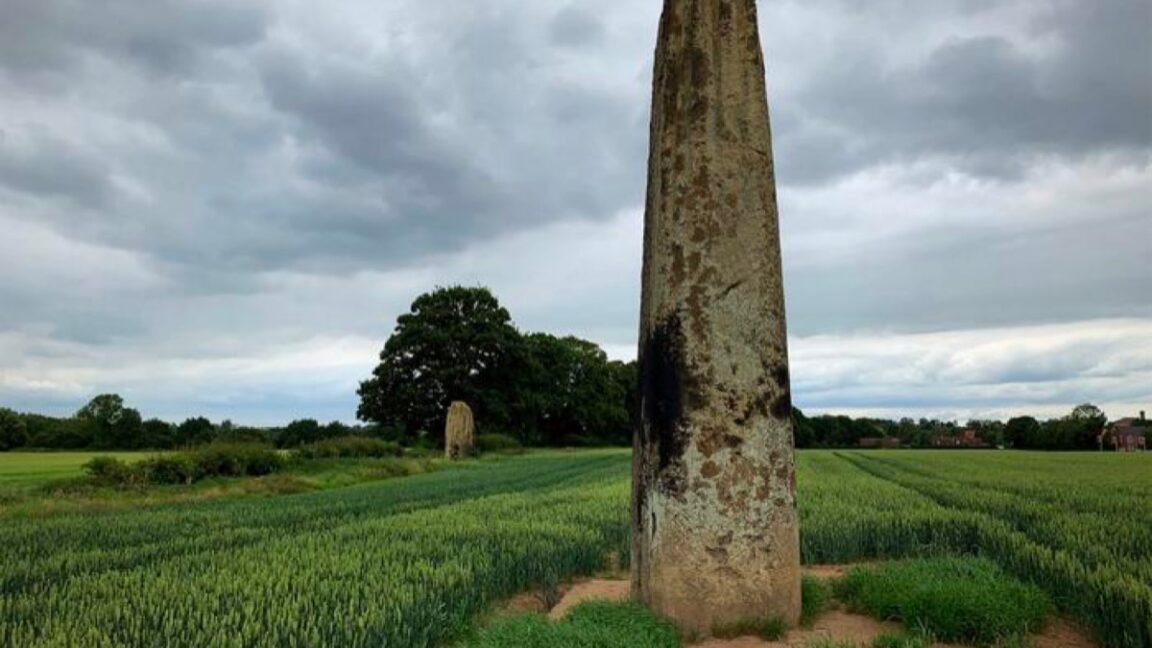
Devil’s Arrows Stones Came From 18 Kilometers Away, New Study Finds
A new scientific analysis suggests that the prehistoric builders of the Devil’s Arrows deliberately transported the monument’s stones from Brimham Rocks, roughly 18 kilometers away. The discovery indicates that the stones were selected for more than convenience and may reveal how ancient communities valued particular landscapes.
Scientists Trace the Origin of the Devil’s Arrows
Clark and colleagues analyzed samples from all three surviving Devil’s Arrows stones, along with the Battle Cross Monument and Peg Bridge. Researchers collected the samples by applying small sections of adhesive tape to inconspicuous areas free of lichen and moss. Mineral grains adhered to the tape and were later recovered by dissolving the adhesive with mineral turpentine.
The team removed coarse magnetic material and light minerals, including quartz and feldspar, before examining the remaining grains with a field-emission scanning electron microscope. Isotope analysis of zircon and apatite minerals provided an age and geological “fingerprint” that researchers could compare with potential stone sources.
Brimham Rocks Identified as the Most Likely Source
The Devil’s Arrows are made from coarse-grained sandstone. Although Plumpton Rocks had previously been proposed as a possible source, the new mineral and isotope evidence points instead to Brimham Rocks as the most likely origin.
That conclusion means the stones were transported much farther than previously believed. Reconstructions of regional ice flow also ruled out glacial movement as a likely explanation, suggesting that prehistoric people deliberately moved the massive stones themselves.
“Our research shows that these stones were not simply taken from the nearest available source, but were deliberately selected from a difficult landscape 18 kilometers away,” Clark said. “Moving them would have required an incredible amount of planning, coordination and engineering. This tells us that prehistoric people really valued the landscape itself. It’s likely that where the stones came from had meaning to them, not just convenience.”
A Lost Devil’s Arrow Stone Was Reused
The research also confirmed that the Battle Cross Monument was made from one of the lost Devil’s Arrow stones. The finding provides evidence that stones associated with prehistoric monuments were later reused in other structures and landscapes.
“Reuse does not erase meaning,” the authors conclude. “Rather, it adds a further episode to the biography of a stone. A monolith may begin as bedrock, become a selected and transported prehistoric object, acquire significance in a megalithic environment, and later be reconsidered as a building stone, a bridge fabric, a crossroads sign, or a Christianized part of an urban landscape. At each stage, the interpretive framework is changed. The object is not a static remnant of a single past, but a material witness of repeated human involvement.”
The study, published in the Proceedings of the Royal Society A: Mathematical, Physical and Engineering Sciences, offers new insight into prehistoric engineering, monument construction and the cultural importance of Britain’s ancient standing stones.
Study: 10.1098/rspa.2026.0504
Source: arstechnica.com