


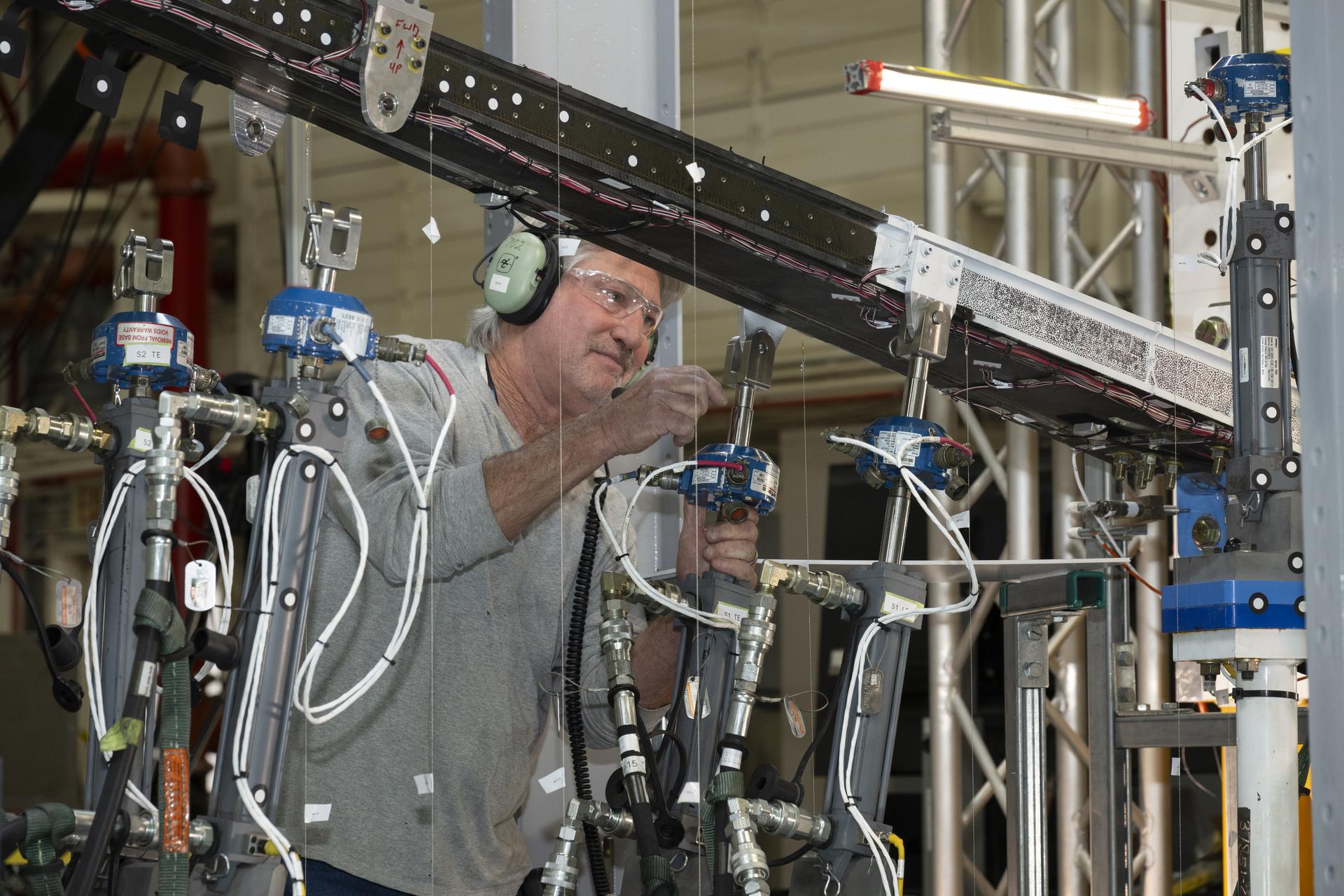
NASA researchers have recently unveiled a groundbreaking wing design characterized by its elongated, thin shape and lightweight structural framework. After a series of rigorous tests to determine its structural limits, the findings were promising, highlighting the wing’s potential even beyond its design thresholds.
The 15-foot Truss Bracing Evaluation Wing Structural Experiment, known as SWEET-15, is integral to NASA’s mission to innovate future super-efficient aircraft. This design features a long wing supported by aerodynamic struts, building upon NASA’s pioneering transonic truss-braced wing concept.
The research team aims to evaluate whether the SWEET-15’s lightweight structural design can lead to significant fuel savings for commercial airliners. Understanding the wing’s behavior under various flight forces is crucial to achieving this goal.
To create the SWEET-15 design, NASA engineers utilized five advanced composite manufacturing and assembly techniques, resulting in a novel structural configuration. The test wing was designed and built at NASA’s Langley Research Center in Hampton, Virginia, before being shipped to NASA’s Armstrong Flight Research Center in Edwards, California for extensive testing.
During several months of testing, NASA engineers purposefully bent the wing at the NASA Armstrong Flight Loading Laboratory. They installed numerous strain and load sensors, including cutting-edge fiber optic strain sensors, throughout the structure to monitor its response to increasing forces.
Data collected from these sensors aligned with predictions from NASA’s computer models. Initial results show that the wings effectively withstood anticipated in-flight forces, boosting the team’s confidence in the innovative manufacturing techniques and connection methods employed in the SWEET-15 design. This includes a manufacturing process that leverages advanced composite robotic integrated structural assembly, geared towards creating lightweight, durable composite structures for aerospace applications.
The testing culminated in an intentional failure exercise, where engineers loaded the wing beyond its design specifications to identify failure points. The structure ultimately failed at about 127% of its design limit load, with noticeable damage near the wing’s trailing edge and upper cover. This data provided critical insights into the behavior of joints connecting the wing to its main and secondary struts under extreme conditions.
This marks the first comprehensive structural evaluation of a typical composite truss-braced airfoil configuration. Such evaluations were made possible through extensive NASA collaboration across various centers and projects, utilizing cutting-edge fiber-optic sensing systems originally developed to collect data for both aircraft and spacecraft.
Before testing, NASA Langley engineers meticulously designed, analyzed, and manufactured the wing, ensuring thorough safety preparations and laboratory setups were completed.
Researchers are now in the process of analyzing the collected data to inform upcoming vehicle designs and deepen NASA’s commitment to advancing efficient aviation technology.
This initiative is part of the Subsonic Flight Demonstrator project within NASA’s Research and Technology Mission Directorate. The successful evaluation of multiple innovative components signifies a major breakthrough in NASA’s aeronautics research.
For more information, please visit:
Source: www.nasa.gov