


A 1,000-Mile Cloud on Mars May Require “Exotic Physics” to Explain
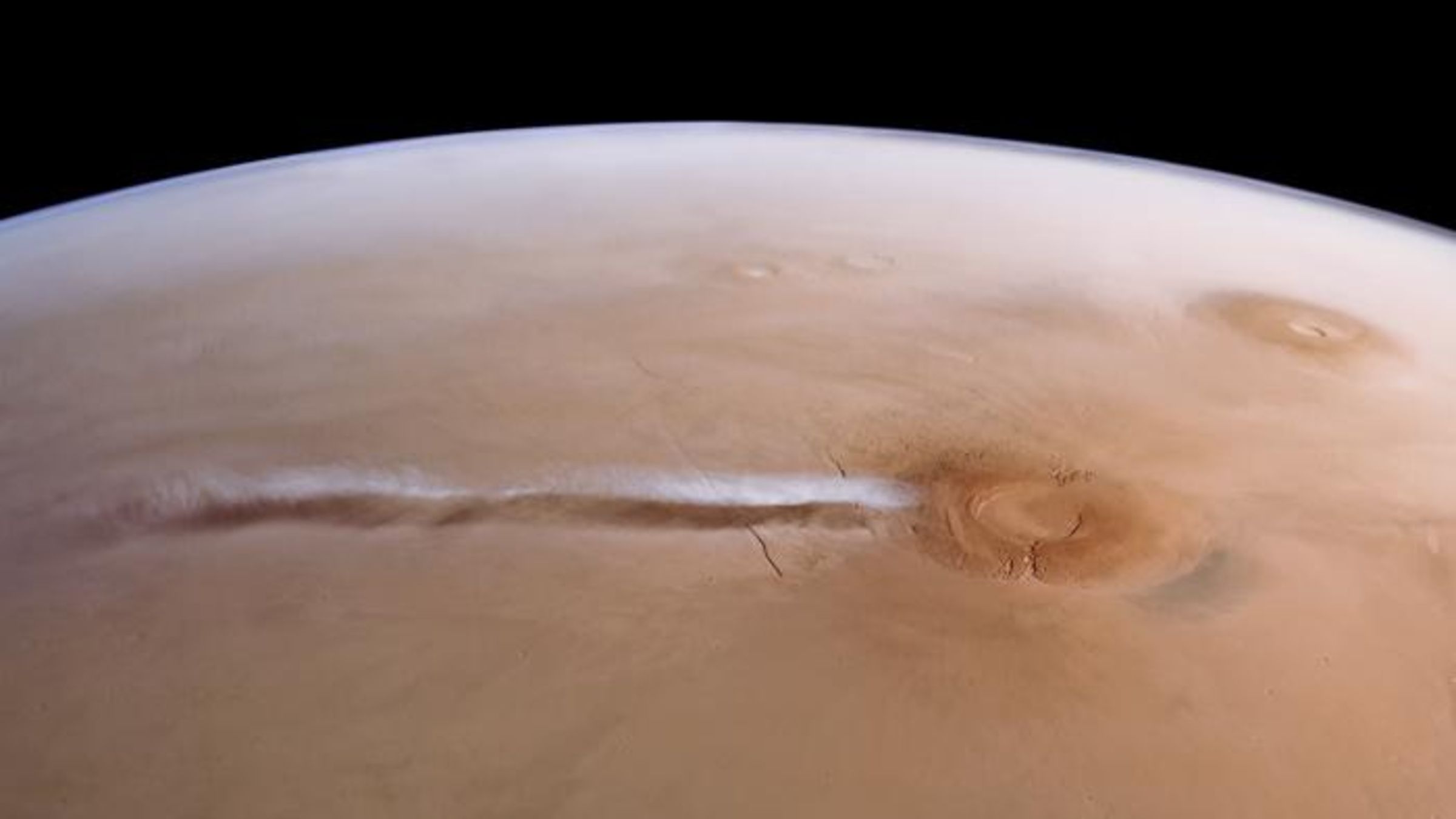
A mysterious water-ice cloud that stretches for more than 1,000 miles (1,600 kilometers) across the Martian sky may be even stranger than scientists realized. A new simulation suggests that the cloud’s formation can only be explained by a theoretical process that has never been observed in a planetary atmosphere.
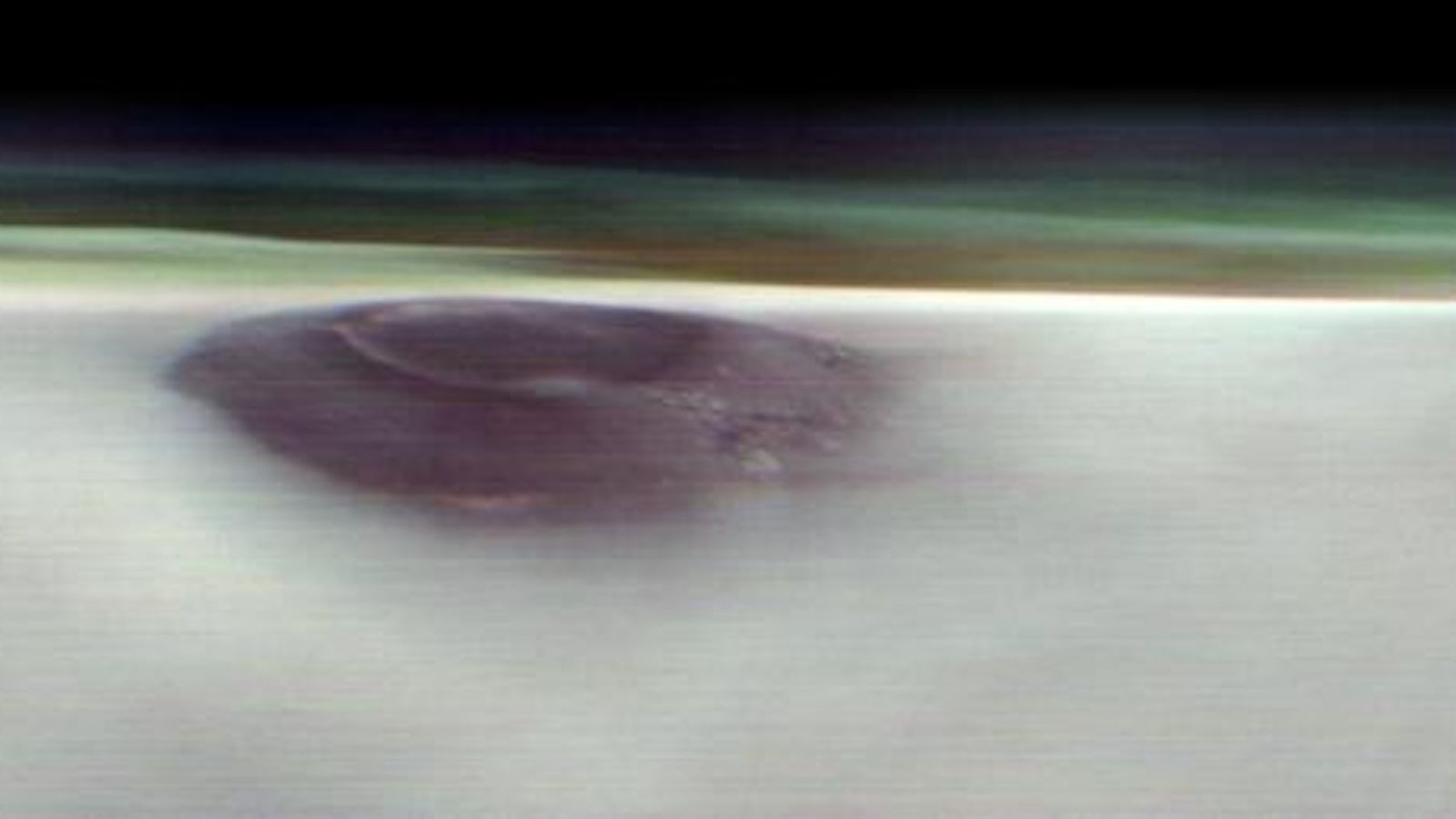
Known as the Arsia Mons elongated cloud (AMEC), the formation appears above Arsia Mons, an extinct volcano in Mars’ Tharsis region. The mountain rises about 12 miles (20 km) above the surrounding plains, making it more than twice the height of Mount Everest.
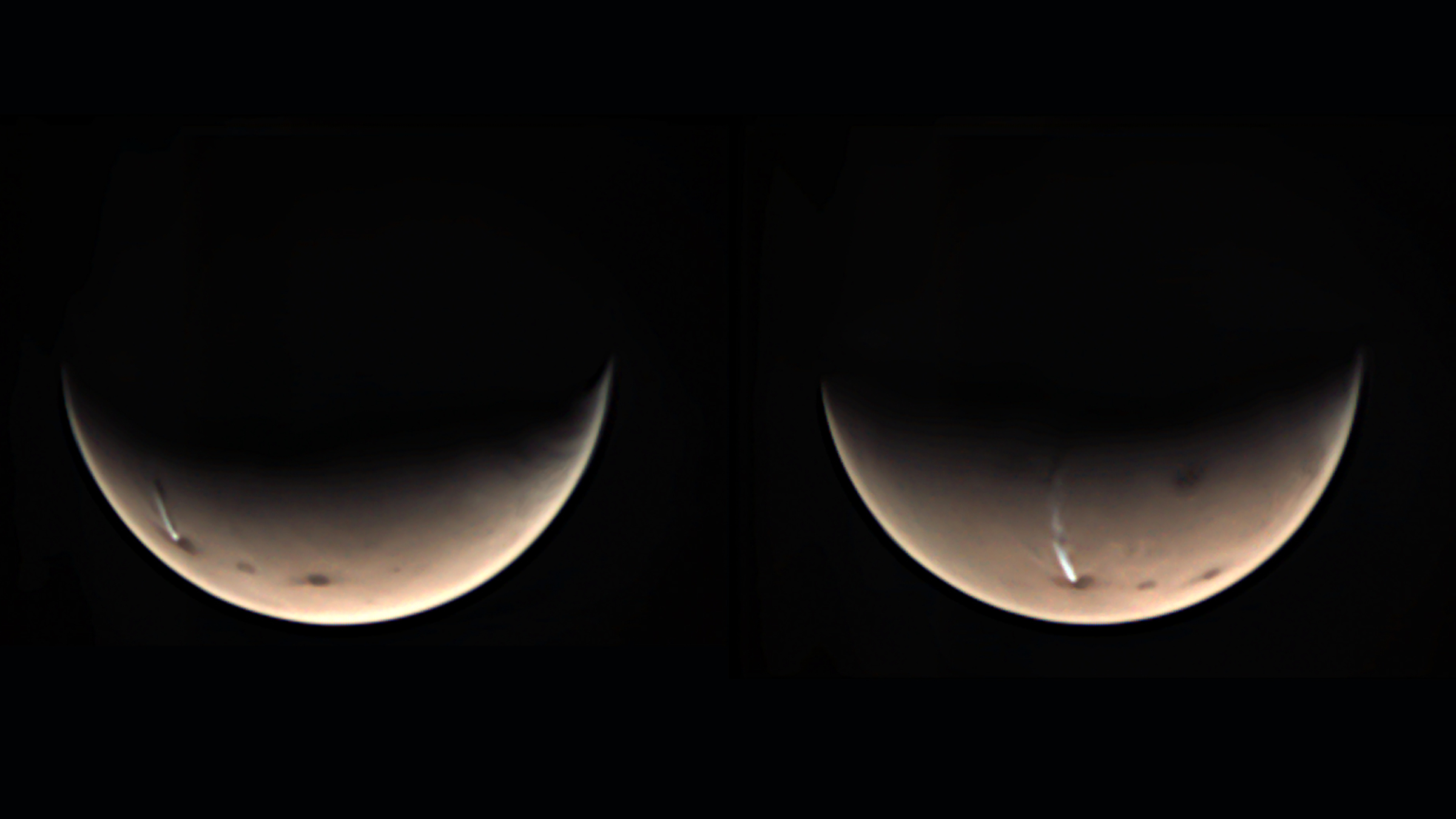
The European Space Agency’s Mars Express orbiter first discovered the cloud in 2018. Since then, the spacecraft has observed AMEC appearing almost every morning during spring and summer in the Martian southern hemisphere.
Despite its immense size, the cloud usually vanishes within a few hours. Strong winds push water vapor up the slopes of Arsia Mons, where the air rapidly cools and the vapor freezes into ice particles.
Why is this Martian cloud so unusual?
Mars is not usually a cloudy world. Its atmosphere is extremely thin and contains very little water vapor. The planet is better known for enormous dust storms and seasonal carbon dioxide clouds than for vast water-ice formations.
Clouds like AMEC are classified as orographic clouds. On Earth, they form when moist air is forced upward over a mountain or other elevated terrain. Similar clouds can sometimes form near the Rock of Gibraltar in southern Europe.
However, the familiar cloud-forming process on Earth could not fully explain what happens above Arsia Mons. When researchers attempted to recreate AMEC using conventional models, the cloud did not appear correctly.
“We found that to create AMEC in our modeling, we needed to include some unusual physics: physics that is included in textbooks but is treated as theoretical and typically not thought to occur in nature,” lead author Jorge Hernández-Bernal, a planetary scientist at the University of the Basque Country in Spain, said in a statement.
Once the researchers included that process, the simulation reproduced the cloud’s appearance and daily evolution.
The “exotic” process behind AMEC
On Earth, ice clouds usually form through heterogeneous nucleation. In this process, water vapor freezes around tiny particles suspended in the atmosphere, such as dust, salt, pollen or soot. These particles provide a surface where ice crystals can begin to grow.
Mars has plenty of atmospheric dust, but the researchers found that dust does not appear to be necessary for AMEC. Instead, water vapor may freeze directly into ice particles without first attaching to another substance.
This process is called homogeneous nucleation. It has been proposed in theoretical studies, but researchers say it has never previously been observed in a planetary atmosphere.
“For AMEC, cloud formation appears to take place without the need for such ‘stuff’ in the air,” Hernández-Bernal said. “Water vapor turns directly into ice cloud particles without going through any intermediate steps. It resembles condensation water droplets that appear in the center of a room rather than on a window.”
The researchers described the result as completely unexpected. Previous studies had suggested that homogeneous nucleation might occur in the upper atmospheres of Earth or Venus, but the process would require humidity levels roughly 100,000 times higher than those found at Earth’s surface.
How Arsia Mons creates the cloud
The new simulation used observations from Mars Express to model the atmosphere around Arsia Mons. The researchers found that powerful winds rushing up the volcano’s slopes can generate atmospheric waves that carry air rapidly into the upper atmosphere.
As the air rises, its temperature may fall by as much as 54 degrees Fahrenheit (30 degrees Celsius) in only 10 minutes. The sudden cooling makes it easier for water vapor to freeze.
The atmospheric waves also increase the local humidity, creating conditions in which homogeneous nucleation can occur. Some of the water vapor may already be present in Mars’ atmosphere, while additional water could come from frost covering the summit of Arsia Mons.
Once the cloud reaches the upper atmosphere, strong winds stretch it downwind until it can extend up to 1,100 miles (1,800 km)—approximately one-twelfth of Mars’ circumference. That is about twice the length of England or roughly the distance between New York City and Miami.
Mars Express has tracked the cloud for years
Mars Express has played a central role in the investigation. The orbiter has used its visual monitoring camera, high-resolution stereo camera and OMEGA instrument to observe how AMEC forms and changes over time.
The spacecraft is also one of the few Mars missions able to observe Arsia Mons during the day, when the elongated cloud develops.
“Mars Express discovered AMEC, tracked and monitored it for years, and is now helping to uncover the secrets of its formation,” Colin Wilson, a Mars Express project scientist who was not involved in the new study, said in a statement.
What the discovery means for Mars and other worlds
The new simulations offer a major step toward explaining one of Mars’ most unusual weather systems. They also highlight how differently weather can operate on other planets, even when it follows the same basic physical principles found on Earth.
Understanding AMEC could improve scientists’ knowledge of the Martian atmosphere and help them interpret atmospheric phenomena on other planets and exoplanets.
“Clouds on Earth and Mars appear to be governed by the same ‘rules,’ but it took some exotic physics to understand these unusual Martian clouds, and this may be true elsewhere in the universe,” Wilson said.
The study, by Hernández-Bernal, A. Mettanen, A. Spiga and F. Forget, is titled “Uniform ice nucleation from water vapor suggested by Mars’ elongated clouds.” It was published in Nature Geoscience.
Source: www.livescience.com