


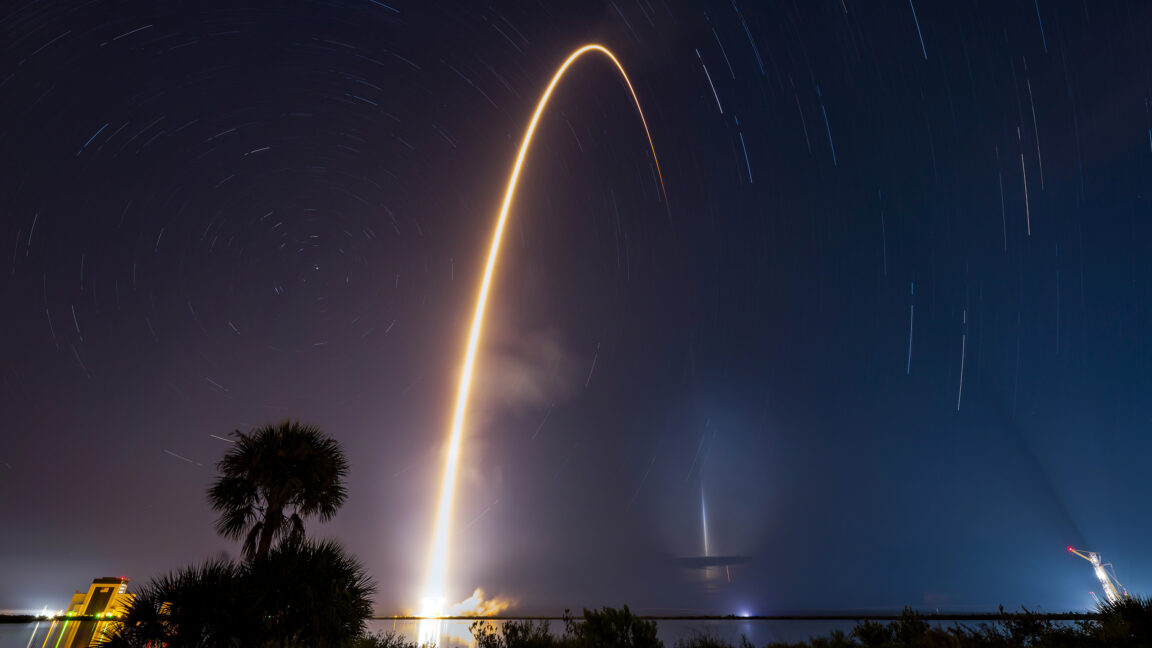
Tuesday’s SpaceX launch marked several important milestones. Most notably, it was the 37th flight of the company’s fleet-leading Falcon 9 first-stage booster, setting a new reuse record. Because the rocket launched shortly before sunrise, sky watchers along the U.S. East Coast were also treated to a clear view of Falcon 9 climbing northeast from Cape Canaveral.
The SpaceX launch team poses with the Falcon 9 rocket at Space Launch Complex 40 at Cape Canaveral Space Force Station, Florida.
Credit: SpaceX
“I’m very proud of this great team,” Donchev continued. “You made Falcon 9 the most reliable launch vehicle in history. You also helped build the world’s largest low-Earth-orbit satellite constellation, providing connectivity to millions of people and laying the foundation for what comes next.”
SpaceX has launched approximately 260 Starlink missions aboard Falcon 9 rockets from Florida. Going forward, all Falcon 9 and Falcon Heavy launches from Florida are expected to carry customer payloads. The next major mission is scheduled for August 30, when a Falcon Heavy will launch from Kennedy Space Center’s Launch Complex 39A carrying NASA’s Nancy Grace Roman Space Telescope. The next Falcon 9 launch is planned for mid-September and will transport four new crew members to the International Space Station.
SpaceX ultimately plans to phase out Falcon 9 in favor of Starship, at least for commercial missions. That transition has raised concerns among customers about whether dependable launch services will remain available after 2028.
The company still plans to begin launching Starship and Super Heavy boosters from Launch Complex 39A by the end of this year. However, that schedule appears unlikely given the extensive work still required at the site and the lack of signs that SpaceX is preparing to transport Starship from its operational factory in South Texas to Florida. Starship’s first launch from Kennedy Space Center now appears more likely to occur by mid-2027.
Starship is powerful enough to deploy as many as 60 Starlink Version 3 satellites in a single mission. The spacecraft is larger, heavier and more capable than the Starlink Version 2 satellites currently launched by Falcon 9. SpaceX plans to use Starship’s 14th test flight, known as Flight 14, to place the first Starlink V3 satellites into low Earth orbit from Starbase, Texas, potentially as early as next month.
Source: arstechnica.com