


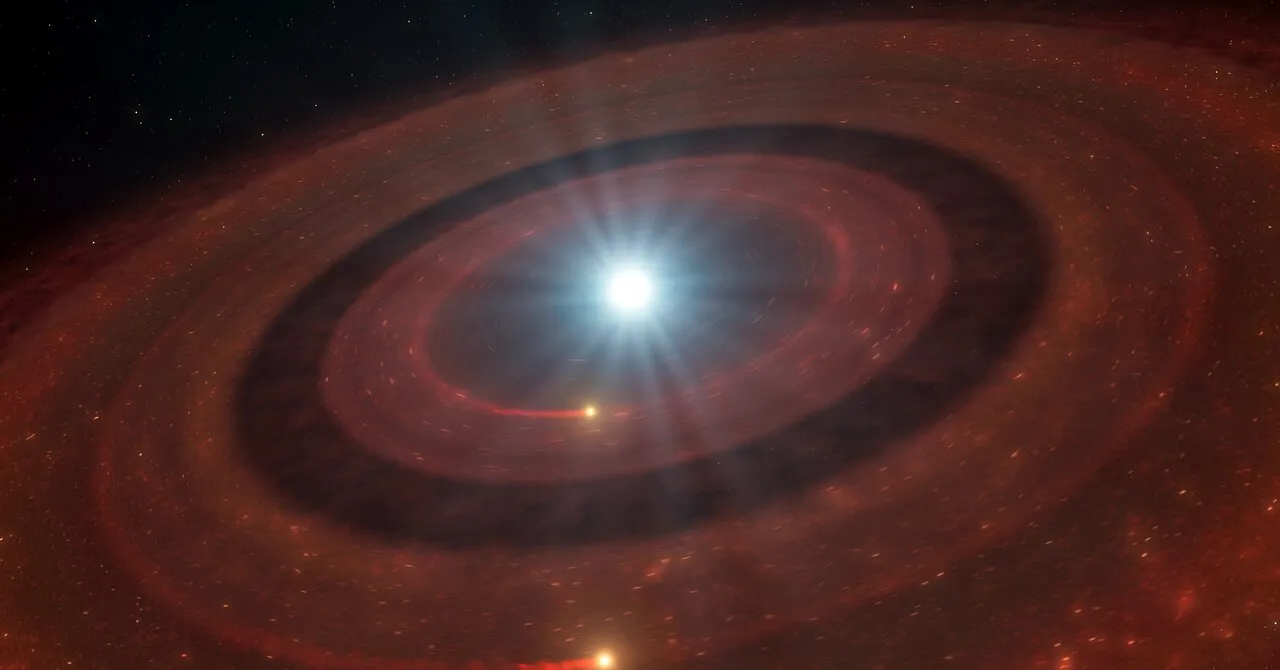
Astronomers observing the white dwarf J1328-1450 have found two debris rings that may reveal what happens to planetary systems after their stars die. The rings could have been shaped by at least two planets that survived the star’s transformation, although researchers have not yet directly confirmed the existence of those objects.
What may happen to the Solar System
The processes that formed this system could eventually occur in our own. In about 5 billion years, the Sun will run out of fuel and expand into a red giant. During this phase, it may engulf nearby celestial bodies, including the closest planets.
The Sun’s outer layers will eventually peel away, leaving behind a white dwarf. Rocky objects that survive the transformation could break apart and create a disk of debris around the dead star—similar to the structure astronomers are observing around J1328-1450.
Two debris rings may point to surviving planets
The presence of two debris rings around the white dwarf suggests another possibility. Their structures appear to have been shaped by objects that astronomers have not yet been able to identify directly. The observations indicate that at least two planets may have survived in the system’s remnants after the star changed.
Researchers believe the two objects could differ substantially in size. Objects close to white dwarfs are only a few kilometers in diameter, while more distant bodies can be as large as Pluto’s moon. Interactions between these objects and the surrounding debris could explain how the two rings formed.
However, the objects have not yet been confirmed as separate bodies. Another possibility is that the structures came from different parts of a single planet-like object, such as its crust or core.
This story was originally published by WIRED (Spanish version) and translated from Spanish.
Source: www.wired.com