


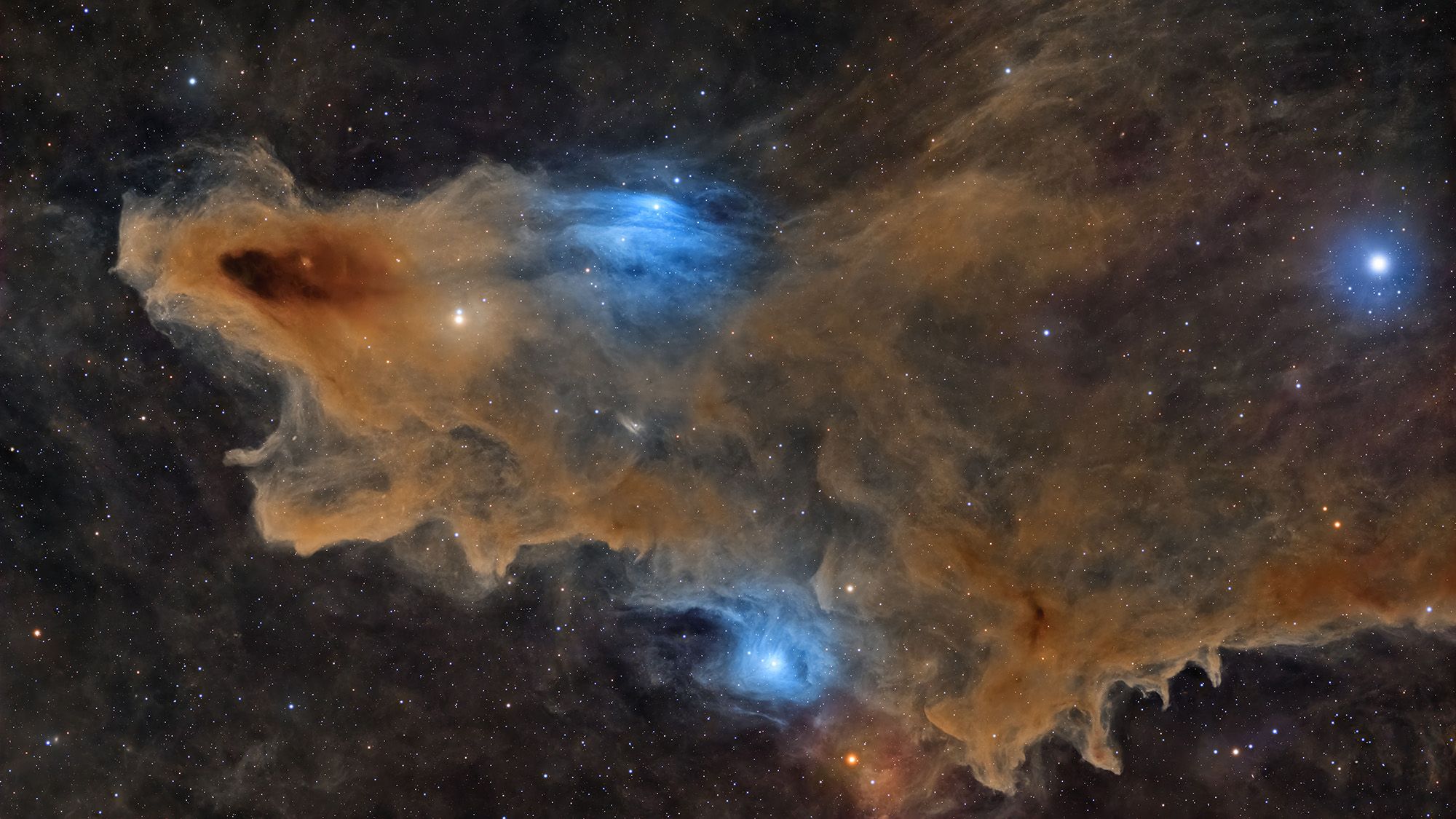
Shark Nebula Photo Wins Astronomy Photographer of the Year Competition
A distant gas cloud shaped like a shark has won the top prize in the Royal Observatory Greenwich’s amateur space photography competition.
The image, titled “Silent Predator,” was captured by skywatcher Ali Alobaidly. It shows the Shark Nebula, also known as LDN 1235, in the constellation Cepheus, about 650 light-years from Earth. By comparison, the closest star system to our planet is roughly four light-years away.
The photograph was named the overall winner of the Royal Observatory Greenwich’s 18th ZWO Astronomy Photographer of the Year competition. The winners were announced on Thursday, September 17.
Alobaidly captured the winning image over two days in August 2025 from Kuwait’s Jafra Governorate. He used an Askar 140 APO telescope, a Sky-Watcher EQ8-R mount and a ZWO ASI2600MM Pro camera.
“The juxtaposition of marine predators roaming over the Kuwaiti desert is something that I find very poetic and is what first drew me to this amazing region of the sky,” Alobaidly said in a statement. “For me, it perfectly represents my love for both space and the deserts of my ancestors.”
Alobaidly’s winning image and the 10 category-winning photographs will be displayed at London’s National Maritime Museum from Friday, September 18. He received a prize of £10,000, approximately $13,300, while smaller prizes were awarded to category winners and runners-up.
Other winning astronomy photographs
Here are several of the other winning images from the ZWO Astronomy Photographer of the Year competition.
Aurora: Radoslav Sviretsov’s photograph, titled “The Crown,” was taken during strong winds at a small church between Keflavik and Reykjavik in Iceland. The location is far from light pollution, creating dark skies and vibrant auroras.

Our Moon: Petr Horalek’s “The Pearl of Venus on the Moon” was captured as the Moon passed in front of Venus on September 19, 2025. Judges said the moment Venus began to disappear behind the crescent Moon looked like “a shining pearl on the edge of the moon.”

Our Sun: Miguel Claro’s “Active Region 4122” was created with a new dual-band telescope to capture the Sun’s photosphere, or visible surface layer. The image shows convective cells, regions of superheated gas or plasma, along with bright spots between them.

People and Space: Max Inwood’s winning photograph, “Messages from the Ancients,” features ancient petroglyphs in the California desert beneath a pink galaxy. The composition includes the 13 full moons Earth typically witnesses each year.

Planets, Comets and Asteroids: Tom Williams’ “Saturn Equinox” shows Saturn’s rings viewed squarely from Earth. The photograph captures a rare event associated with Saturn’s roughly 30-year orbit around the Sun and the beginning of local spring in Earth’s southern hemisphere.

Sky View: Stefano Pellegrini’s “Botswana Star Trail” was photographed near a large baobab tree at Nsaipan in Botswana. Pellegrini used exposure and saturation to create the image’s psychedelic appearance.

Galaxy: “NGC 4753: Symphony of the Virgo Dust Lane” by Zhi Ying and Xinran Li was captured in Chile. It shows the galaxy NGC 4753 in the constellation Virgo, about 60 million light-years from Earth, with dust lanes swirling around its luminous core.
See the complete list of winners and the judges’ statements on the official Astronomy Photographer of the Year competition website.
Source: www.livescience.com