


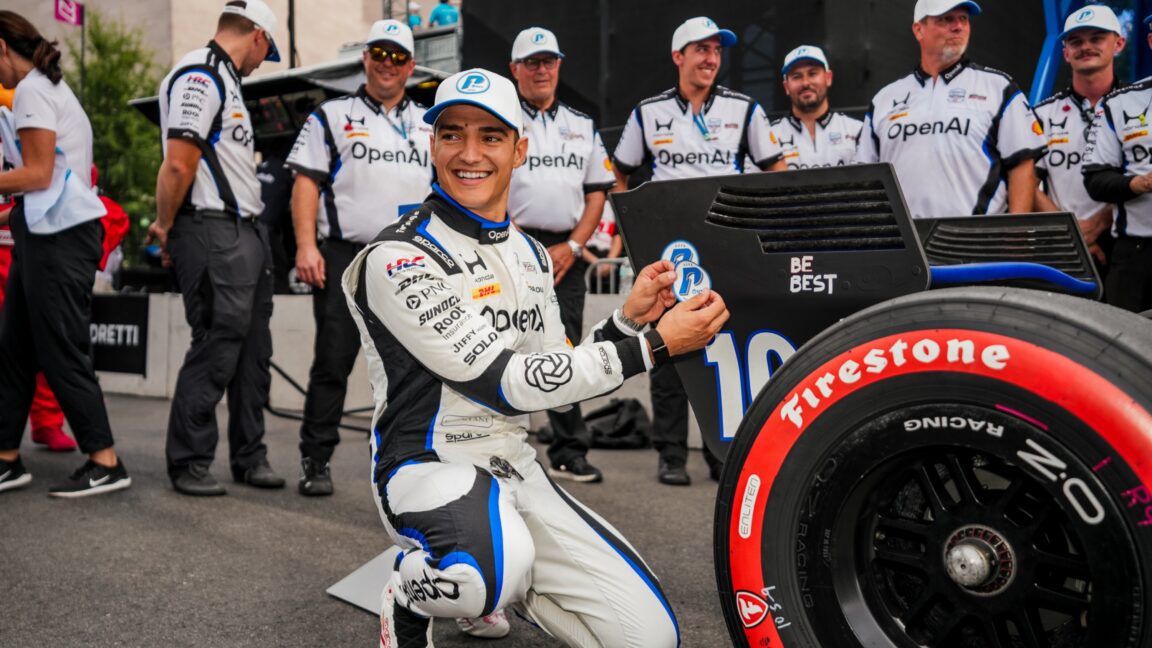
How OpenAI Is Helping Chip Ganassi Racing Optimize Alex Palou’s IndyCar
Motorsport sponsorship has changed significantly in recent years, largely because of where the money comes from. Tobacco and, to a lesser extent, alcohol once dominated race-car liveries. Many of those sponsors are now banned, and today’s cars are more likely to display companies associated with cryptocurrency, cybersecurity, or artificial intelligence.
That shift is not surprising. These industries account for an increasingly large share of GDP, and the companies behind them have the resources to invest in racing. At the amateur level, technology CEOs are increasingly becoming privateer drivers alongside—or instead of—the dentists who traditionally filled those seats. Last weekend’s Petit Le Mans, for example, included the co-founders of GitHub, CrowdStrike, and Shopify, as well as the creator of Ruby on Rails.
OpenAI brings more than sponsorship money to IndyCar
But Chip Ganassi Racing (CGR) and OpenAI have demonstrated how a sponsor can provide tangible benefits to a motorsports partner beyond a financial transfer.
Ganassi’s team may not be the most resourceful operation on the IndyCar grid, but it has been the most dominant. Its drivers have won the championship 13 times in the past 20 years. Dario Franchitti and Scott Dixon accounted for many of those victories, while Alex Palou has now won the biggest prize five times in six seasons.
In some races, Palou’s car carries OpenAI colors. The partnership also extends to the team’s technical work: OpenAI and one of its researchers are collaborating with CGR and Palou to optimize the car’s setup.
Alex Palou’s 2026 IndyCar season
The 2026 season was tougher than usual for Palou. He won one-third of IndyCar’s 18 races, but that was still twice as many victories as any other driver. His eight pole positions were also better than anyone else achieved.
The collaboration between OpenAI, Chip Ganassi Racing, and Palou is the subject of a YouTube documentary series. The second episode was released this morning. Watch the first part here.
Source: arstechnica.com