


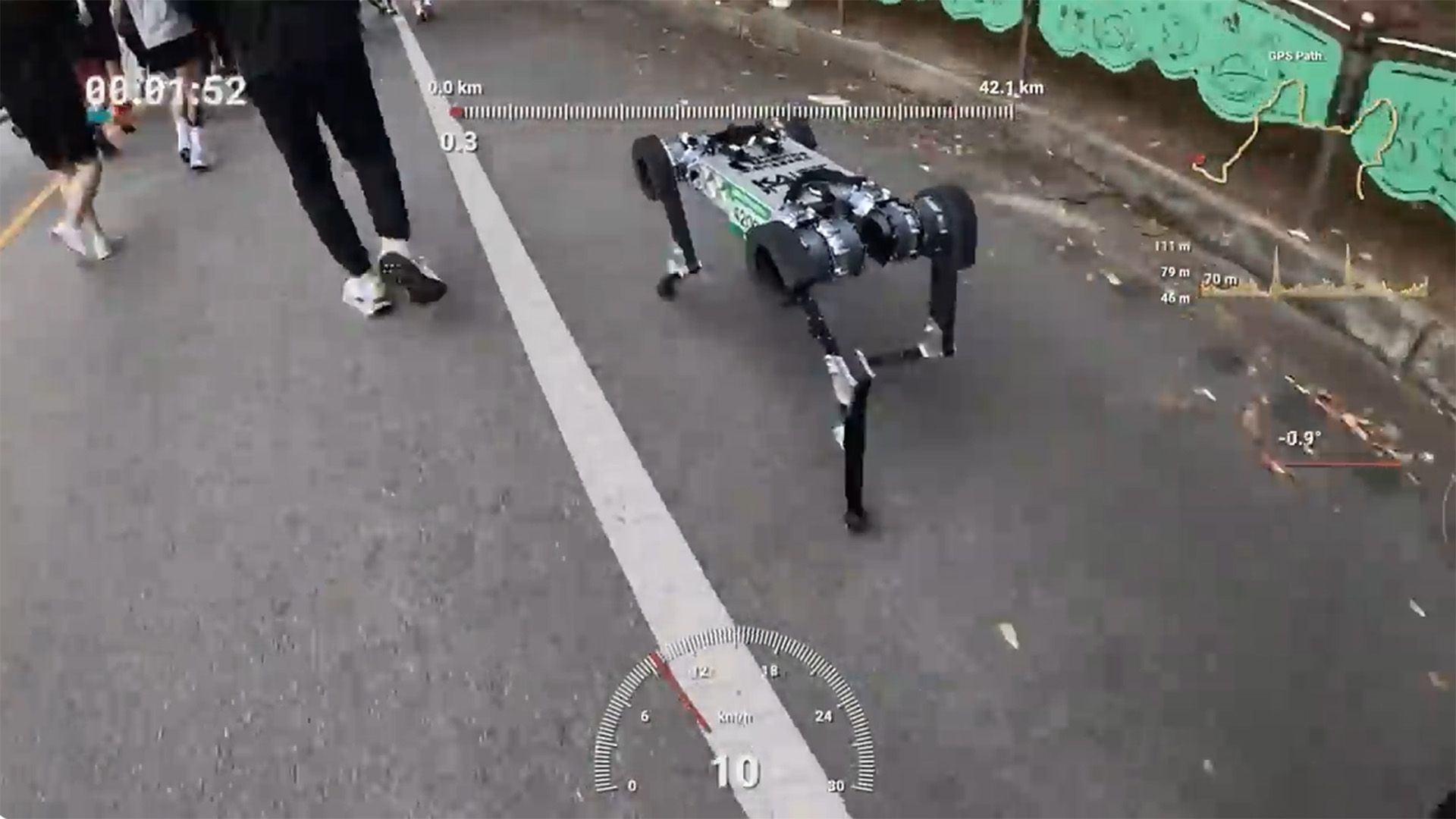
Robot Dog Completes a Full Marathon on a Single Battery Charge
RAIBO2, a four-legged robot, has completed a 42.2-kilometer marathon on a hilly public-road course in South Korea without stopping to recharge. Researchers say the achievement sets a new endurance milestone for quadruped robots.
The dog-shaped robot completed the 22nd Sangju Dried Persimmon Marathon in just over 4 hours and 19 minutes. According to its creators, RAIBO2 is the first quadruped robot to finish an official marathon-distance event on a single battery charge.
Quadruped robots are often called “robot dogs” because the movements of their front and hind legs resemble those of a dog. Unlike wheeled robots, they can navigate challenging terrain such as stairs, steep paths and uneven ground. However, their endurance has traditionally been limited by the energy required to support their weight and repeatedly move and stabilize multiple joints.
A study published September 23 in Nature details how RAIBO2 completed the feat on November 17, 2024.
Why a marathon is difficult for a quadruped robot
Quadruped robots continually use energy at their joints to support their weight. They also lose kinetic energy when their feet repeatedly make contact with the ground, making long-distance travel more demanding than it is for wheeled machines.
RAIBO2 faced an especially difficult test during the Sangju Dried Persimmon Marathon, where robots competed alongside human runners. The course included two 50-meter (164-foot) elevation rises and slopes of up to 10 degrees. The hills increased the robot’s energy demands and tested its ability to manage battery power over a long distance.
How RAIBO2 improved its battery range
Before the marathon, RAIBO2 had completed a 43-kilometer route on a flat playground using GPS guidance. It finished that run in 4 hours and 40 minutes on a single charge.
However, an earlier marathon attempt on uneven terrain ended when the robot’s battery ran out at approximately 37 kilometers. The developers attributed the failure partly to frequent changes in pace as RAIBO2 tried to match nearby runners.
To address the problem, the team increased the robot’s battery capacity by 33% and modified its control system. One key change was the addition of joint-stiffness control for the actuators. This allowed RAIBO2 to use softer legs to absorb shocks and provide a steadier, more powerful push when needed.
After those changes, the robot’s maximum estimated range increased to 67 kilometers (41.6 miles) in a straight line.
Robot dog was more energy-efficient than the human benchmark
The researchers also measured RAIBO2’s total transportation cost, which describes the energy required to move an object over a given distance. Lower values indicate greater efficiency.
RAIBO2 achieved a total transportation cost of 0.25, compared with a human benchmark of 0.37. The researchers said this was the first time a quadruped robot had surpassed that benchmark.
The team credited the robot’s performance to several hardware and software improvements, including lightweight mechanical components capable of transferring kinetic energy through the joints with minimal interference. The robot also used a low-loss motor-drive circuit and a streamlined movement policy designed to reduce energy consumption.
RAIBO2’s control system was trained in RaiSim, the team’s simulation environment. RaiSim includes models of hills, stairs and icy roads, allowing the robot to practice movements across different types of terrain.
Regenerative braking helps on downhill sections
Like many electric vehicles, RAIBO2 can recover some energy by capturing kinetic energy as it travels downhill. This regenerative capability can offset part of the energy used while climbing, although it does not eliminate the additional energy costs of hilly terrain.
The robot has a total battery capacity of 2,016 watt-hours. The researchers say it can travel more than three times farther on a single charge than existing quadruped robots. Its current estimated maximum range is 67 kilometers, or about 25 kilometers farther than the marathon distance.
How marathon-range robot dogs could be used
The endurance demonstrated by RAIBO2 could expand the use of quadruped robots in areas where wheeled machines are difficult to operate. Potential applications include disaster zones and mountainous regions, where robots could carry cameras, sensors and communication equipment across rough terrain.
Lee, C., Youm, D., Park, J., Lee, J., Choi, S., Ji, G., Mun, J., Jung, M., Choi, H. C., Kim, H., Oh, H., Nam, K., Lee, M., Hur, J., Choi, D., Kim, D., An, Y., and Hwangbo, J. (2026). A quadruped robot designed to run a marathon on a single battery charge. Nature. Read the study.
Source: www.livescience.com