


The letter arrived so quietly that I had almost forgotten what receiving a letter felt like. There was no sound or warning. It simply rested on the table, as if it had always been there. I do not mean that poetically. I believe I placed it there myself and then forgot. This happens more often than I would like to admit.
Notice regarding relocation to Mt. Oba: Final date enclosed.
I read the letter twice, then a third time. Words tend to rearrange themselves when you are not looking at them directly. That is the situation today.
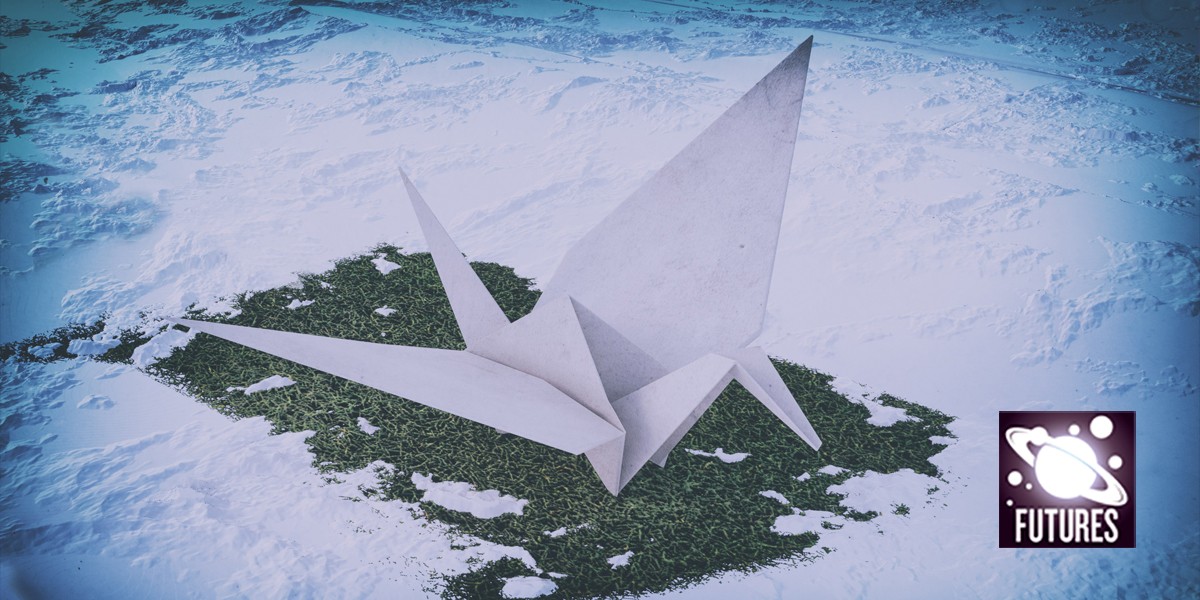
I folded the paper into the shape of a crane. I have always claimed that I am not good with my hands, but that is not entirely accurate. Your hands remember what your mind pretends not to notice. The creases were sharp and unmistakable. I placed the paper crane in the living-room window that no longer opens, above the radiator. It is a narrow window facing east toward the railroad tracks.
Below me, Tokyo continued moving forward without hesitation, as it had for many years. A drone traced a careful arc through the air. The turnstile sang softly, accepting the authorized bodies and rejecting the others. Somewhere nearby, an announcement reminded us: balance is a care. I repeated the words as instructed, although I have never completely overcome the habit. Repetition can be comforting.
Obayama.
Read more science fiction from Nature Futures
When I was young, people spoke about Mt. Ubadake half-jokingly, as if it belonged to a folktale no one truly believed. According to the old legends, it was the mountain where elderly people left behind by changing times were granted mercy during periods of crisis. I thought the practice was cruel. I also remember, with some embarrassment, thinking that it was efficient. I am not proud of that thought, but I cannot honestly say I regret having it.
Now the practice is neither wise nor cruel. It is administrative.
I checked my reflection in the same living-room window, but the glass was dark and offered almost no image. The records list 83 cases, a number that remains unchanged even as other details shift. My estradiol tablets stopped arriving years ago. There was a letter explaining why, but I no longer remember what it said. Sometimes my face softens beyond recognition. The faint outline of my chest still catches me by surprise, but I remain myself. At least, I think I do.
I remember the first time the state sent me a letter with my chosen name blacked out and replaced. I cried openly, and with more embarrassment than I care to admit. I felt as though I were being mocked from a distance. The name I had chosen was not considered valid. Only my birth name was allowed to exist.
I filed an appeal. After that, I was supposed to receive an official update: a settlement notice confirming which version of me the system had selected. Name, gender marker, care category, project cost, and other classifications would be finalized once the audit was complete.
No update arrived. Or perhaps it did, and I missed it.
The algorithm is said to have flagged my file with the following assessment: Low utility, high cost. I have never seen the designation myself, but I have no reason to doubt it. A small pink triangle appears beside my record: Gender-affirming care: legacy categories. I do not believe the color was intentional. There are many things like that.
On the day of the transfer, I boarded the bus with a confident smile. I had been practicing it for years. The attendant examined my wrist and frowned.
“The system is slow,” he said, with the tired frustration of someone who did not want to attach a story to his shift.
I need to clarify something. I told other people, and myself, that I had spent three years cultivating bokeh. I learned to walk with enough instability to confuse the recognition software. I borrowed medicine from a neighbor to steady my pulse. I changed my spelling and my gender. I filed an appeal under an old alias from a life that may or may not have been as real as I remembered.
All of those things could be true.
It is equally possible that the system is simply less perfect than promised.
Obayama emerged from the fog, unfinished and without decoration. Its bald, bare shape stirred a surprising affection in me, which I attributed to nervousness.
At the gate, the scanner flashed red.
Then green.
“Please,” the attendant said quickly, already turning away.
I wondered whether he would remember me later, or whether I would dissolve into the statistics before he reached the end of the platform.
Source: www.nature.com