


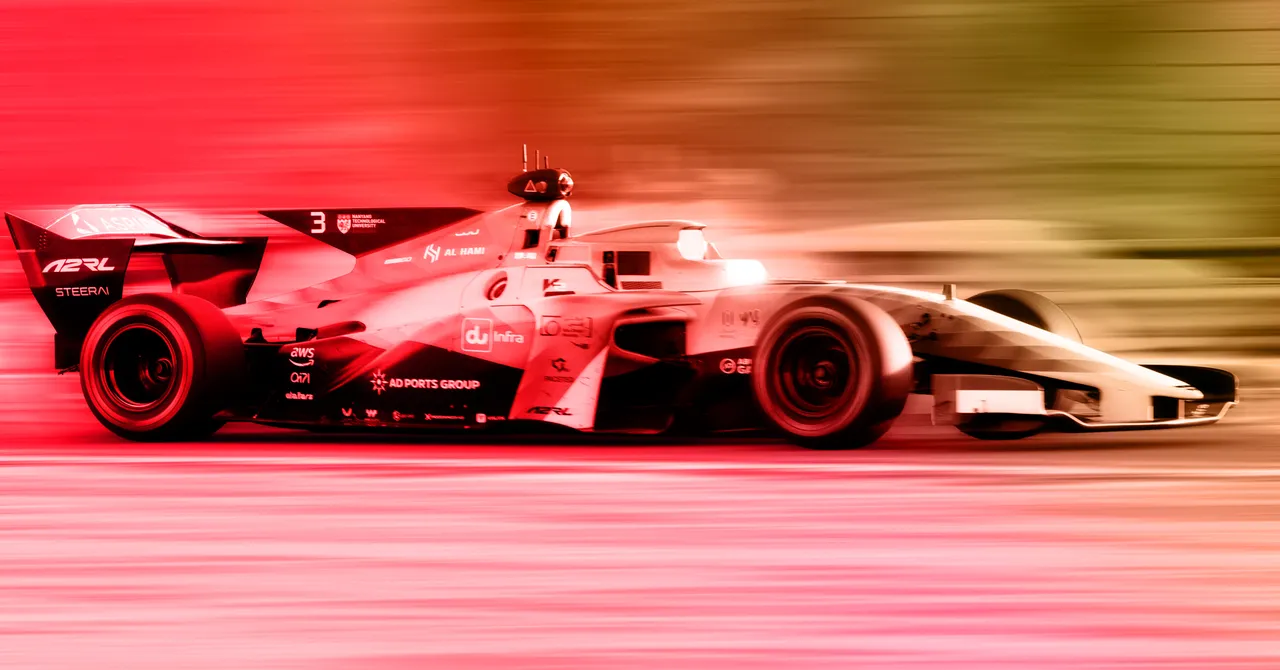
Autonomous Race Car Crashes at A2RL Imola Event as Self-Driving Tech Faces High-Speed Test
The audience was excited until engineers in the paddock watched in shock as an unmanned PoliMove race car collided with a decelerating Unimore vehicle during an event organized by the Abu Dhabi Autonomous Racing League (A2RL).
Autonomous Cars Collide at Imola’s Rivazza Corner
Both vehicles crashed at Rivazza, a challenging section of the Autodromo Internazionale Enzo e Dino Ferrari in Imola, Italy. The circuit’s final sequence features notoriously difficult corners, where even an F1 champion has suffered a similar fate. This time, however, there was no human driver in danger.
Launched in 2024, A2RL aims to bring self-driving vehicles into motorsport while testing the limits of autonomous driving technology. The Imola race highlighted a major gap between the cars’ computing power and their ability to react when conditions suddenly change.
Only Two Cars Finished the Autonomous Racing Final
Five cars entered the final, but only two completed the race. UAE-based Kinetiz took first place, followed by Germany’s Constructor Racing. PoliMove was classified third, although its damaged car had to be replaced before the awards ceremony. TUM, a two-time winner, retired after suffering a brake problem during the formation lap.
The participating teams had only nine days of physical testing in rain and hail before the event. The Imola race was also A2RL’s first international competition outside its usual testing grounds at Yas Marina Circuit in Abu Dhabi.
Why Hold an Autonomous Race at Imola?
So why choose one of the world’s most demanding motorsport venues? The answer is the circuit’s merciless layout.
“Easy means anyone can do it, right?” said Nicola Palarchi, director of engineering at Aspire, the company that founded A2RL. “We have to show that we’re going to the places that matter.”
Palarchi made clear that autonomous racing is not intended to compete with human racing. Instead, it is developing as its own motorsport, while also supporting advances that could benefit conventional racing and vehicle technology.
Autonomous Racing Is a High-Speed Laboratory
Autonomous racing is being presented as more than a spectacle. It is a laboratory with guardrails, allowing engineers to test perception, prediction, and vehicle control at extreme speeds without putting human drivers at risk.
Those capabilities are also central to the safety of self-driving cars in the real world. Measuring where autonomous vehicles succeed—and where they fail—could help improve future technology.
Why Self-Driving Cars Struggle in a Race
An autonomous race car must first use its sensors to determine its location and understand its surroundings. Planning software then selects a trajectory, while the control system translates that decision into steering, acceleration, and braking.
Every stage becomes more difficult at racing speeds. The vehicle has less time to interpret incomplete information, predict the movements of other cars, and perform evasive maneuvers. The PoliMove and Unimore collision at Imola showed just how challenging those decisions can be when something goes wrong.
Source: www.wired.com