


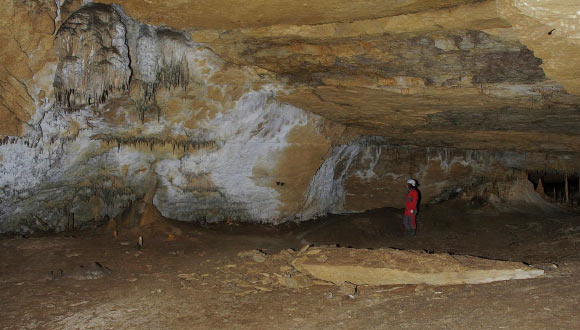
Recent radiocarbon dating from Sala Queimada, a challenging-to-access chamber within Cueva Palomera in northern Spain’s Burgos province, reveals that generations of people revisited this sacred location between the end of the Ice Age and the Iron Age, leaving behind a wealth of artifacts, structures, and offerings.
Sala Queimada, a chamber at Cueva Palomera in Burgos, Spain. Image credit: Ortega-Martinez et al., doi: 10.1016/j.jasrep.2026.105818.
According to Dr. Ana Isabel Ortega Martínez, lead researcher at the Instituto Fernán González and Royal Academy of History and Art of Burgos, “Cueva Palomera serves as the main entrance to the expansive Ojo Guareña cave system, where a majority of rock art is found.”
“Sala Queimada is situated on the third level of the cave, approximately 290 meters from its entrance,” she explained.
“Accessing it involves crawling through a narrow and low passageway, measuring 13 meters wide and 0.2 meters high.”
The study produced 18 new radiocarbon dates from charcoal samples, drawings, and bone remains within Sala Queimada.
The oldest date, approximately 13,700 years old, indicates the site was already in use during the Upper Paleolithic. In contrast, the most recent evidence features remains of a domestic piglet, dating from the Iron Age, around 2,100 years ago, hinting at ritualistic uses of the cave.
Spanning the intervening eras, the evidence shows consistent human activity during the Neolithic, Chalcolithic, and Bronze Ages.
Notably, each generation respected earlier artists’ works, preserving them while also contributing new marks and paintings.
The researchers identified a significant discovery: a complex structure made from two large limestone slabs that stand upright, bolstered by smaller stones. “The main slab, measuring 1.5 meters, features a meticulously shaped upper edge, creating a distinctive profile akin to animal figures facing the main artwork,” the scientists noted.
This slab, along with its supporting stones, bears carvings and charcoal marks that indicate substantial human activity around the structure.
“This site bears striking resemblances to another Paleolithic slab found in Tito Bustillo Cave (Ribadesella, Asturias), albeit larger,” they added.
The findings elevate Sala Queimada’s status within the broader context of cave reserves across the Iberian Peninsula, where prehistoric humans have returned for millennia to sites they deemed sacred.
The authors noted, “Eight distinct stages of human activity were identified in Sala Queimada, making it one of the most remote and sheltered sanctuaries in Cueva Palomera.” This suggests that for thousands of years, humans not only utilized the cave entrance as a habitat but also continually revisited this intricate underground world.
These findings, published in the May 23rd issue of the Journal of Archaeological Science: Reports, reveal the rich historical significance of Sala Queimada.
_____
Ana Isabel Ortega-Martinez et al. 2026. Sala Queimada: A New Paleolithic Sanctuary in Cueva Palomera, Ojo Guareña (Burgos, Spain). Journal of Archaeological Science: Reports 73: 105818; doi: 10.1016/j.jasrep.2026.105818
Source: www.sci.news