


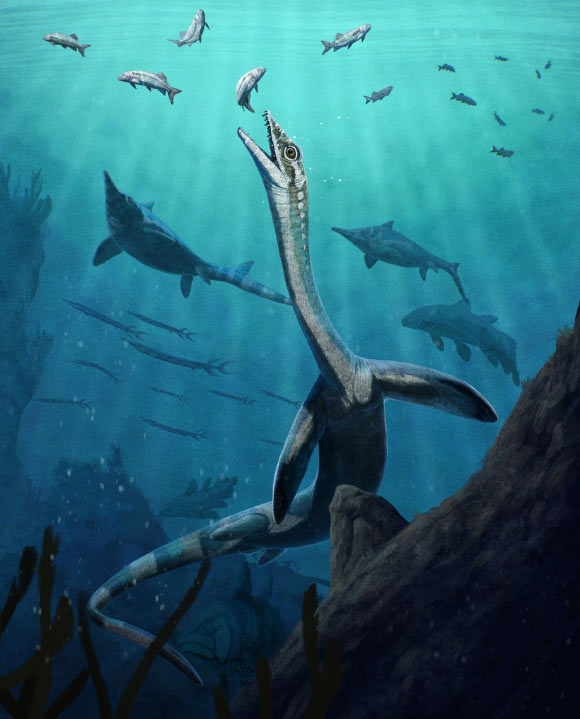
A remarkably preserved fossil of Austronaga minuta, a small long-necked marine reptile from Triassic China, contains traces of its stomach, liver and intestines. The discovery gives paleontologists their oldest detailed evidence of digestive organs in an early reptile.
Austronaga minuta lived in the Tethys Ocean during the Middle Triassic, approximately 244 million years ago.
The species belonged to Tanysauria, a group of early archosauromorph reptiles distantly related to the lineage that later produced dinosaurs, crocodiles and birds.
“Although it was only about 60 cm long, Austronaga minuta had an exceptionally long neck and tail,” said Dr. Wei Wang of the Institute of Vertebrate Paleontology and Paleoanthropology at the Chinese Academy of Sciences and his colleagues.
“The animal was highly adapted to aquatic life. Its elongated tail provided propulsion, while its long, fin-like forelimbs helped it steer and remain stable in the water.”
“By contrast, the hind limbs were strongly reduced and appear to have played little role in swimming.”
“This body plan is particularly unusual because Austronaga minuta is not closely related to other well-known marine reptiles, such as ichthyosaurs or giant mosasaurs, which evolved similar swimming adaptations.”
For their study, the researchers re-examined a nearly complete skeleton of Austronaga minuta that was first described two years ago.
In addition to its exceptionally preserved bones, the fossil retains impressions and chemical traces of the animal’s internal organs, including the stomach, liver and intestines.
Ultraviolet photography allowed the team to identify the faint outlines of these soft tissues. The liver displays a reddish coloration that may have formed from iron-rich compounds associated with decomposed blood.
The digestive system of Austronaga minuta was relatively simple and unspecialized. It included a single-chambered stomach and a short, loosely coiled intestine, resembling the digestive anatomy of modern fish-eating monitor lizards more closely than that of highly specialized marine reptiles.
The researchers propose that evolutionary pressure affected the animal’s limbs and pelvis more strongly than its internal organs as Austronaga minuta adapted to life in the sea.
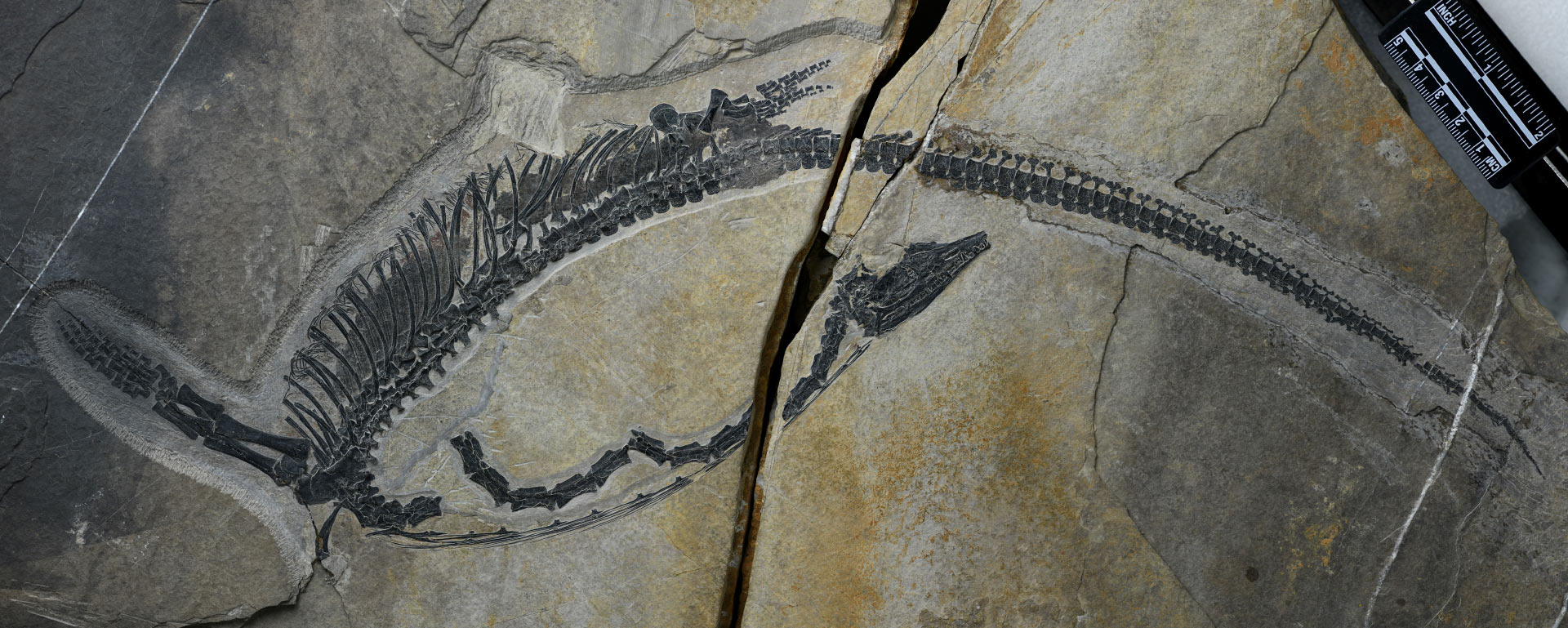
The holotype specimen of Austronaga minuta. Image credit: Wei Wang.
“Compared with the highly specialized external body shape of Austronaga minuta, its internal organs appear to have undergone much less modification,” Dr. Wang said.
“The preserved organs include a large, sac-like stomach near the front of the body, followed by a distinctly red liver containing traces that may be derived from hemoglobin.”
“A long, uncomplicated tube behind the liver represents the small and large intestines.”
“Together, these features indicate that the digestive system of Austronaga minuta was structurally simple.”
“This is the oldest known fossil reptile with a largely complete digestive system preserved.”
“Modern birds and crocodiles have a two-part stomach, whereas Austronaga minuta had only one stomach chamber,” said Dr. Nick Fraser of National Museums Scotland.
“The fossil suggests that archosaur stomachs were initially simple and became more specialized later in their evolutionary history.”
“It is also notable that Austronaga minuta had a short and relatively uncomplicated digestive tract, closely resembling that of living fish-eating reptiles.”
Close relatives of Austronaga minuta included species ranging from mostly terrestrial animals to the highly aquatic, long-necked Dinocephalosaurus. This diversity makes the group an important example of reptiles adapting to life in the water during the early Mesozoic.
“The discovery of Austronaga minuta expands our understanding of early archosauromorph ecology and shows that marine colonization by stem archosaurs began earlier and was more extensive than previously recognized,” the researchers concluded.
“The transition from land to sea occurred within this major reptilian group near the beginning of the Mesozoic, paralleling the better-known marine radiations of Sauropterygia and Ichthyosauria, as well as exclusively Triassic groups such as Thalattosauria.”
“Taken together, these findings point to a broader range of reptilian adaptations that helped animals survive in the arid environments of southern China during the Triassic.”
The results were published in the journal Science Advances.
_____
Wei Wang et al. 2026. Highly aquatic marine stem archosaur with soft tissue preservation. Science Advances 12 (31); doi: 10.1126/sciadv.aeb7528
Source: www.sci.news