


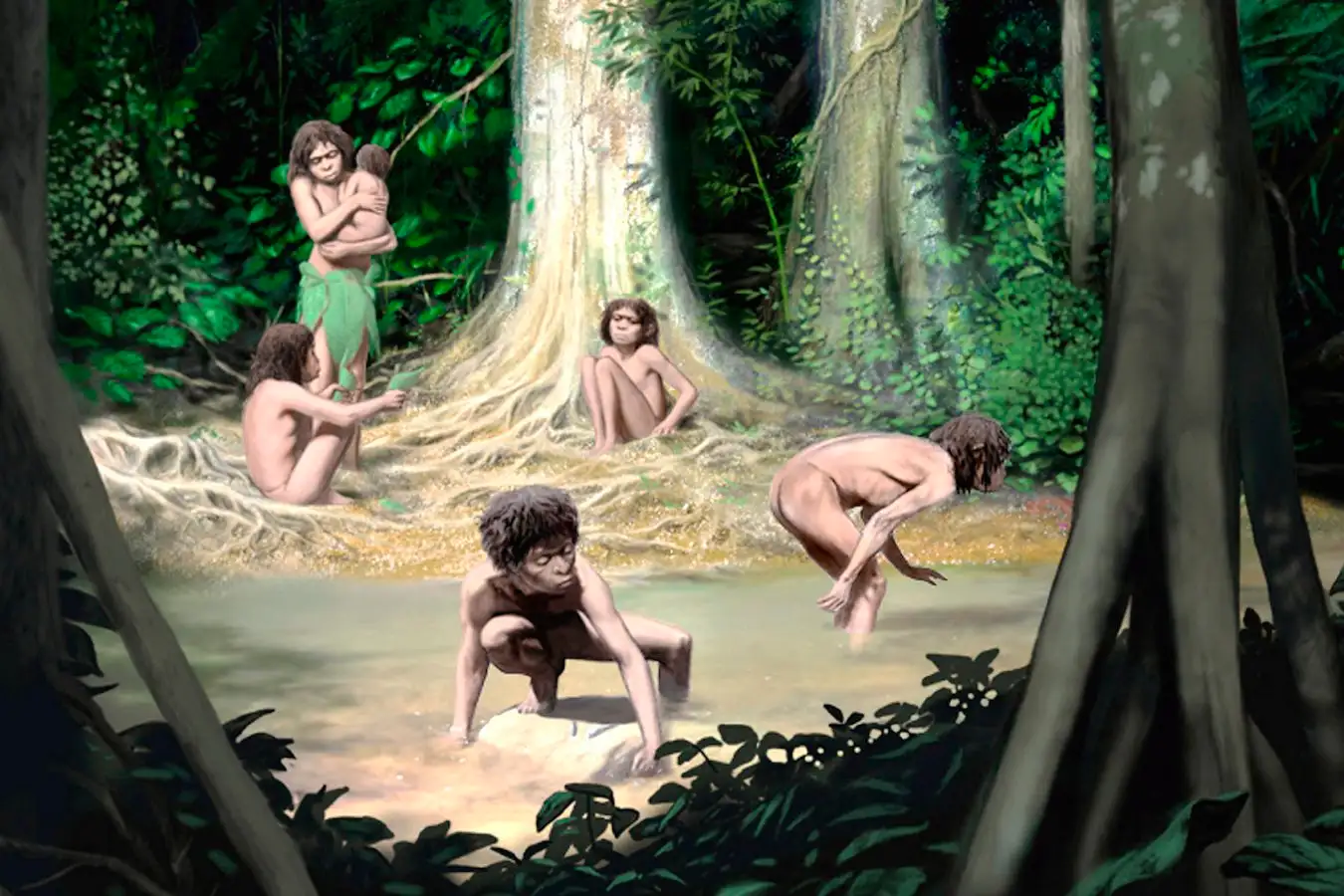
Homo floresiensis was a small hominin that inhabited the island of Flores.
Lionel Brett/Eurelio/Science Photo Library
A recent study on animal bones excavated from caves suggests that ancient humans, commonly referred to as “hobbits,” inhabited the Indonesian island of Flores until approximately 50,000 years ago. These small hominins likely relied on scavenging meat left by Komodo dragons rather than sophisticated hunting techniques.
First identified in 2004, Homo floresiensis was a diminutive hominin standing just over a meter tall, with remains dating back between 90,000 and 50,000 years.
Initially, stone tools and charred bones discovered alongside their remains indicated advanced behaviors like fire usage and big-game hunting. However, recent investigations have raised questions about the cognitive abilities of these small-brained hominins.
“The prevailing thought in our field is that Homo floresiensis required some level of advanced cognitive skill to reach and survive on the island amidst a declining animal population,” states Elizabeth Veitch from the Smithsonian Institution in Washington, DC.
The Liang Bua Cave, where the remains of Homo floresiensis were discovered, also contained numerous bones from a dwarf elephant species, Stegodon florensis insularis. Researchers suspect that these animals fell prey to the island’s Komodo dragons—large reptiles native to Flores and nearby Indonesian islands.
To ascertain the types of marks left by Komodo dragons on the bones of large mammals, Veitch and her research team fed a dead goat to a Komodo dragon at Zoo Atlanta, Georgia. “Since Stegodon elephants are extinct, it would be virtually impossible to test their consumption with real elephant remains,” Veitch explained.
After the Komodo finished its meal, researchers examined 72 bones, finding 26 with 192 distinct tooth impressions. Comparisons were made against over 3,000 known Stegodon bone fragments found in Liang Bua Cave, alongside around 7,000 bones from more contemporary giant rats and modern humans (Homo sapiens). Each of these approximately 10,000 bones was scrutinized for evidence of fire exposure.
Findings revealed that Komodo dragons prefer to consume the meatiest parts of carcasses, such as hind and front legs. However, the bones associated with Homo floresiensis and Stegodon were located predominantly in less desirable areas like the skull and thoracic vertebrae—suggesting that humans did not actively hunt these elephants.
Out of over 3,000 Stegodon bones, only one showed signs of fire exposure, which likely resulted from later disturbances by humans. In contrast, nearly 20% of rat bones left by modern humans post-extinction displayed signs of cooking.
“The rat bones clearly illustrate the discrepancy—there are no burned bones from Homo floresiensis, while hundreds of layers from modern humans contain distinct burning patterns. Claims of advanced behaviors have steadily diminished, indicating that Homo floresiensis likely didn’t use fire or hunt large game as previously posited,” remarked Adam Brumm from Griffith University in Brisbane, Australia.
Martin Porr from the University of Western Australia emphasized that earlier claims about hunting Stegodon and fire usage are contentious: “These new discoveries align more closely with what we understand about other small-bodied hominins, like australopithecines, making sense given their brain size and weight.”
Nonetheless, the broader question remains: did Homo floresiensis evolve from smaller, more widespread hominids, or did they descend from larger beings like Homo erectus and lose their capabilities over time?
“Both scenarios are plausible, but further research is necessary in and around Flores for clarity,” Porr concluded.
Topics:
- Evolution of Humanity/
- Ancient Humans
Source: www.newscientist.com