


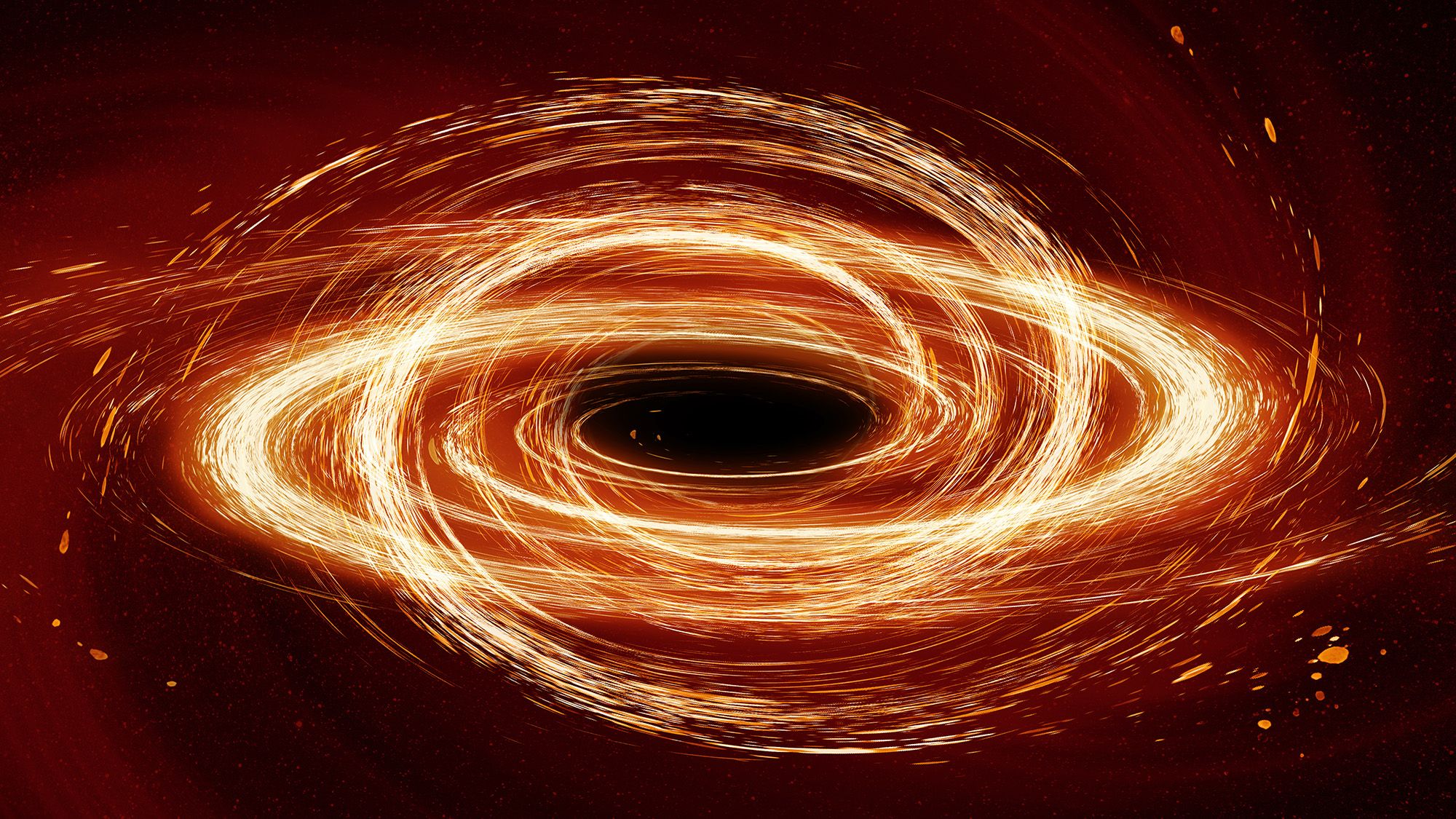
Recent advancements in physics have enabled scientists to generate light from a black hole through a series of optical fibers, marking the first observation of this light reacting and returning to the simulated black hole that produced it.
This groundbreaking result offers a rare opportunity to study Hawking radiation—the faint thermal emissions predicted by physicist Stephen Hawking that should theoretically escape from black holes. Researchers assert that this study offers initial insights into minute pressures that could, theoretically, lead to the gradual evaporation of actual black holes.
Leveraging tabletop fiber optic experiments, an international research team detected both the radiation and its anticipated “reverse reaction,” where the emitted radiation returns energy to reshape the originating objects.
Latest Videos from

A recent study published in the journal Nature, demonstrated that the emitted light behaves as expected by Hawking’s theories—appearing as a warm object with a specific temperature and a spectrum that diminishes at higher frequencies, even under conditions that challenge conventional black hole models.

An infographic explaining the principles of Hawking radiation, in contrast to traditional general relativity predictions.
(Image credit: ALAIN BOMMENEL, VALENTINA BRESCHI, WILLIAM ICKES via Getty Images)
Where Three Great Theories Intersect
Hawking radiation is particularly significant as it represents the convergence of three fundamental scientific concepts: physics—the biggest idea yet.
“Jacob Beckenstein theorized that black holes possess both entropy and temperature, while Hawking calculated the thermal emissions from these black holes,” stated Wolf Leonhardt, a physicist at Israel’s Weizmann Institute of Science, via email to Live Science. “Hawking-Bekenstein radiation amalgamates quantum physics, general relativity, and thermodynamics—disciplines that regularly conflict with each other.”
This deep-seated conflict persists: while general relativity smoothly represents space and time, quantum mechanics embodies a realm of unpredictable and discrete changes, and achieving harmony between them has proven elusive.
Discover the world’s most captivating findings delivered straight to your inbox.
The difficulty in studying Hawking radiation is compounded by the fact that astronomers have yet to observe Hawking radiation emitted from actual black holes, likely due to its extremely faint glow being undetectable across the universe. Consequently, physicists have turned to laboratory counterparts that mimic the equations: constructing black hole analogs using flowing water, ultracold atoms, and, in this instance, light.

According to Stephen Hawking, black holes can release information via elusive radiation. This new research focuses on mechanisms that facilitate such emissions.
(Image credit: Bryan Bedder / Stringer via Getty Images)
Constructing a Black Hole from Light
The ingenuity of black hole analogs hinges on the movement of the medium. “Imagine an athlete swimming in an ocean where the current is faster than they can swim,” explains Leonhardt. “They get swept away—which mirrors the conditions beyond a black hole’s event horizon.”
An event horizon delineates where the flow (or space, in reality) accelerates beyond the speed of anything else. To emulate this, researchers required a material that seemed to be moving at light speed. The innovative solution involved creating “materials” using light itself.
“Optics demands materials that seem to be traveling at light speed,” Leonhardt elaborates. “For this purpose, we employed light itself. In nonlinear optics, light behaves like matter.”
The research team exposed thin photonic crystal fibers to intense, ultrashort “pump” pulses. These fibers consist of glass with a series of tiny air channels running along their length, enabling precise manipulation of light’s path. As the pulse transmits, the glass’s alteration of the light bends it slightly, altering its speed. Once the main pulse couldn’t keep pace, it formed an artificial event horizon, creating an analog black hole.
Capturing the Emission and Its Reaction
The results appeared in ultraviolet light. According to theory, Hawking radiation emerges in pairs; one escapes, while the other remains trapped, absorbing “negative” energy and falling back into the black hole. Within the fiber system, the counterpart manifested as ultraviolet light.
“We detected photons in the ultraviolet range corresponding to Hawking’s escaping partner beyond the horizon,” explained Leonhardt. “Their wavelength measured around 233 nanometers, which served as our signal.”
Understanding the mechanics of this emission is crucial. It was previously believed that fibers accumulate Hawking radiation through a series of intermediate conversions. However, the researchers determined that a single direct interaction generates Hawking pairs in a seamless step. This simplified model can potentially extend to other analogs and even real black holes.
To produce Hawking radiation, energy must derive from somewhere. In real black holes, that “nudge” manifests as they lose mass over unimaginable timeframes, as Hawking described in his landmark 1974 paper. No experiment has successfully captured this reaction until now.
In this experiment, the team observed a slight shift in the color of a portion of the pump pulse as it generated the radiation, resulting in a distinct bias in the spectrum. This asymmetrical signature, never before recorded, signifies a reverse reaction or recoil. Black hole analogs inherently incur an energetic cost for their emissions.
The Path to Quantum Experiments
The findings also address one of the most intricate puzzles in black hole physics: the trans-Planck problem. Retracing Hawking’s radiation to its source leads calculations into realms where physicists grapple with uncertain outcomes. The Planck scale represents the incredibly minute size at which traditional concepts of space and time collapse, and current laws of physics begin to disintegrate. Essentially, Hawking’s predictions seem to rest on a foundation that might not exist.
“Light stretches significantly as it moves away from the horizon,” stated Leonhardt. “Thus, it must originate from waves smaller than the smallest dimensions defined in physics, suggesting unknown territories. Will this phenomena still yield Hawking radiation? That was our inquiry, and we provided experimental answers.” Remarkably, under these extreme conditions, the emitted glow remained consistently warm.
The team has concrete future plans. While they have successfully replicated the spectrum of Hawking radiation using conventional laser light, they have yet to explore its deeper quantum characteristics. Their next aim is to “quantize,” Leonhardt revealed. “We will seek methods to delve into the quantum domain and uncover phenomena such as entanglement—the mysterious connection linking the fleeing Hawking particle to its lost counterpart.
Test your knowledge about black holes. Take the Black Hole Quiz!
Source: www.livescience.com