


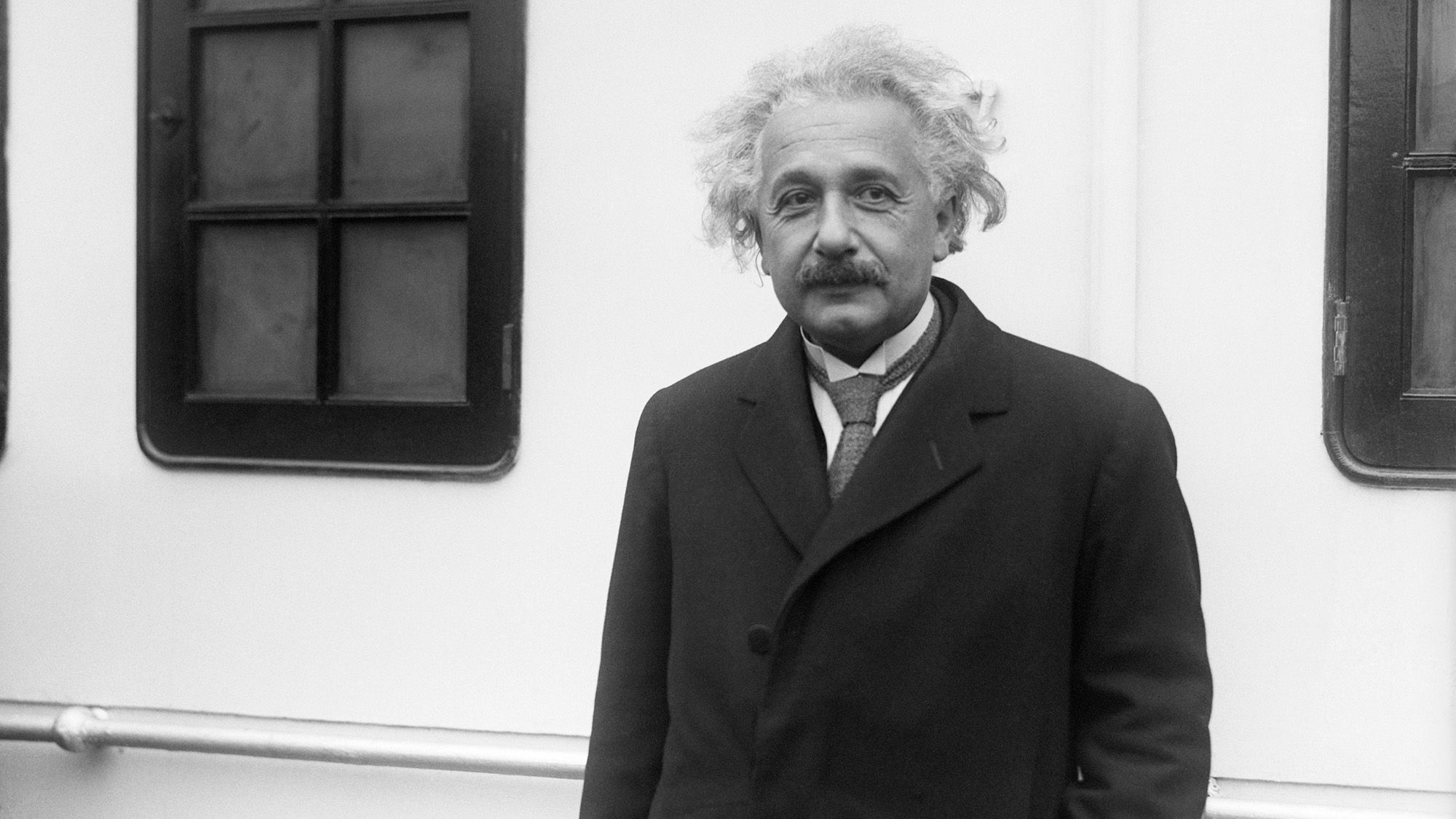
Albert Einstein provided us with the groundbreaking theory of relativity, elucidated the photoelectric effect, and predicted the existence of gravitational waves. His revolutionary insights transformed our comprehension of space, time, and gravity.
Einstein’s name has become synonymous with “genius.” However, even the greatest minds are not infallible—was Einstein ever wrong?
“Indeed, he was wrong on several occasions,” says Nicholas Younes, a theoretical physicist at the University of Illinois at Urbana-Champaign. “While we mostly remember him for his accurate predictions that astonished the scientific community, his theories have shaped our understanding of reality.”
Sign Up for Our Newsletter
(Image credit: Marilyn Perkins / Future)
Subscribe to our weekly Life’s Little Mysteries newsletter for the latest insights before they’re available online.
One of Einstein’s notable errors occurred in 1916 when he recognized that matter’s acceleration could produce ripples in spacetime—what we now call gravitational waves. Unfortunately, while depicting these waves mathematically alongside physicist Nathan Rosen, they encountered a divergence issue within general relativity, leading to erroneous conclusions. “The results indicated divergences that could not serve as a physical representation of reality,” explains Younes.
Consequently, Einstein revised his stance, asserting that gravitational waves could not exist. He documented this in a manuscript submitted to Physical Review, which had recently begun peer reviews. An anonymous reviewer discovered a flaw in Einstein’s calculations; infuriated, Einstein withdrew the paper and submitted it elsewhere.
The reviewers eventually identified a legitimate issue: Einstein’s mathematical infinity was merely a coordinate artifact. Just like Earth’s longitudinal lines converge at the “singularity” at the North Pole—where no physical anomaly exists—Einstein’s mathematics could have been rectified with alternative coordinates.
Unknown to Einstein, the reviewer became friends with his assistant and illustrated the error to them, leading to Einstein’s correction. He subsequently republish his findings, confirming that gravitational waves do in fact exist.

Einstein initially believed in the existence of gravitational waves but altered his stance when faced with mathematical discrepancies. A reviewer named Howard Percy Robertson provided crucial assistance in correcting his errors.
(Image credit: MARK GARLICK/SCIENCE PHOTO LIBRARY, Getty Images)
Calculating the “Impossible Infinity”
Remarkably, Einstein made a similar error again. While exploring the mathematics surrounding black holes, he once again calculated an impossible infinity—this time at the event horizon. He prematurely concluded that these celestial bodies could not exist.
“Einstein remained skeptical about the existence of black holes,” says John D. Norton, a professor at the University of Pittsburgh. “He was convinced that a singularity existed in space and time, yet it is now recognized as the point of no return for objects journeying into a black hole.”
In this case, Einstein was not swayed by alternative interpretations of his mathematical infinity as a byproduct of the specific calculative method he favored. According to Norton, this reflected Einstein’s philosophical view of the interconnectedness of mathematics and physics.
“He was not persuaded by the analysis that questioned whether the mathematical infinity was solely a result of his preferred calculation method,” remarks Norton.

Einstein hesitated to accept the existence of black holes due to his mathematical findings indicating a collapse of spacetime at their borders (illustrated here in a 3D rendering).
(Image credit: Cavan Images / Luca Pierro via Getty Images)
Einstein and Quantum Mechanics
Einstein’s reluctance to accept quantum mechanics remains one of his most famous misinterpretations. His primary objection centered around quantum entanglement, wherein two particles can be correlated such that the measurement of one instantaneously influences the other—regardless of distance. In a letter to colleague Max Born in 1947, he expressed: “We must not seriously entertain this theory since it contradicts the notion that physics should accurately depict the reality of time and space without implying ‘spooky actions at a distance.’
Einstein believed that such instantaneous phenomena conflicted with the special theory of relativity, which maintains that nothing can travel faster than light. As a consequence, he was convinced that quantum mechanics must be incomplete and that a deeper understanding of reality was necessary to rectify this disorder.
“He passed away without embracing quantum mechanics,” Younes remarks. It wasn’t until 1964—almost a decade posthumously—that John Bell validated the existence of entanglement.
“We can attest to its validity, as contemporary technology heavily depends on quantum mechanics,” Younes asserts. “Yet, there remains a discord between it and general relativity. Einstein’s theories are classical in nature.”
“General relativity may also be flawed,” Younes cautions. “In scenarios of intense gravity, particularly at the Planck scale, where quantum phenomena dominate, quantum mechanics might not provide the appropriate framework.” This is increasingly relevant when considering the core of a black hole, which is compressed to quantum proportions while simultaneously being subjected to the universe’s strongest gravitational fields—a scenario where general relativity predicts singularities that quantum mechanics fails to elucidate.
Despite his shortcomings, many of Einstein’s mistakes propelled scientific progress. “For instance, general relativity is a prime example,” notes Norton. “Einstein laid the groundwork for his theory based on his attempts to expand the principle of relativity and Mach’s principle, both of which were later found to be incompatible with the ultimate formulation of general relativity.”
The surprising nature of Einstein’s errors was not lost on him. While collaborating on a book with Leopold Infeld, Infeld remarked that he was focusing intently on the text because it bore Einstein’s name. To this, Einstein chuckled and replied, “There will also be an incorrect document attributed to me.”
Test your knowledge of Albert Einstein in the following article: Einstein Quiz!
Topics
Source: www.livescience.com