


Key Insights
What is it: The galaxy cluster MACS J0553.4-3342, known for its collision activity
Location: Found within the Columba constellation
When revealed: July 2026
Approximately a century ago, Albert Einstein made bold predictions regarding the cosmos. Many turned out to be accurate (despite the fact that errors sometimes occurred). Physicists theorized that massive celestial bodies, akin to a magnifying glass, could bend the light from distant stars. This gravitational effect distorts and magnifies light, making far-off objects appear altered when observed from Earth.
Today, this phenomenon is referred to as gravitational lensing. It has been confirmed through numerous telescope observations and is a vital tool for astronomical studies. The James Webb Space Telescope (JWST) leverages this effect to examine light from the universe’s earliest and faintest galaxies. The recently released JWST imagery showcases the gravitational effects that Einstein theorized.
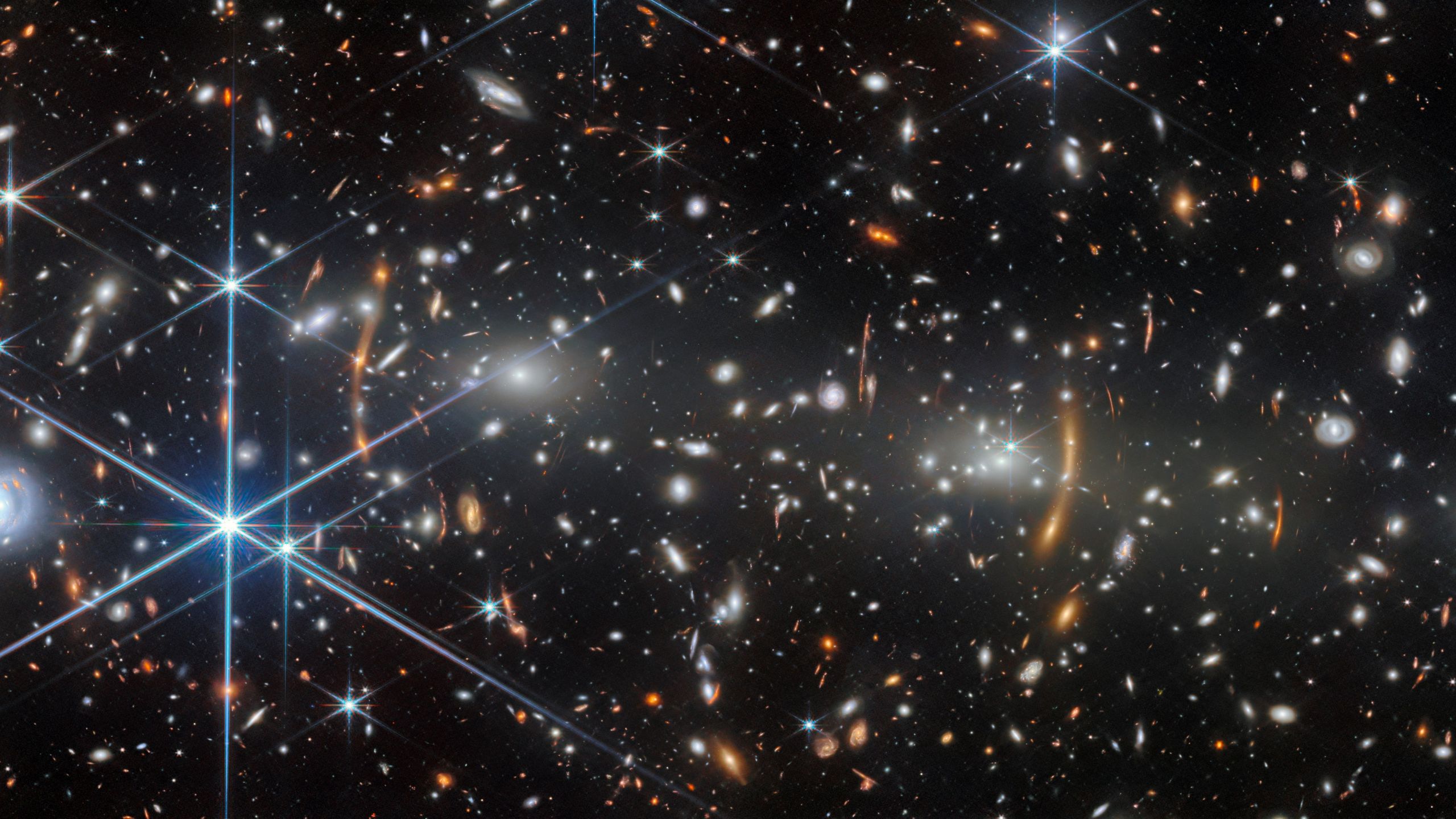
Prominently displayed are two bright white points, encircled by a halo, marking the gravitational center of MACS J0553.4-3342. This colossal collection of galaxies is located in the Columba constellation. According to researchers, these luminous points represent giant elliptical galaxies, each accompanied by a grouping of smaller sub-clusters. A statement from the European Space Agency (ESA) notes that these two clusters are engaged in a tumultuous encounter.
Featured Videos from

Examining light from galaxies dating back 4.4 billion years reveals that galaxy clusters are in the complex process of merging. The two major elliptical galaxies have already collided once and are now approximately 1 million light-years apart (equivalent to about 10 light-years compared to the Milky Way). Over time, this distance is expected to diminish as these massive galaxies draw closer to merge into one.

Actual size view of JWST observations
(Image credits: ESA/Webb, NASA & CSA, S. Fujimoto)
Evident in the backdrop are distorted arcs of orange light flanking the galaxy cluster, where the gravitational lensing effect reveals fainter galaxies that emerged less than 1 billion years post-Big Bang.
The European Space Agency notes that the three bright spots on the left represent multiple images of a single galaxy. This unusual effect recurs throughout the image, creating a distorted glimpse into the distant universe.
Through JWST’s observations, astronomers have unearthed some of the oldest stars and galaxies in the universe, which have grown larger and faster than major cosmological models suggest. The implications of gravitational lensing will continuously engage astronomers as they utilize one cosmic phenomenon to decode another.
Receive the world’s most fascinating discoveries right in your inbox.
Source: www.livescience.com