


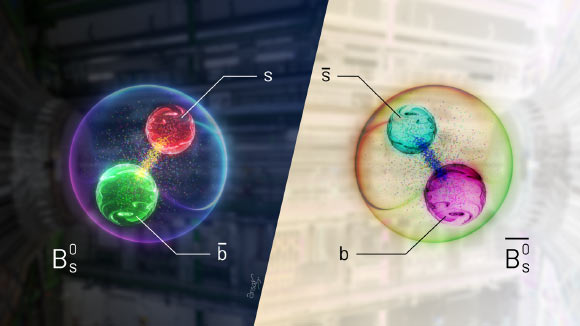
Physicists from the CMS Collaboration at CERN’s Large Hadron Collider (LHC) have enhanced a long-standing test of the delicate imbalance that enables our universe to exist, utilizing the largest sample ever of particles known as beauty mesons.
Beautiful neutral mesons can flip into their own antimatter or back to antimatter. Image credit: Ansar Iqbal/CMS.
One of the greatest mysteries in physics is the reason the universe consists almost entirely of the ordinary matter that forms us and everything we interact with.
Each matter particle has a corresponding antiparticle with identical mass but opposite charge. According to prevailing theories, the Big Bang should have produced nearly equal amounts of matter and antimatter; however, very little antimatter remains today.
A recent study by CMS physicists focuses on a potential explanation for this imbalance: a subtle difference in the behavior of matter and antimatter known as charge parity (CP) violation.
“The neutral beauty meson, which consists of a beauty antiquark and a down-type quark, is among the best candidates for investigating CP violation,” they stated.
This is due to a fascinating property of neutral mesons: they can spontaneously transform into their own antiparticles and back again.
By measuring the small differences in how frequently the matter and antimatter varieties of these particles decay over time, researchers can test the Standard Model with unprecedented accuracy.
The team analyzed proton-proton collision data from 2022 to 2025 and reconstructed specific decays of approximately 1.4 million B0 mesons containing down quarks and 16,000 B0s mesons containing strange quarks.
A significant challenge was identifying the type of each meson at its creation moment, prior to its decay into a J/ψ meson and a neutral kaon.
To accomplish this, scientists utilized advanced artificial intelligence-based algorithms.
This system integrates information from muons, electrons, jets, and, specifically for B0s mesons, nearby particles generated during the collision.
This greatly enhanced the experiment’s capability to ascertain the initial state of the meson compared to earlier analyses.
“The observed CP violations align with Standard Model predictions and include the most precise measurements to date of CP violations in B0s particles decaying to J/ψ mesons and neutral kaons,” the researchers commented.
_____
CMS Collaboration. 2026. Time-dependent CP violation in B0(s)→J/ψK0S decay measured with CMS detector. CMS-PAS-BPH-26-005
Source: www.sci.news