


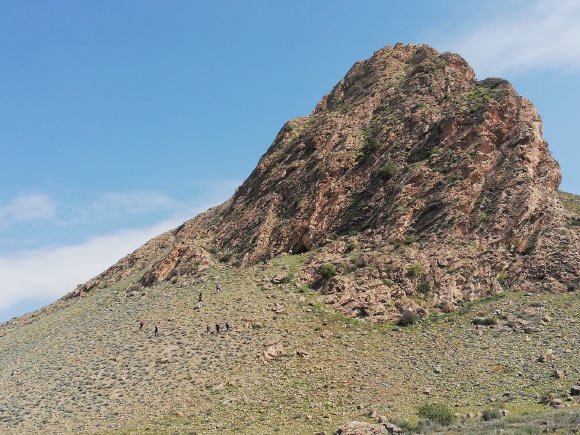
Ararat-1 Cave is a modest limestone formation situated at an altitude of 1,034 meters on the eastern side of Armenia’s Ararat Depression. This site has unveiled intriguing insights into how Middle Paleolithic humans navigated and interacted with their environment.
Dr. David Nora from the Hebrew University of Jerusalem commented, “The Caucasus region features diverse geography and ecosystems, fostering a complex environment for ancient human populations along with endemic flora and fauna.”
“With a rich archaeological history, the Middle Paleolithic era accounts for roughly 60% of over 450 Paleolithic sites identified in the region,” he elaborated.
“These sites encompass an array of locations, including caves, rock shelters, open-air sites, and isolated discoveries.”
“They are strategically situated amidst diverse landscapes such as river canyons, terraces, coastal peninsulas, mountain plateaus, hills, and lava domes.”
The recent study involved an analysis of 1,770 stone tools excavated from the Ararat-1 Cave, located northeast of Mount Ararat, dating back approximately 52,000 to 35,000 years, during the Upper Middle Paleolithic.
The findings revealed critical information about two raw materials: obsidian and chert.
Obsidian, a volcanic glass regarded as the primary stone resource of the region, exhibited signs of extensive reworking, shaping, and repair. This indicates that ancient toolmakers carried finished or partially finished obsidian fragments, maintaining them over time, with sources up to 200 kilometers away.
Conversely, chert tools were typically created on-site, with minimal evidence of long-term curation, suggesting they were locally sourced and quickly utilized.
This divergence is crucial, as archaeologists have long interpreted the balance between “select” versus “opportunistic” technologies as an indicator of group mobility.
Curated toolkits often imply frequent movement and a necessity for durable, versatile tools, while local toolkits suggest longer stays with minimal effort needed for replacement.
However, the Ararat-1 site presents a conundrum, showing traces of both high mobility and long-term habitation within the same archaeological layer.
“The Ararat-1 cave poses questions on interpreting the migratory patterns of the region,” the researchers noted.
“In the same sedimentary layer, we can observe two different mobility scenarios: one characterized by high mobility with obsidian assemblages and another indicating lower mobility with chert tools.”
“This duality raises questions about whether chert or obsidian deviates from typical technological strategies.”
To delve into this contradiction, scientists utilized an unusual evidence type—tiny fragments, often less than 2 centimeters, produced when sharpening or refurbishing tool blades.
Given that many Ararat-1 artifacts are smaller than 2 cm, a five-category system was developed to track this maintenance debris, providing direct evidence of tool upkeep, even in the absence of the tools themselves.
By examining both the maintenance debris and the distance traveled by obsidian, researchers propose that Ararat-1 served as a transit point rather than a permanent settlement. It appears to have functioned as a rest stop where groups would pause to repair and refresh their portable obsidian toolkits before utilizing nearby chert for immediate needs.
“Our research illustrates that ancient hunter-gatherers were adaptable and strategic thinkers,” stated Dr. Ariel Malinsky Buller of the Hebrew University’s Institute of Archaeology.
“They employed a diverse toolkit strategy, balancing long-range portable tools with readily accessible local resources. Caves like Ararat-1 served as essential hubs for resting, repairing equipment, and planning their next movements across challenging terrains.”
This study is published in the Quaternary Science Review.
_____
David Nora et al. 2025. The role of stone technology in shaping mobility and decision-making: The case of Ararat-1 cave. Quaternary Science Review 366: 109524; doi: 10.1016/j.quascirev.2025.109524
Source: www.sci.news