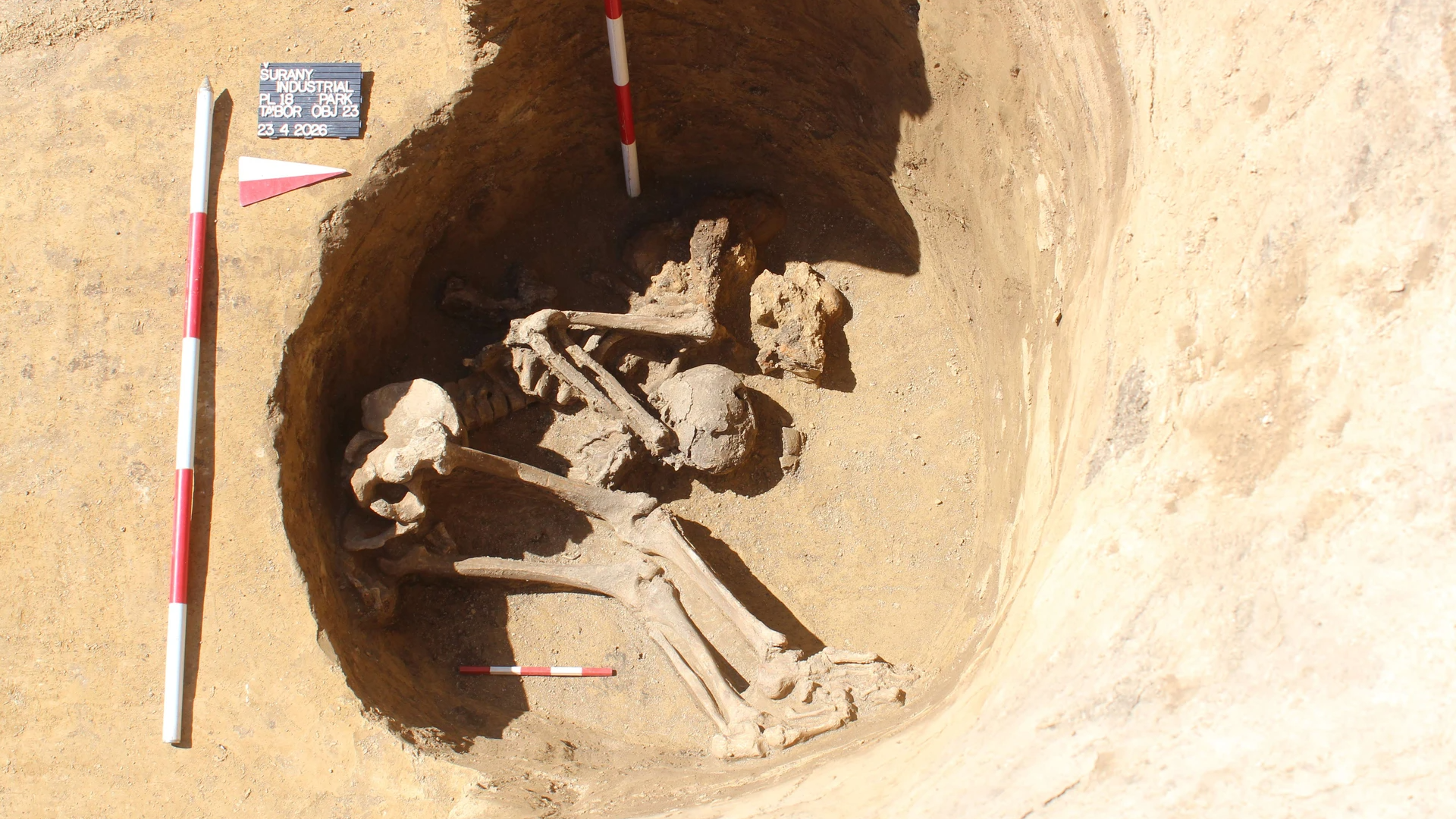
Archaeologists in Slovakia have unearthed a substantial Roman military camp, likely utilized by the armies of Marcus Aurelius during skirmishes with Germanic tribes in the latter half of the 2nd century. This “extremely unusual” camp has caught the attention of archaeologists, particularly due to the hasty burial of numerous soldiers in distinct tombs, which incorporated wells.
As reported on July 17, the remnants of the expansive 18.2-acre (7.4-hectare) camp were located near Szlany in southwestern Slovakia. According to a statement from MH Invest, the excavation was conducted in collaboration with the Institute of Archeology of the Slovak Academy of Sciences (SAS).
“We have a rare opportunity to explore nearly the entireRoman marching camp, which is exceptionally rare in Europe,” stated Matej Rutkaj, director of the SAS Institute of Archeology. “We are evidently investigating the site of a sudden disappearance shortly after military conflicts between the Romans and Germans.”
From 166 to 180 AD, the Romans were embroiled in multiple battles against the Marcomanni, a Germanic tribe located north of the Danube River, which borders present-day Slovakia and the Czech Republic. Roman Empire leader Marcus Aurelius, who ruled from 161 to 180, led his forces in the Marcoman Wars, aimed at fortifying Rome’s borders against barbarian invasions. Notably, historians of the 3rd century recounted that the conflict concluded after Aurelius’s death when his son Commodus brokered peace with the Marcomanni, as noted by Cassius Dio.
The newly uncovered Roman military camp featured various defensive elements, including five entrance gates, fortifications, and systems of curved ditches and ramparts typical of marching and legionary camps. Remarkably, the Šlanj camp is only the second Roman military installation discovered in western Slovakia, following a previously discovery made in 2024, where it is believed that Marcus Aurelius penned some of his meditations.
The statement revealed that archaeologists were astonished by the significant quantity of human bones and remains unearthed in ditches, wells, and hastily dug shallow graves at the Šlanj camp.
“Preliminary findings suggest that most of these remains belong to Roman soldiers,” noted Marek Wojtekuk from the SAS Institute of Archeology. “Numerous artifacts, including weapons and military gear, have also been discovered alongside the skeletons, such as spears, arrowheads, helmet fragments, segmented and scaled armor, legionary brooches, coins, and unique weapons. Notably, a military sandal called Karigae was found, with preserved iron nails on its sole,” he explained.
X-ray examinations of the clay block confirmed that the nails of the sandal are intact and now reside in a specialized lab at the SAS Institute of Archeology for further study. “Seeing the original specimen is a wonder,” added Michal Cheben, further emphasizing that the size of the sandal can also be determined.
Cheben explained that the unusual burial practices raise critical questions concerning the use and eventual abandonment of the Roman military camp, such as whether soldiers succumbed to battle injuries or disease, and why their remains were not looted prior to burial or disposed of in a storage pit or well. “Subsequent laboratory and genetic analyses may yield further insights,” Cheben stated.
Given the camp’s vast size and the plethora of artifacts, a thorough investigation of the site will require several years, involving carbon dating, soil assessments, isotope analysis, and the expertise of international antiquity specialists. DNA analysis is part of the proposed study, as outlined in the statement.
“This is a lengthy undertaking, thus many findings will only become apparent over the next few years,” noted Latkei.
From Augustus to Nero, test your knowledge about ancient Rome’s renowned leaders in this article. Roman Emperor Quiz!