


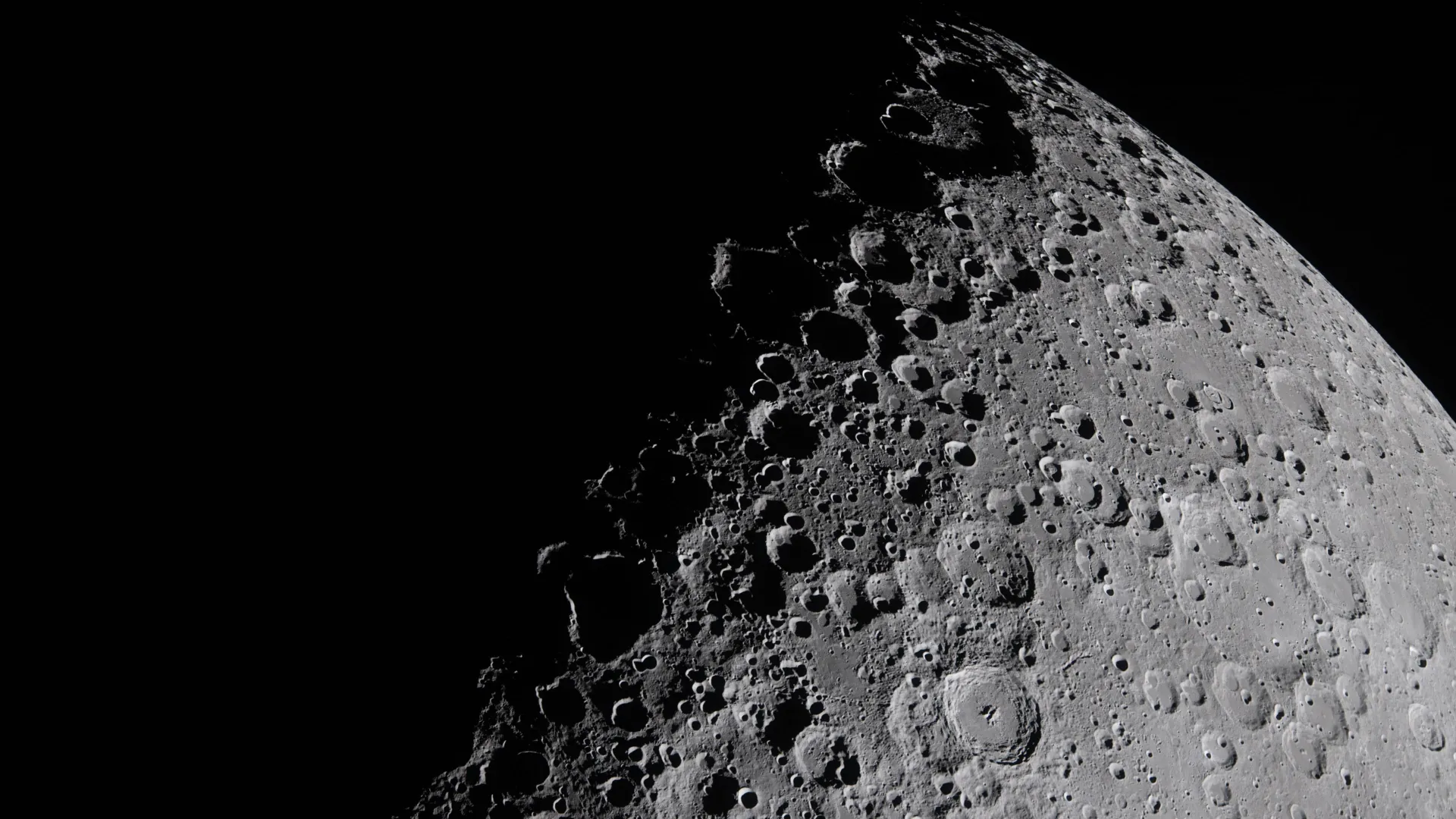
Scientists may be able to detect and map water ice buried beneath the moon’s surface by studying how seismic waves travel through the lunar ground.
Researchers from the University of Maryland, Lawrence Berkeley National Laboratory and the University of Hawaii found that seismic waves—the vibrations measured during earthquakes—could reveal hidden deposits of lunar ice beneath the surface.
Lunar Ice Could Support Future Moon Missions
The findings, published in Science Advances on July 31, 2026, come as space agencies prepare for a new era of lunar exploration. NASA’s Artemis program plans to send astronauts to the moon’s south polar region in 2028, where permanently shadowed craters could contain significant deposits of water ice.
For future astronauts, lunar ice could be an essential resource. After being melted and purified, it could provide drinking water. Electricity could also split the water into oxygen for breathing and hydrogen for rocket fuel. Using locally sourced water would reduce the supplies that missions must transport from Earth.
“It’s crucial to identify any materials on the moon that an astronaut can make use of while they’re up there,” said Nicholas Schmerr, an associate professor in UMD’s Department of Geological, Environmental, and Planetary Sciences and a co-author of the study. “Since they will be limited by the few resources they brought from Earth, anything they find on the moon will help them basically live off the land, especially for longer-term missions or outposts.”
Satellites Cannot See Deep Underground
Scientists do not yet know how much water ice exists on the moon or where most of it is buried. Although orbiting spacecraft can scan the lunar surface, their instruments primarily detect materials in the uppermost layer of lunar soil.
Some lunar ice deposits may lie much deeper underground, beyond the reach of orbital observations. The new research suggests that seismic monitoring could help locate these hidden deposits and estimate their size.
Frozen and dry lunar soil respond differently when seismic waves pass through them. Ice increases the stiffness of the surrounding material, allowing vibrations to travel two to three times faster than they do through dry soil.
Ice-rich layers can also reflect seismic energy rather than allowing it to pass through the ground. This process is similar to sound bouncing off a wall and creating an echo. According to Schmerr, a seismometer positioned in the right location on the moon could detect both changes.
“We can use seismic waves to not just see whether ice is present but also roughly how much of it there is,” he explained.
Testing the Seismic Signature of Lunar Ice
The research team tested the potential method using three complementary approaches.
Lead author Harrison Lisabeth (Ph.D. ’16, geology), a rock physicist at Lawrence Berkeley National Laboratory and UMD alum, studied volcanic rock from Arizona. When crushed, the rock closely resembles lunar dust. Lisabeth froze the material and used X-rays to examine how ice formed in the tiny spaces between individual grains.
Co-author Matthew Siegler of the University of Hawaii developed detailed temperature models for the moon’s south polar region. The models helped identify craters that have remained cold enough to preserve water ice for billions of years.
At UMD, Schmerr used computer simulations to model small moonquakes moving through underground lunar ice deposits. All three methods showed that ice creates distinct and measurable changes in seismic signals.
Lunar Ice May Preserve Ancient Solar System History
Lunar ice could provide valuable resources for astronauts, but it may also preserve evidence about the early history of the solar system.
Deeply shadowed craters near the lunar poles can trap water and other volatile materials for extremely long periods. Because the surrounding rocks are approximately four billion years old, the ice preserved in these locations could reveal how water moved through the early solar system.
“The moon witnessed some of the most critical parts of the early solar system, including how water was delivered,” Schmerr said. “Studying the ice deposited there could reveal how water spread and ultimately how Earth’s oceans formed.”
Upcoming Lunar Missions Could Test the Method
Researchers may soon be able to compare their seismic predictions with measurements collected directly on the moon.
China’s Chang’e-7 mission is expected to land near Shackleton Crater in late 2026. The mission will carry a seismometer, and several suspected lunar ice deposits are located nearby.
NASA’s Artemis astronauts could also deploy the Lunar Environmental Monitoring Station in 2028. Schmerr helped develop the instrument for seismic exploration on the moon.
“Our findings are laying the groundwork for an observation we’ll get in the next couple of years,” Schmerr said. “No one has physically measured the ice on the moon yet, but we now have a prediction for what to look out for. That’s an important first step.”
This research was funded by the U.S. Department of Energy Office of Science, Office of Basic Energy Sciences, Chemical Sciences, Geosciences, and Biosciences Division (Contract No. DEAC02-05CH11231), and the NASA Solar System Exploration Research Virtual Institute CLEVER project (Grant No. GR00024738) and GEODES project (Grant No. 80NSSC19M0216). This article does not necessarily reflect the views of these organizations.
Source: www.sciencedaily.com