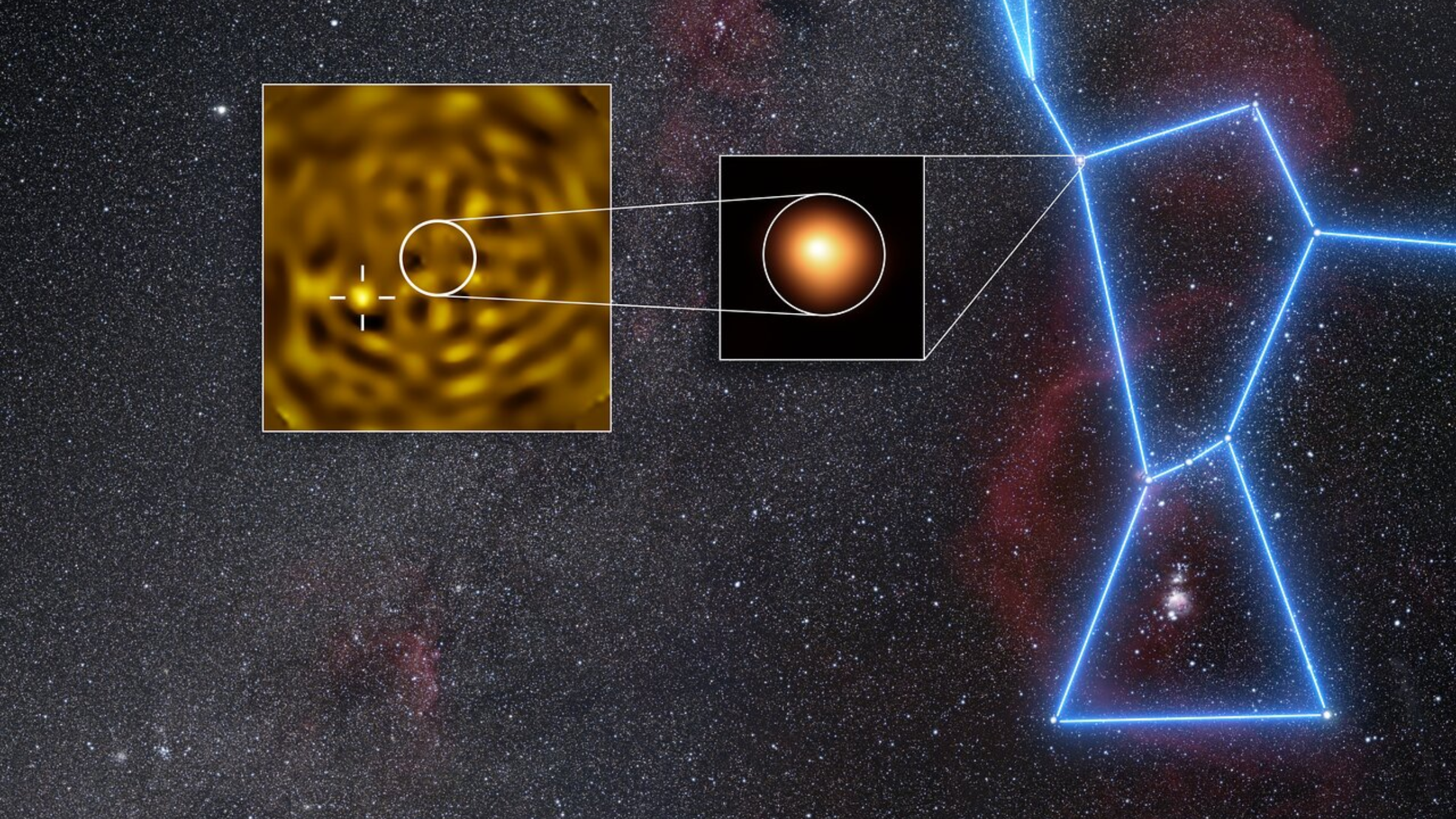
Betelgeuse May Have a Hidden Companion Star, Astronomers Say
Betelgeuse, the brilliant red star marking Orion’s shoulder, may not have been alone after all. Astronomers have captured the clearest evidence yet of a faint companion star orbiting close to the famous red supergiant.
Astronomers say the observation provides the strongest evidence so far that Betelgeuse has a stellar companion. The discovery was announced by the European Southern Observatory (ESO) on Tuesday, July 28, and described in a new study published in Astronomy & Astrophysics.
Betelgeuse’s unusual six-year brightness cycle
Betelgeuse is usually among the 10 brightest stars visible from Earth. The red supergiant naturally expands and contracts during a roughly 400-day pulsation cycle, according to NASA. These changes cause Betelgeuse to brighten and fade over time.
For decades, however, researchers have also observed a slower variation in the star’s brightness and motion. This secondary pattern repeats approximately every six years, outside Betelgeuse’s regular 400-day cycle.
Two independent research teams investigated the long-term variation using decades of brightness measurements and stellar-velocity data. One team was led by Harvard University astrophysicist Morgan MacLeod, while the other was led by Jared Goldberg, a postdoctoral researcher at the City University of New York.
Both teams reached the same conclusion: Betelgeuse’s long-term wobble and brightness pattern could be caused by a previously unseen companion star orbiting extremely close to the red supergiant’s swollen outer layers.
Their models predicted that the companion might move far enough from Betelgeuse in December 2024 to become visible with powerful ground-based telescopes.
Very Large Telescope detects possible Betelgeuse companion
In December, a team led by Paris Observatory astronomer Miguel Montargès pointed the European Southern Observatory’s Very Large Telescope toward Betelgeuse. After months of analyzing the observations, the researchers identified what appears to be a nearby companion star, informally nicknamed Betelgeuse B.
“The fact that we can still discover a nearby companion, more massive and brighter than the Sun, around such a well-studied star is remarkable,” Montargès said in an ESO statement. “These are among the best moments in science: seeing something new and unexpected.”
Betelgeuse B may be more massive than expected
The suspected companion star was also more massive than scientists initially predicted. Earlier estimates suggested that Betelgeuse B might have a mass similar to the Sun. The new observations indicate that it could be two to three times more massive than our star, making it brighter and potentially easier to detect.
Researchers say another observation is still needed to confirm the discovery. The team hopes to photograph the object again in about a year, when it should appear on the opposite side of Betelgeuse. A second image would help prove that the faint object is truly orbiting the red supergiant rather than being an unrelated background star.
Could the companion affect Betelgeuse’s future?
If confirmed, the companion star could change how astronomers understand Betelgeuse’s evolution. As a red supergiant, Betelgeuse is approaching the final stage of its stellar life and will eventually explode as a supernova. However, predicting when that explosion will occur remains extremely difficult.
Astronomers are now investigating whether Betelgeuse B could influence the red supergiant’s development, mass loss or eventual supernova. “The question is whether this companion is going to have an impact on the evolution of the red supergiant,” Montargès said.
De Ugarte Postigo, A., Фатхуллин, Т. А., Jóhannesson, G., Gorosabel, J., Соколов, В. В., Castro‐Tirado, A. J., Balega, Y. Y., Spiridonova, O. I., Jelínek, M., Guziy, S., Pérez-Ramírez, D., Hjorth, J., Laursen, P., Bersier, D., Pandey, S. B., Bremer, M. N., Monfardini, A., Huang, K. Y., Urata, Y., . . . Трушкин, С. А. (2006). Extensive multiband study of the X-ray rich GRB 050408. A likely off-axis event with an intense energy injection. Max Planck Digital Library.