


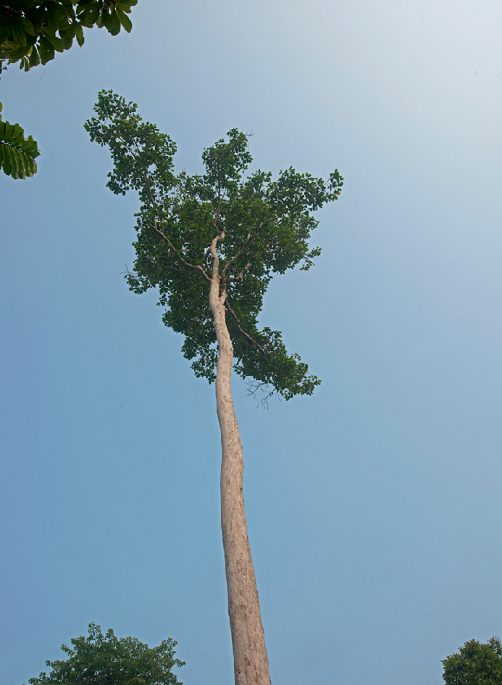
How do the world’s tallest tropical trees transport water to their highest leaves? A recent study published in Science by Paulo Bittencourt of Cardiff University and colleagues investigated this question in five species of dipterocarp—the tallest flowering trees and a dominant feature of Southeast Asian rainforests.
The researchers measured hydraulic traits at multiple locations on trees ranging from 7.7 to 71 meters tall. They also tracked trunk growth before, during, and after the severe 2023–2024 El Niño drought. The findings showed that water-conducting tissues expanded from branch tips toward the trunk quickly enough to offset the increased resistance caused by longer transport distances. Although leaf water potential declined in the upper canopy as tree height increased, the leaves also became more drought-tolerant. Consequently, taller trees experienced less growth reduction than shorter trees during and after the drought.
These results challenge the assumption that extreme height makes giant trees more vulnerable to hydraulic stress. Instead, the tallest dipterocarps appear to counteract gravity and long water-transport pathways by adapting their wood anatomy and leaf function. The study also suggests that canopy conditions may influence tree hydraulic properties more strongly than height alone, offering new insight into how tropical rainforests respond to drought and climate change.
Source: www.nature.com