


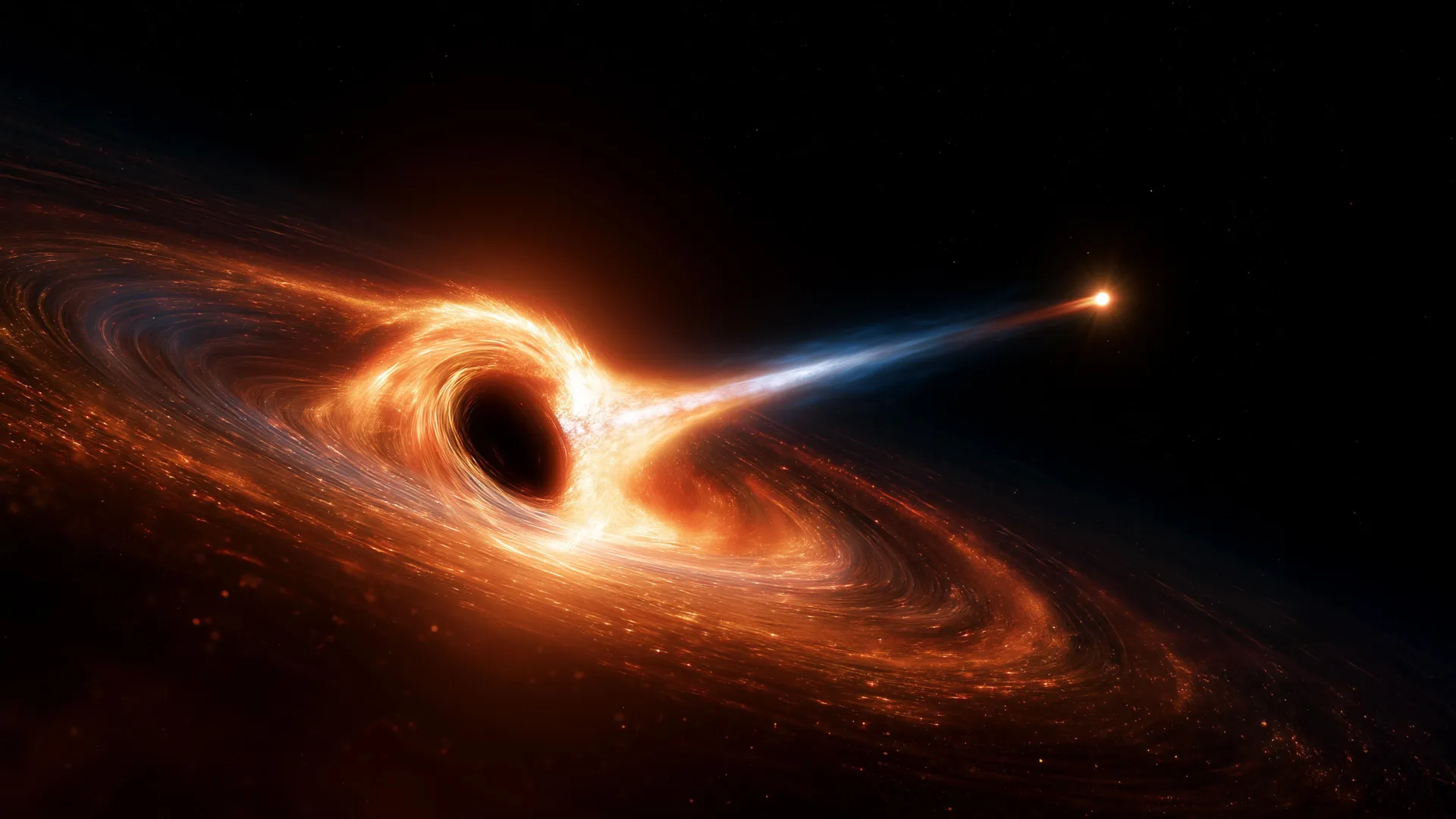
Astronomers have compared a spectacular tidal disruption event—in which a giant star was torn apart and gradually consumed by a black hole—to “preparing a lunch snack.”
Astronomers around the world observed this rare black hole encounter, which was announced at the American Astronomical Society conference in Phoenix, Arizona. Researchers explained that the star was ripped apart by the black hole’s immense gravitational force, with its material consumed piece by piece.
Daniel Perley, an associate professor of astrophysics at Liverpool John Moores University, is the lead author of a study published in Monthly Notices of the Royal Astronomical Society. “We have discovered what we believe to be a black hole merging with a massive companion star and shredding it into a disk that feeds the black hole. This is a rare and awe-inspiring phenomenon,” he told the conference.
The destruction triggered one of the most powerful cosmic events ever recorded. Although the event was relatively short-lived, it released approximately 400 billion times the energy produced by the Sun, surpassing even the most powerful supernova known to astronomers.
Black hole swallows giant star
Astronomers have previously observed black holes apparently consuming stars in events known as tidal disruption events. However, researchers had never witnessed such an encounter occurring on this enormous scale.
Perley and study co-author Anna Ho, an assistant professor of astronomy at Cornell University, identified the extraordinary event shortly after its light reached Earth. Ho detected the object using the Zwicky Transient Facility at Palomar Observatory in California. The event was officially designated AT2024wpp and nicknamed the Whippet.
Researchers quickly suspected that the event could be a luminous fast blue optical transient, or LFBOT—a rare and poorly understood type of cosmic explosion associated with the destruction of stars. Within a day, observations from the Liverpool Telescope in the Canary Islands and NASA’s Swift satellite confirmed that the object had the expected characteristics of an LFBOT. It appeared unusually blue and emitted powerful X-rays.
Distance measurements provided by co-authors R. Michael Rich of UCLA and Yu Jing Qin of the California Institute of Technology showed that the transient released far more energy than a typical supernova. Combined with other observations, including its unusually high temperature, the findings led researchers to conclude that they were witnessing a giant star being torn apart and swallowed by a black hole.
“We had our suspicions about what it was, but it was still unusual,” Perley added. “This event was many times more energetic than similar events and more powerful than any known explosion caused by the collapse of a star.”
“These events not only help us identify black holes, but also provide new ways to understand where black holes originate, how they form and grow, and the physics behind these extreme processes,” Perley added.
A shock wave travels through the surrounding gas
Additional studies of AT2024wpp revealed that the event generated a powerful shock wave that moved outward through dense surrounding gas at approximately one-fifth the speed of light. After about six months, however, the shock wave appeared to suddenly “disappear.”
Material stripped from the star formed a disk around the black hole and became extremely hot as it spiraled inward. This process generated X-rays and powerful outflows of gas. The outflow collided with material the star had expelled before its destruction, producing the bright blue and ultraviolet radiation observed during the first few days. It also created radio and millimeter-wave signals detected by astronomers.
Researchers believe the shock wave appeared to vanish when it reached the outer edge of a bubble formed by gas previously expelled by the doomed star.
Strange signals emerge from the aftermath
One puzzling mystery remains. Observations from the Keck Observatory, Magellan Observatory, and the Very Large Telescope revealed no clear chemical signatures during the first month after the explosion. As the event began to fade, however, faint signs of hydrogen and helium emerged.
The helium signal offered an especially unexpected clue. The gas was moving along our line of sight at more than 6,000 kilometers per second, suggesting that a dense structure may have survived the initial explosion and is now traveling rapidly toward Earth.
Researchers speculate that the signal may have originated from a stream of material ejected from the star’s core as the black hole’s immense gravity tore it apart. A more speculative possibility is that the material came from a third object in the system and was blown away by a high-velocity wind of particles and X-ray radiation generated by the feeding black hole.
Source: www.sciencedaily.com