


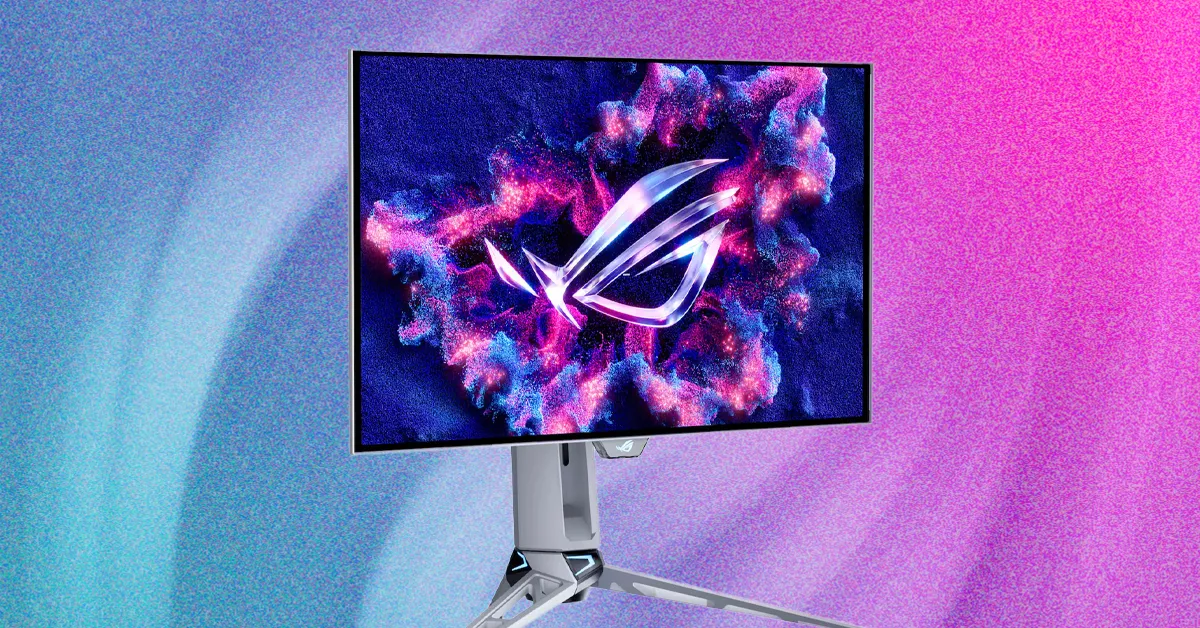
The Asus ROG Swift PG27UCWM delivers impressive color performance and image quality, even though its measured gamut is slightly narrower than that of the best QD-OLED monitors. The panel covers 94 percent of the DCI-P3 color space and 89 percent of AdobeRGB, compared with up to 98 percent and 95 percent, respectively, on leading QD-OLED displays.
In practice, the PG27UCWM’s ultra-clear image, deep contrast, and vibrant colors make a strong visual impact. Its RGB-striped OLED panel also improves color volume, allowing the monitor to maintain brighter, more saturated colors across a wider portion of its color gamut. As a result, the monitor’s overall image quality competes with the best OLED gaming monitors available.
However, the glossy screen coating produces mirror-like reflections. In bright conditions, the display can reflect its surroundings so clearly that it almost doubles as a shaving mirror. Reflections are manageable in a dark room but remain noticeable even with moderate ambient lighting.
This is an important consideration for anyone shopping for an OLED monitor. Many OLED enthusiasts prefer glossy screens because they enhance perceived contrast, black levels, and color vibrancy. Others, myself included, prefer a matte finish that minimizes distracting reflections.
Neither option is universally better, so consider your room lighting and personal preferences before buying the Asus ROG Swift PG27UCWM.
Excellent 4K Sharpness and Impressive HDR
Under its glossy coating, the PG27UCWM uses a tandem RGB-striped OLED panel with a native 3840 x 2160 4K resolution. Earlier OLED monitors often relied on unconventional subpixel layouts that could reduce text and image sharpness. The PG27UCWM uses a more traditional RGB subpixel arrangement, helping eliminate those concerns.
This panel technology is sometimes marketed as “fifth-generation QD-OLED,” although it first appeared in 34-inch monitors such as the Alienware AW3426DW. The PG27UCWM brings the technology to a more practical 27-inch display format.
Text clarity has long been one of the biggest concerns when choosing an OLED monitor, but the PG27UCWM performs extremely well in this area. Its 4K resolution produces a pixel density of approximately 165 pixels per inch across the 26.5-inch panel. Text and fine details looked sharp when I connected the monitor to both a Windows 11 desktop and an Apple MacBook Air with the M4 chip.
HDR is where the PG27UCWM’s tandem OLED panel really stands out. During testing, the monitor reached approximately 800 nits of brightness. That is not a record-breaking result, but it matches the performance of many premium OLED monitors, which typically reach between 800 and 900 nits. The brightest models I have tested only barely exceed 1,000 nits. The PG27UCWM also supports the relatively uncommon Dolby Vision HDR format.
The combination of 4K resolution, OLED contrast, and high brightness gives HDR games genuine visual impact. Bright highlights can appear intensely vivid and occasionally overwhelming. Fortunately, Asus includes an HDR brightness adjustment that lets you reduce the intensity when necessary.
That said, the Asus PG27UCWM is not the brightest HDR monitor on the market. The Alienware AW3426DW, Acer Predator X27 X1, and the MSI MPG 32URXW delivered similar HDR brightness in my testing, although some comparable monitors cost considerably less.
Even so, the PG27UCWM offers a substantially better HDR experience than budget OLED monitors such as the entry-level Alienware AW2726DM, which reaches only about 400 nits in HDR.
Sharp, Fluid Motion at 4K and 240Hz
Photo: Matthew S. Smith
The PG27UCWM supports a 240Hz refresh rate at its full 4K resolution, making it a strong choice for high-end PC gaming. This refresh rate has become standard among premium 4K OLED gaming monitors in 2026.
Asus also includes a dual-mode feature that reduces the resolution to 1080p in exchange for refresh rates of up to 480Hz. This mode is especially useful for competitive gamers who prioritize maximum responsiveness and motion clarity over 4K detail. Although dual-mode OLED monitors remain less common, an increasing number of gaming displays now offer the same flexibility.
Source: www.wired.com