


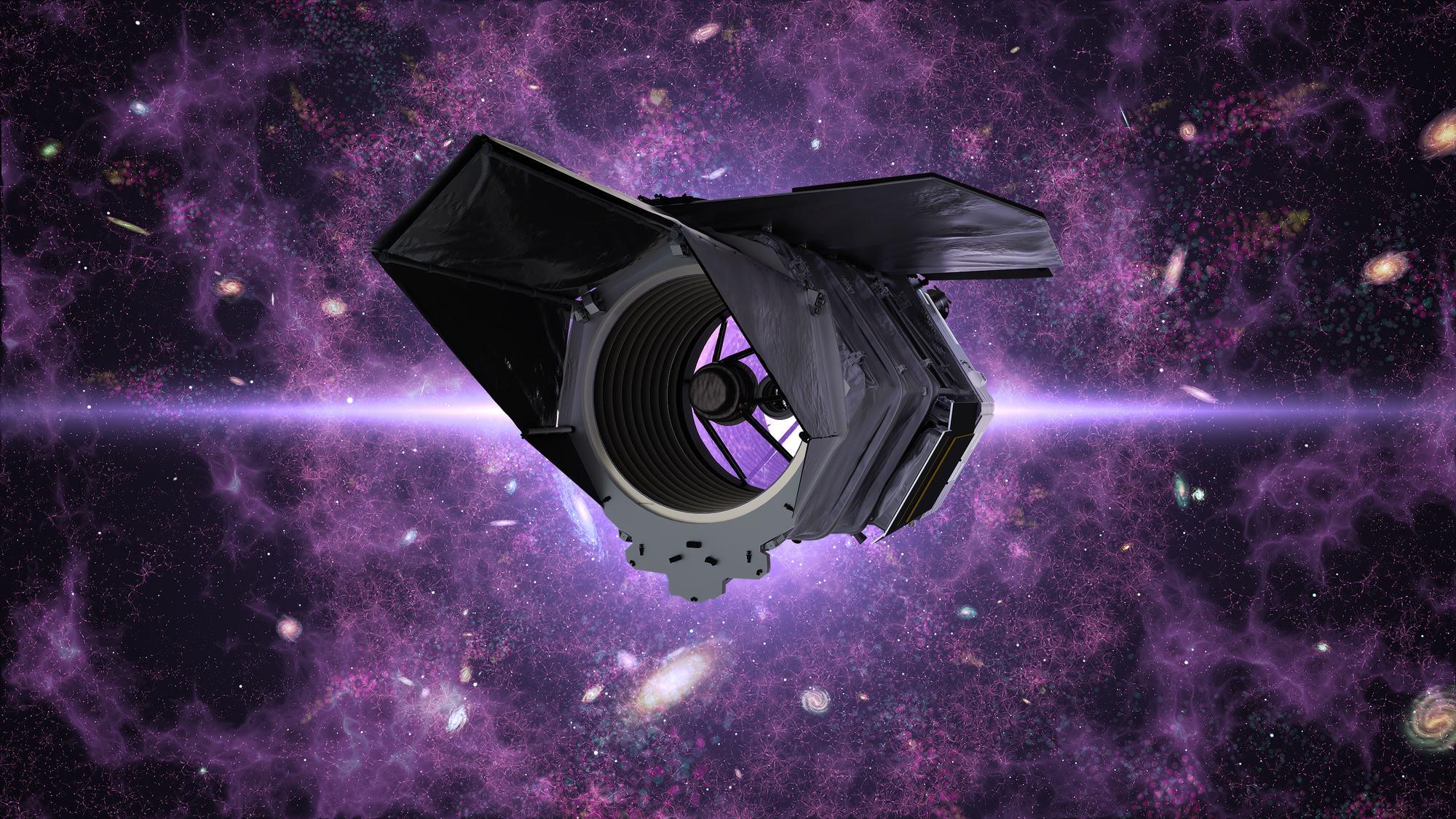
NASA’s Nancy Grace Roman Space Telescope, scheduled to launch on Sunday, August 30, will give astronomers an unprecedented view of the universe. The mission is designed to investigate dark energy, dark matter, exoplanets beyond our solar system, and the formation and evolution of galaxies across cosmic time. Researchers at NASA’s Ames Research Center in California’s Silicon Valley are contributing advanced software, technology, supercomputing expertise, and mission support to help maximize Roman’s scientific discoveries.
Advanced software to predict and remove telescope glare
Roman’s primary camera, the Wide Field Instrument, will capture enormous, high-resolution images of the universe in optical and near-infrared light. These wide-field observations will help scientists investigate some of astronomy’s most important unanswered questions.
However, unwanted glare and scattered light can reduce image quality and make it more difficult to study faint cosmic structures. To address this challenge, researchers at NASA Ames, NASA’s Goddard Space Flight Center in Greenbelt, Maryland, and IPAC/California Institute of Technology in Pasadena, California, developed innovative image-processing software called ROSALIA, or Roman Sky Analyst for Low Surface Brightness Imaging and Astronomy.
ROSALIA predicts and removes unwanted light from images captured by Roman’s Wide Field Instrument. The software will also help astronomers optimize observation plans and reduce the impact of glare on important scientific targets.
Stray light occurs when photons scatter inside a telescope’s optical system. This unwanted glow can create image artifacts that resemble real planets, nebulae, or other astronomical objects. By modeling these effects in advance, ROSALIA can help scientists distinguish genuine celestial features from contamination caused by the telescope.
Stray light can also form a diffuse background that hides the faintest regions of the universe. Studying these dim areas is essential for understanding how large-scale cosmic structures formed and evolved.
Another source of background light is zodiacal light, a natural glow created when sunlight scatters off dust particles between the planets. ROSALIA will help predict and remove contamination from zodiacal light and other sources, allowing astronomers to detect faint, diffuse emissions around the edges of galaxies. These observations could reveal valuable clues about the history and evolution of the universe.
Multistar technology could improve exoplanet imaging
Roman’s coronagraph is one of the telescope’s two scientific instruments and will demonstrate some of the most advanced space-based technology ever developed for directly imaging planets around other stars. The instrument uses a series of masks and mirrors, including two deformable mirrors, to block intense starlight.
By precisely changing the shape of the deformable mirrors, the coronagraph creates a dark zone around a star. This allows astronomers to search for the much fainter reflected light of planets orbiting that star.
The Roman coronagraph’s baseline operating mode is designed to observe exoplanets in single-star systems. Most current coronagraphs cannot sufficiently suppress additional starlight from multiple stars, including binary systems.
Although our solar system has one star, the Sun, approximately half of Sun-like stars are part of multistar systems. The ability to directly image exoplanets in these systems could increase the chances of finding signs of life beyond our solar system. It could also improve scientists’ understanding of how planets form and evolve, since planetary systems around single stars and multiple stars can develop in significantly different ways.
NASA Ames researchers are addressing this challenge with an advanced technology called multistar wavefront control, or MSWC. The system combines a custom shading mask with specialized software to suppress light from multiple stars and reveal otherwise hidden exoplanets.
In collaboration with NASA’s Jet Propulsion Laboratory in Southern California, the MSWC mask is being incorporated into the Roman Coronagraph flight instrument as an additional capability beyond the mission’s baseline observation mode. The technology could be used if the coronagraph team receives additional observation time after the primary technology demonstration is complete.
Alpha Centauri, the closest star system to our solar system, is a nearby multistar system located approximately four light-years from Earth. This triple-star system includes Alpha Centauri AB, a Sun-like binary pair, and Proxima Centauri, a smaller and fainter star.
Although no exoplanets have been confirmed around the Sun-like stars in the Alpha Centauri system, NASA’s James Webb Space Telescope has identified a planet candidate in the habitable zone of Alpha Centauri A. Researchers, including members of the NASA Ames MSWC team, are developing the tools needed to study this nearby system and search for planets around its stars.
NASA Ames also leads and supports the hardware working group for the Roman Coronagraph Participation Program. This international collaboration is developing capabilities that go beyond the coronagraph’s baseline mode, including multistar observations, new optical masks, and advanced wavefront-control and detection algorithms.
High-performance computing supports Roman’s mission
Experts from NASA Ames’ Advanced Supercomputing Division bring extensive experience in data pipelines, high-performance computing, and mission operations to the Nancy Grace Roman Space Telescope project. Their guidance throughout key stages of mission development will help ensure reliable ground systems, efficient scientific data processing, and high-quality data products.
NASA Advanced Supercomputing researchers also worked with the Ames MSWC team to develop high-performance computing tools for multistar wavefront-control simulations. These simulations helped researchers evaluate the feasibility and performance of MSWC technology for future exoplanet observations.
Learn more:
Nancy Grace Roman Space Telescope Mission:
For news media:
Roman media resources: Roman Media Resources
Members of the media interested in reporting on NASA’s Roman Space Telescope, exoplanet imaging technology, or NASA Ames research should contact the NASA Ames Newsroom.
Source: www.nasa.gov