


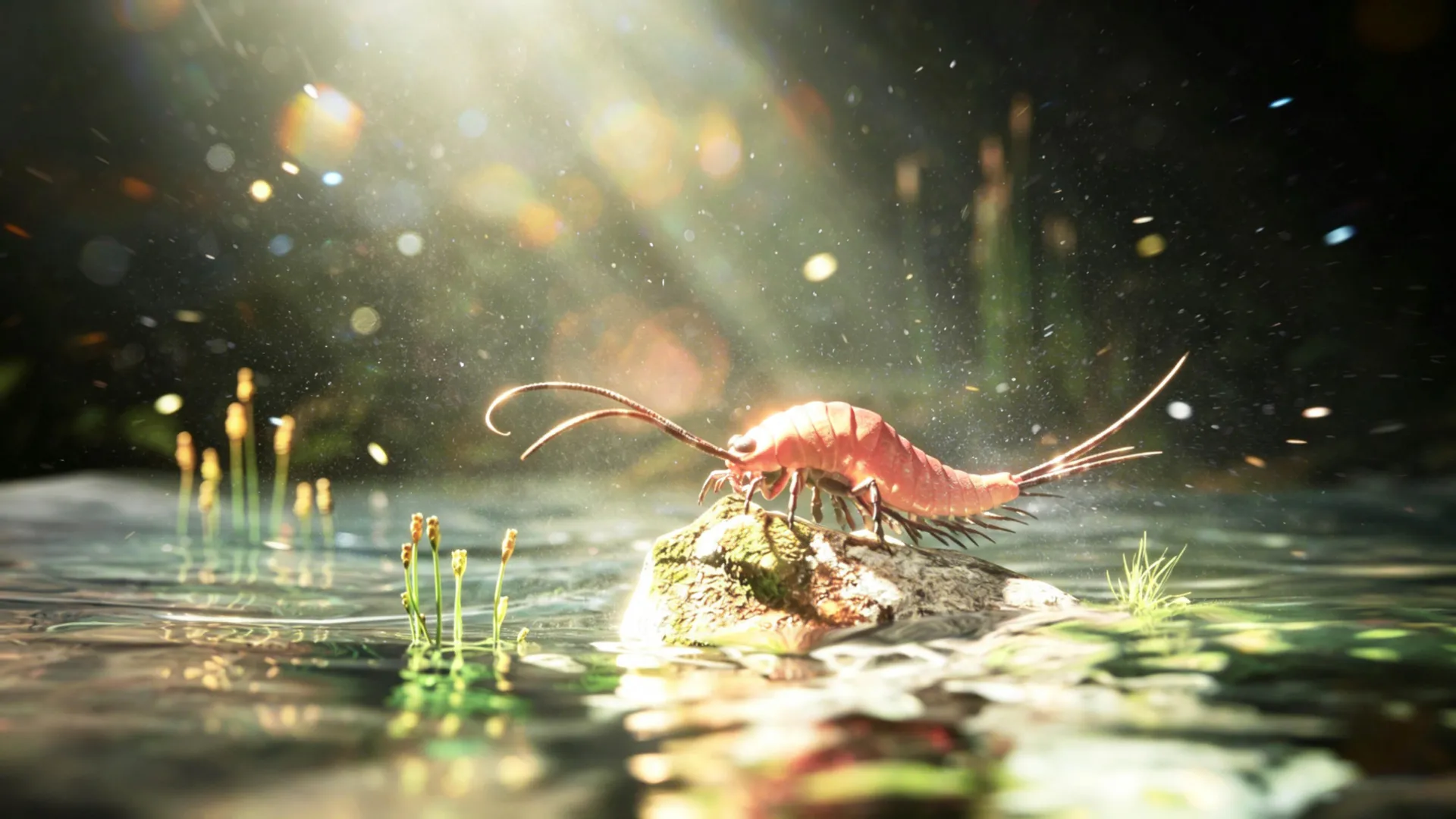
The emergence of complex terrestrial ecosystems marked a major turning point in the history of life. As organisms expanded beyond the oceans, land environments became home to increasingly diverse communities. Insects, now the most species-rich group of animals on Earth, eventually became central to these ecosystems. However, important details about their early transition from water to land have remained uncertain.
An international research team has identified a stem-group insect that lived approximately 324 million years ago during the Late Mississippian. By examining this fossil alongside other enigmatic specimens from the Early Devonian and Late Carboniferous, the researchers reconstructed key stages in the early evolution of insects.
The findings suggest that insects did not become fully terrestrial immediately after colonizing land. Instead, early insects retained and modified traits inherited from aquatic ancestors, spending long periods in semi-aquatic or amphibious environments.
The research was led by Professor Chenyang Cai and doctoral researcher Erik Tihelka of the Nanjing Institute of Geology and Paleontology, Chinese Academy of Sciences, in collaboration with researchers from the University of Cambridge, the United States, Spain, and other countries.
The study was published in Nature on August 26.
New insect species from 324 million years ago
Researchers described a new fossil species from the Late Mississippian and reassessed mysterious stalked insects from Early Devonian chert deposits in the United Kingdom and the Late Carboniferous Mason Creek biota in the United States.
These fossils help fill major gaps in the early fossil record of insects. They also challenge long-standing ideas about how insect body plans evolved and how pancrustacean ancestors adapted to life on land. Most importantly, the specimens provide direct fossil evidence that the transition from aquatic to terrestrial environments occurred gradually.
Molecular clock studies indicate that hexapods diverged from their marine crustacean relatives and began adapting to terrestrial habitats as early as the Cambrian or Ordovician periods. However, the fossil record from this critical interval is incomplete.
Undisputed hexapod fossils first appear in the Early Devonian Rhynie cherts, approximately 405 million years ago. Clearly recognizable insect fossils do not become abundant until the Late Carboniferous, leaving an approximately 80-million-year gap in the fossil record.
Fossils documenting intermediate stages are particularly rare. Scientists have had limited direct evidence showing how early insects moved from aquatic and semi-aquatic habitats into terrestrial environments or how their bodies changed during this transition. Consequently, the evolutionary pathways, anatomical innovations, and ecological adaptations involved in insect terrestrialization have remained poorly understood.
Fossil insect was once mistaken for a crustacean
The newly described fossil was discovered in calcareous claystone concretions from the Tesnus Formation of the Marathon Uplift in West Texas. These deposits preserve exceptionally detailed anatomical features.
Using cross-polarized light imaging, researchers identified distinctive characteristics that showed the fossil had been misclassified for many years. The specimen was an adult female insect rather than a crustacean larva.
The body measured 32.09 millimeters in length. Including the central caudal filament and two cerci, its total length reached 49.66 millimeters. Its streamlined, spindle-shaped body combined insect-like characteristics with features inherited from more primitive pancrustacean ancestors.
Detailed analysis revealed that the fossil had an ovipositor, a terminal tail filament, a segmented body, and six walking legs—the fundamental body features associated with insects.
However, its abdomen contained a far more unusual feature.
Segments one through nine each possessed segmented appendages, while the posterior abdominal limbs had evolved into paddle-like structures. Modern crown-group insects have no comparable abdominal appendages.
Geological reconstructions indicate that the fossil-bearing sediments formed in a coastal setting, probably within a shallow delta near the shoreline. Combined with the animal’s anatomy, this evidence suggests that the insect lived an amphibious, semi-aquatic lifestyle in humid habitats along the boundary between water and land.
Fossils help bridge the 80-million-year insect gap
The research team also reassessed three enigmatic Paleozoic hexapods, comparing their anatomy and evolutionary relationships in detail. These included an Early Devonian species from Scotland, an unnamed hexapod from the Mason Creek biota of Illinois, and the newly described Late Mississippian fossil.
The researchers concluded that all three species belonged to the primitive stem lineage of insects.
Together, these fossils represent some of the oldest known insect relatives and help fill a major gap in the evolutionary history of insects.
The discovery could significantly change scientific understanding of how terrestrial insects originated and diversified. It pushes the earliest known diversification of insects into the Early Devonian and Late Carboniferous, helping close the long-standing 80-million-year gap in the hexapod fossil record.
This revised timeline is more consistent with estimates from molecular clock studies. The newly recognized Late Mississippian fossil also provides a rare snapshot of an intermediate stage in insect evolution.
How did insects lose their abdominal limbs?
The fossil sheds light on another major evolutionary development: the emergence of the modern insect body plan.
Modern hexapods have six walking legs attached to the thorax, while abdominal appendages are almost entirely absent. Many Paleozoic stem-group insects were different, retaining limbs along much of the abdomen.
The new evidence suggests that the gradual reduction of abdominal appendages was an important adaptation during the transition to life on land.
As insects evolved away from their crustacean ancestors, swimming and respiratory appendages were gradually simplified and lost. Over time, this process produced the body arrangement characteristic of modern insects.
These fossils therefore record an important anatomical transition from pancrustacean ancestors to terrestrial hexapod insects.
Another significant feature preserved in the fossil is its ovipositor. Its presence indicates that early insects had already evolved specialized adaptations for laying eggs. Such structures may later have helped insects exploit a wide range of terrestrial microhabitats and contributed to their extraordinary diversification.
Early insects lived between water and land
Researchers also reconstructed the likely ecology of these ancient insects.
Early stem-group insects appear to have combined aquatic adaptations for movement and respiration with body structures increasingly suited to terrestrial life. They may have fed on humus, decaying plant material, and fungal spores.
This lifestyle would have allowed them to occupy several ecological roles, including those of decomposers and consumers in environments where aquatic and terrestrial ecosystems met. In doing so, early insects may have contributed to the development and increasing complexity of Paleozoic land ecosystems.
The fossil and related Paleozoic stem-group insects provide new insight into how Earth’s most species-rich animal group began expanding onto land. They also challenge previous ideas about insect body size, ecological adaptation, and the coevolution of insects and terrestrial ecosystems.
Rather than making a sudden transition from water to land, insects appear to have undergone a long evolutionary process. Traits inherited from aquatic ancestors were retained, repurposed, simplified, and eventually lost as insects became increasingly adapted to terrestrial environments.
The amphibious stage may therefore have served as an important evolutionary bridge between aquatic and fully terrestrial habitats. These fossils offer new clues about the origin and early evolution of the insect body plan while revealing how the rise of insects contributed to the development of increasingly complex ecosystems on land.
Source: www.sciencedaily.com