


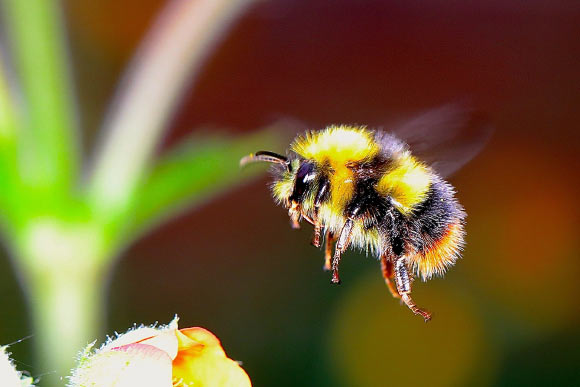
New research published in Royal Society Open Science suggests that buff-tailed bumblebees, also known as Western bumblebees (Bombus terrestris), may alter their foraging behavior after pathogen exposure. Colonies exposed to a brood-killing fungus spent more time collecting nectar containing quercetin, a natural compound with antimicrobial properties. The findings offer new evidence of possible self-medication and social medication in bumblebees.
Researchers used robotic flowers to test whether buff-tailed bumblebees (Bombus terrestris) change their nectar preferences after pathogen exposure. The study focused on quercetin, a natural nectar compound with antimicrobial activity. Image credit: Josef Pichler.
“Animal pharmacology examines how animals use natural compounds to relieve pain, fight infections and protect themselves from parasites,” said Dr. Maria Pozo of the University of Valladolid and her colleagues at the University of Leuven in Belgium.
One of the best-known behaviors in this field is self-medication. This occurs when an animal consumes natural compounds that can reduce an existing infection or help prevent disease, even though those substances may be toxic or nutritionally less valuable for healthy individuals.
Self-medication is considered a form of adaptive behavioral plasticity. In other words, animals can change their diets when they encounter increased pathogen pressure.
Researchers generally expect self-medication to be more common among infected individuals because medicinal compounds can carry costs. Healthy animals, by contrast, should benefit from avoiding substances that offer little nutritional value or may have harmful effects.
In this study, the scientists investigated whether social bees display self-medication or social medication after exposure to different pathogens.
The researchers used robotic flowers to monitor how bumblebee colonies chose between ordinary sugar water and nectar supplemented with quercetin. This flavanol is naturally found in some plants and nectar and has demonstrated antimicrobial activity against a variety of microorganisms.
The colonies were assigned to one of three conditions: remaining healthy, exposure to the fungus Ascosphaera apis, which causes chalkbrood disease in bee larvae, or exposure to the bacterium Serratia marcescens, which can infect the digestive systems of adult bees.
During a five-day free-feeding period, colonies exposed to Ascosphaera apis increasingly visited and consumed nectar containing quercetin as the experiment progressed.
Healthy colonies did not show the same change in nectar preference. Colonies exposed to Serratia marcescens also showed no significant shift toward quercetin-containing nectar.
The researchers suggest that the contrasting results may be linked to the different effects of the two pathogens on bumblebee colonies.
Chalkbrood primarily affects developing larvae rather than adult foragers. As a result, the increased collection of quercetin by fungus-exposed colonies may represent a form of social medication, in which worker bees gather plant compounds that could benefit infected brood.
Serratia marcescens, in contrast, primarily affects adult bees. Because quercetin may not directly treat this bacterial infection, the lack of a change in foraging behavior may reflect the compound’s limited or indirect benefits.
“These results show that pathogen identity shapes behavioral plasticity in nectar foraging and demonstrate the value of robotic flowers for studying adaptive foraging responses to disease,” the researchers concluded.
_____
Camiel Debeukeleare et al. 2026. Hints of self-medication? Bumblebee foraging decisions depend on pathogen exposure. Royal Society Open Science 13 (8): rsos260777. doi: 10.1098/rsos.260777
Source: www.sci.news