


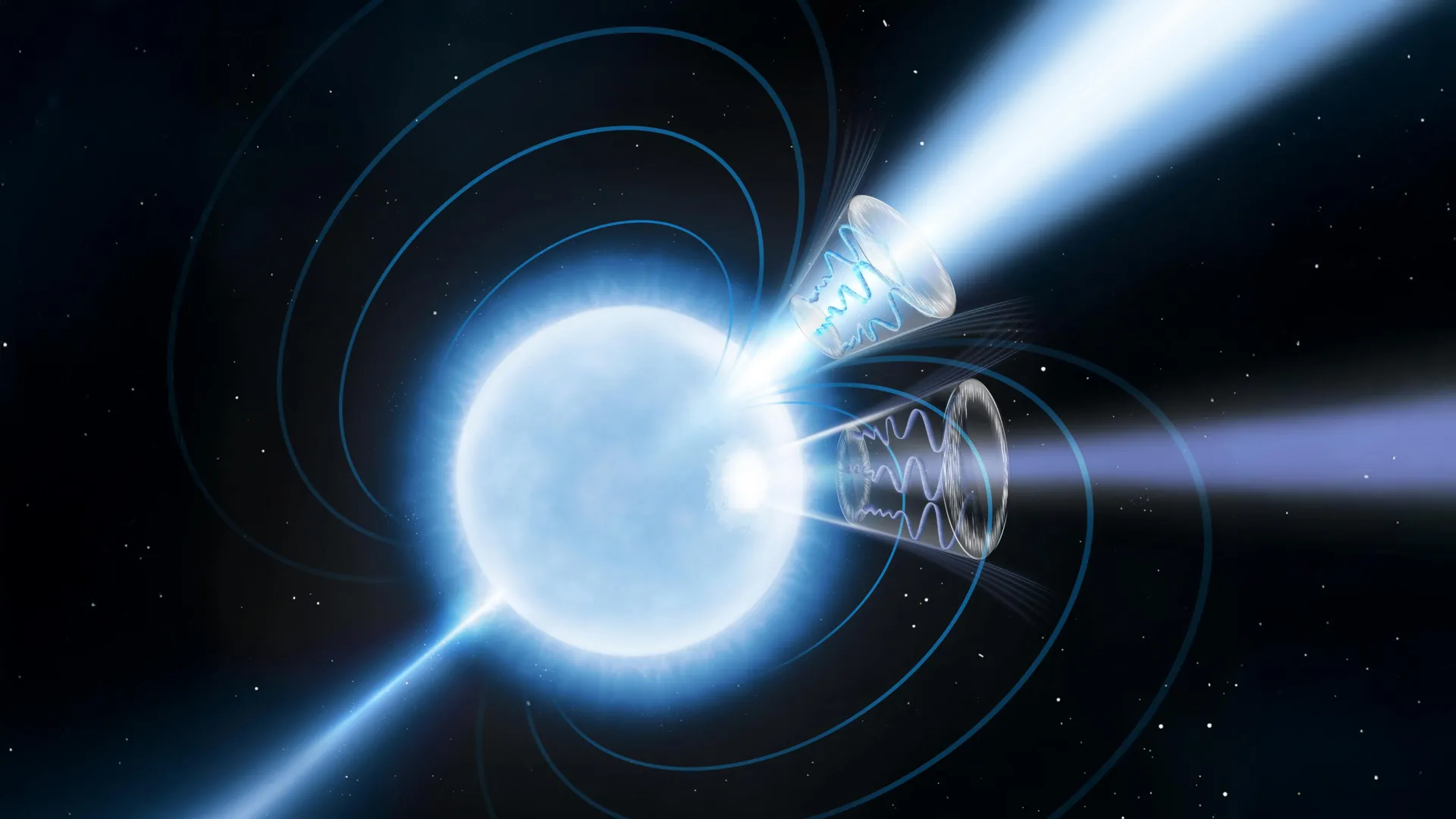
Nearly 90 years ago, physicist Werner Heisenberg predicted a mysterious quantum phenomenon called vacuum birefringence. The effect suggests that empty space can alter the way light travels. In quantum physics, even a perfect vacuum is not completely empty—it contains “virtual particles” that briefly appear and disappear.
Despite major advances in nuclear physics, particle accelerators, and quantum theory since the 1930s, scientists have not yet conclusively confirmed vacuum birefringence. Now, observations of one of the universe’s most extreme objects—a magnetar—may provide some of the strongest evidence yet.
A team of researchers studied a magnetar, a rare type of neutron star surrounded by the most powerful magnetic fields known in nature. Their findings could represent the first observational evidence of vacuum birefringence and offer a new way to investigate quantum physics in conditions impossible to recreate on Earth.
A cosmic test of quantum physics
The research involved scientists from the Space Science and Technology Center, the South African Radio Astronomy Observatory (SARAO), Los Alamos National Laboratory, NASA’s Marshall Space Flight Center, the Center for Research and Exploration in Space Science and Technology (CREST), NASA’s Goddard Space Flight Center, and universities worldwide. Rachel E. Stewart, a physics graduate student at George Washington University, led the study, which was recently published in Nature.
According to quantum theory, when a vacuum is exposed to an extremely powerful magnetic field, Heisenberg’s virtual particles can influence the movement of light. This interaction may cause vacuum birefringence, changing the polarization and behavior of light as it travels through space. The challenge is that magnetic fields strong enough to produce measurable effects are far beyond anything scientists can generate in laboratories on Earth.
Magnetars provide a natural laboratory for studying this phenomenon. Dr. Marcus Lower, an Australian Research Council DECRA Fellow at Swinburne University’s Center for Astrophysics and Supercomputing (CAS), helped lead the observations used in the study.
“To detect vacuum birefringence, we need a magnetic field that is more than 100 million times stronger than anything we have produced on Earth,” Lower said. “Fortunately, nature has provided us with magnetars, which are ideal space laboratories for searching for this effect.”
Observing an extreme magnetar
Lower led observations of the magnetar 1E 1547.0-5408, also known as 1E1547, using CSIRO’s Murriyang radio telescope at Parkes. The resulting data was analyzed with Swinburne University’s Ngarrgu Tindebeek supercomputer.
The researchers combined the radio observations with data from NASA’s Imaging X-ray Polarimetry Explorer (IXPE) and the NICER X-ray telescope aboard the International Space Station. As 1E1547 rotated, the team measured its radio emissions and tracked the direction of the waves’ oscillations, known as their polarization state.
The observations showed that the magnetar’s magnetic axis and rotation axis are nearly aligned. They also indicated that the magnetar is viewed almost directly from its magnetic pole. These characteristics make 1E1547 especially well suited for investigating vacuum birefringence.
X-rays reveal possible quantum effects
X-rays emitted by the magnetar and detected by IXPE displayed an extremely high degree of polarization. The researchers also found that the direction of the X-ray polarization remained consistent with the magnetar’s magnetic field, matching the behavior observed in its radio emissions.
Together, these observations provide important evidence that vacuum birefringence may be taking place around the magnetar.
The researchers explain that the magnetar’s immense magnetic field may cause Heisenberg’s virtual particles to align with the field. By carefully tracking the polarization of the radio and X-ray signals, scientists can search for the changes in light expected from vacuum birefringence. Additional observations and improved simulations could help determine whether the measured signal is caused by this predicted quantum effect.
More evidence is still needed
Further observations and more advanced computer simulations will be required to confirm the discovery. Scientists must determine whether the signal truly originates from vacuum birefringence or whether another physical process could produce a similar pattern.
If confirmed, the findings would give researchers a powerful new method for testing quantum physics in one of the universe’s most extreme environments. They could also provide valuable insight into how fundamental physical theories behave in magnetic fields far stronger than anything achievable on Earth.
Source: www.sciencedaily.com