


The universe is forming far fewer new stars than it did billions of years ago. Over the past 4.5 billion years, the cosmic star-formation rate has fallen to less than half its previous level. Surprisingly, however, the supply of neutral atomic hydrogen—the primary raw material for star formation—has changed very little.
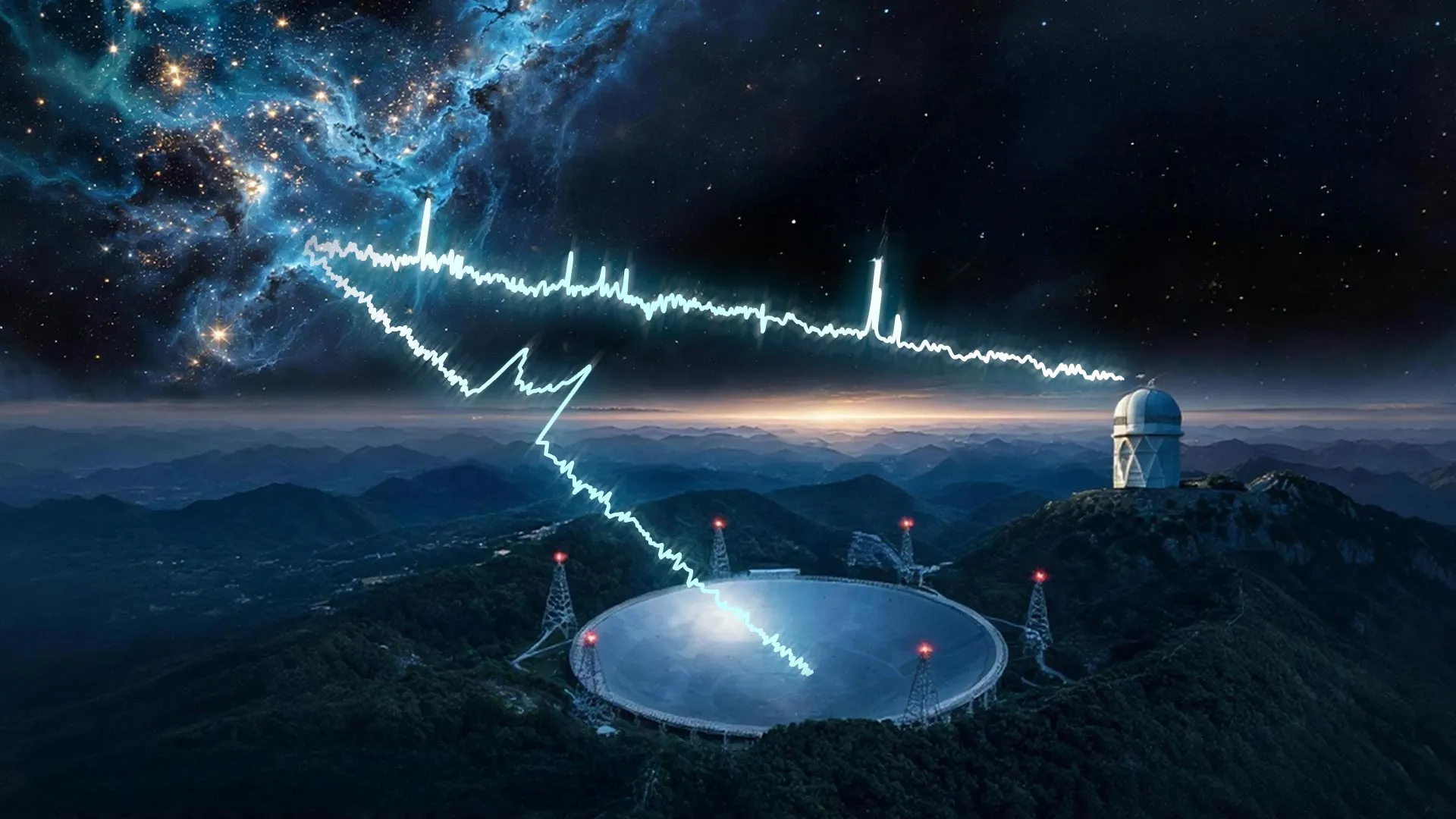
The discovery was reported by an international research team led by scientists from the Chinese Academy of Sciences (CAS), in collaboration with the Dark Energy Spectroscopic Instrument (DESI) project. Using China’s 500-meter Aperture Spherical Radio Telescope (FAST), the researchers made precise measurements of neutral atomic hydrogen across the universe over the past 4.5 billion years.
The results reveal a significant mismatch between star formation and the availability of hydrogen gas. Although the rate of new star formation has declined sharply, the amount of neutral atomic hydrogen (HI)—a major gas reservoir within galaxies—has decreased only slightly.
The study was published online in Nature Astronomy on September 1.
Why is star formation declining in the universe?
Understanding why star formation slows as the universe ages is one of the central challenges in research on galaxy formation and evolution. A straightforward explanation would be that galaxies have gradually consumed the cold gas required to create new stars.
However, if the declining supply of cold gas were the main cause, astronomers would expect the dramatic decrease in star formation to be matched by a similarly large reduction in the amount of available gas. Observations have not shown such a steep decline.
Neutral atomic hydrogen plays a key role in this mystery. It acts as an important reservoir of cold gas inside galaxies, connecting the broader cosmic gas supply with the processes that eventually produce new stars. Astronomers primarily detect HI through its extremely faint 21-centimeter radio emission line.
Detecting this signal from distant galaxies is challenging because it is often buried beneath background noise.
FAST and DESI survey millions of galaxies
For decades, astronomers have faced a difficult trade-off when studying cosmic hydrogen. Deep radio surveys can reach the sensitivity needed to detect weak signals, but they typically cover only limited regions of the sky. Surveys covering much larger areas, meanwhile, have generally lacked the sensitivity required to detect faint HI emissions.
Because of these limitations, scientists have struggled to directly and reliably measure how the total mass of neutral atomic hydrogen has changed from low to intermediate redshifts.
The new study addresses this challenge by combining FAST’s exceptional radio sensitivity with DESI’s extensive optical spectroscopic data. The research team examined approximately 2.5 million galaxies covering nearly one-third of the sky.
The researchers applied a technique known as HI spectral stacking to combine radio signals that were too faint to detect in individual galaxies. Using each galaxy’s precisely measured redshift, they aligned the weak signals and stacked them together. This allowed the average HI emission to emerge from the background noise.
The method enabled the scientists to analyze an unprecedented number of galaxies and measure the evolution of neutral hydrogen across cosmic time with exceptional statistical precision.
Star formation has declined much faster than the hydrogen supply
The findings show a major difference between the evolution of star formation and the abundance of neutral atomic hydrogen.
Approximately 4.5 billion years ago, the universe’s star-formation rate was about 2.5 times higher than it is today. During the same period, the density of neutral atomic hydrogen was only about 1.4 times its current level.
In other words, star formation has fallen dramatically without the cosmic HI reservoir being depleted to the same extent. The results indicate that the gradual loss of neutral hydrogen alone cannot explain the sharp decline in the formation of new stars.
A new mystery in galaxy evolution
The findings shift the central question from “Is the universe running out of gas?” to “Why is it becoming more difficult to form stars despite the continued presence of substantial neutral hydrogen reserves?”
Stars do not form directly from mostly neutral atomic hydrogen. Instead, they are born primarily within dense clouds of molecular gas. Neutral atomic hydrogen occupies a crucial intermediate position between the universe’s broad gas supply and the molecular hydrogen that directly fuels star formation.
The researchers suggest that the most important changes in the recent universe may involve the movement of gas through the baryon cycle rather than a major decrease in the total amount of HI.
As the flow of gas from the cosmic web weakens and the density of gas decreases, galaxies may become less efficient at converting neutral atomic hydrogen into molecular hydrogen. In this scenario, the overall HI reservoir can remain relatively stable while the supply of molecular gas available for star formation gradually declines.
Why the universe’s star factory is slowing down
The implications of this research extend beyond measuring the amount of hydrogen in the universe. The discovery offers important new clues about why the universe’s vast star-forming engine has gradually slowed over time.
The researchers say the combined FAST and DESI observations establish a new benchmark for studying the circulation of cosmic gas, the long-term decline in star formation, and the large-scale processes that shape galaxies during the later stages of cosmic evolution.
The study was led by scientists from the National Astronomical Observatory of China, the CAS Shanghai Astronomical Observatory, Shanghai Jiao Tong University, and researchers involved in the DESI project.
Contributors came from research institutions across Asia, North America, and Europe. The collaboration highlights the scientific potential of combining highly sensitive radio observations with large-scale optical spectroscopic surveys.
Source: www.sciencedaily.com