


Hubble Reveals Star Formation in the Large Magellanic Cloud
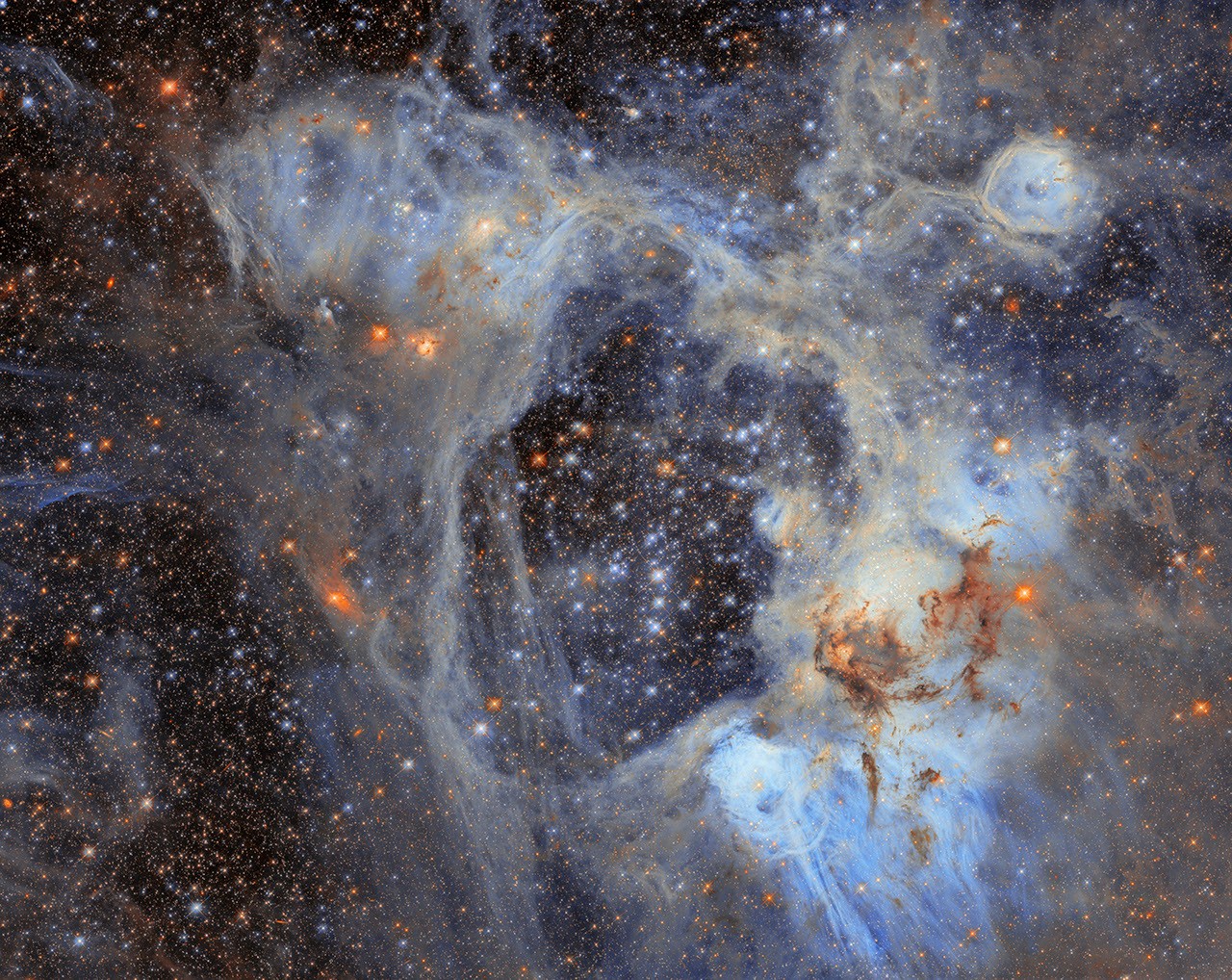
This stunning NASA/ESA Hubble Space Telescope image captures the star-forming nebula LHA 120-N44, commonly known as N44, in the Large Magellanic Cloud (LMC). Located approximately 160,000 light-years from Earth, the LMC is the largest satellite galaxy orbiting the Milky Way and provides astronomers with a close-up view of active stellar nurseries. N44 lies in the constellation Dorado.
The N44 nebula is defined by two remarkable features: an enormous central cavity and a thick, dusty shell of gas. The cavity, known as a superbubble, measures approximately 210 by 140 light-years across. A bright, massive star cluster at its center helped create the void by releasing powerful stellar winds and explosive supernovae that expelled much of the surrounding gas.
As the stars in N44’s central cluster pushed the gas outward, the material became compressed into a shell surrounding the superbubble. This dense shell is now a site of ongoing star formation. By studying N44, astronomers hope to better understand how long it takes for a cold cloud of gas to collapse into a dense core and eventually trigger nuclear fusion inside a newborn star.
The image was created using data from Hubble observing program #14689, led by principal investigator Gouliermis. The program surveyed N44, analyzed its stellar population, and cataloged nearly half a million stars within the cluster, including foreground and background stars. Approximately 30,000 of the stars identified are pre-main-sequence stars, which have not yet begun fusing hydrogen into helium in their cores.
Hubble’s exceptional sensitivity and high spatial resolution made it possible to detect these faint, young stars in the crowded environment of the N44 star cluster. The findings provide valuable insight into the earliest stages of stellar evolution and the conditions that shape new stars.
Ultraviolet radiation from massive stars energizes the gas shell surrounding the superbubble, causing it to glow and revealing its intricate structure. Several features within the larger N44 star-forming complex were cataloged by astronomer Karl Henize during the 1950s. One of these features is the small bubble near the upper-right corner of the image, known as N44F.
N44F is an interstellar bubble created by the intense stellar wind of a single hot, massive star. The star’s powerful winds and radiation have sculpted the surrounding material, carving away at the gas and forming striking columns of dusty matter. A previously released Hubble close-up offers a more detailed view of this dramatic structure.
Hubble’s observations of low-mass stars in N44 are helping astronomers study star formation in environments with relatively few elements heavier than helium. These conditions resemble those found in the early universe and in some ancient galaxies, making the Large Magellanic Cloud an important laboratory for understanding cosmic star birth.
Image and text credit: ESA/Hubble
Media contact:
Claire Andreoli
NASA’s Goddard Space Flight Center, Greenbelt, Maryland
[email protected]
Source: science.nasa.gov