


Chimpanzee vocalizations become more distinct with age, according to a new study of two geographically separated populations. The findings challenge the long-standing belief that chimpanzee calls are largely fixed by genetics and suggest that social and environmental experiences help shape vocal development.
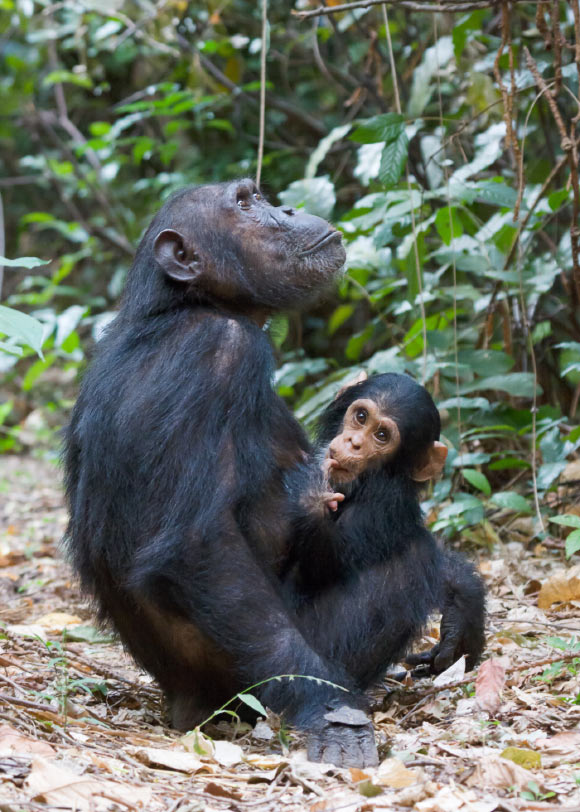
Eastern chimpanzee (Pan troglodytes schweinfurthii), a mother with her child in Gombe Stream National Park, Tanzania. Image credit: Ikiwaner.
“Dialects are a loud expression of demographic composition,” said Cassandra Guiragossian, a postdoctoral researcher at Queen Mary University of London, and her colleagues.
“At the early stages of human development, vocal behavior is relatively similar across populations from an acoustic perspective. As development progresses, differences between populations increase.”
Previous research has shown that chimpanzees display population-specific vocal characteristics. However, scientists have continued to debate whether these differences are primarily caused by social learning, genetics, ecological conditions, or a combination of factors.
In the new study, Guiragossian and her co-authors examined the vocal development of young eastern chimpanzees (Pan troglodytes schweinfurthii) from two geographically separated populations.
One group lived at the Chimfunshi Wildlife Orphanage in Zambia, while the other came from Gombe National Park in Tanzania.
The researchers analyzed several types of chimpanzee vocalizations, including grunts, cries, and laughter. They found that vocal differences between the two groups became increasingly pronounced as the animals grew older, indicating that chimpanzee vocal behavior continues to develop throughout childhood.
The pattern is similar to the way humans develop regional accents. Although young chimpanzees from different communities initially produced broadly similar calls, they gradually developed subtle, population-specific vocal patterns.
Some group-specific vocal features were already detectable during infancy, while others emerged during early childhood. This suggests that chimpanzee communication is influenced by ongoing interactions with social partners and the surrounding environment.
The study provides the first evidence that population-specific vocal differences become more distinct as chimpanzees mature. By examining how vocalizations change over time, rather than simply comparing adults from different groups, the researchers offer new insight into the development of animal communication.
“Understanding how communication develops during early childhood is fundamental to understanding animal behavior,” Guiragossian said.
“Our findings demonstrate that chimpanzee vocalizations are not fixed from birth, but continue to develop as young animals interact with their social and ecological environments.”
The results add to growing evidence that primate communication is more flexible and dynamic than previously recognized. Studying vocal development from an ontogenetic perspective may also help scientists understand how communication systems emerge and diversify within animal populations.
The researchers emphasize that their findings do not suggest chimpanzees possess human language or human-like speech abilities, including agreed grammar and vocabulary. Instead, the study shows that chimpanzee vocal development is shaped by more than genetics alone.
By demonstrating that population-specific vocal patterns emerge and become stronger during development, the research offers new insight into the biological, social, and environmental factors that influence primate communication and the evolution of complex communication systems.
The study was published online in PLoS ONE.
_____
K. Giragossian et al. 2026. Ontogeny of dialects in chimpanzee vocalizations. PLoS ONE 21 (9): e0355313; doi: 10.1371/journal.pone.0355313
Source: www.sci.news