


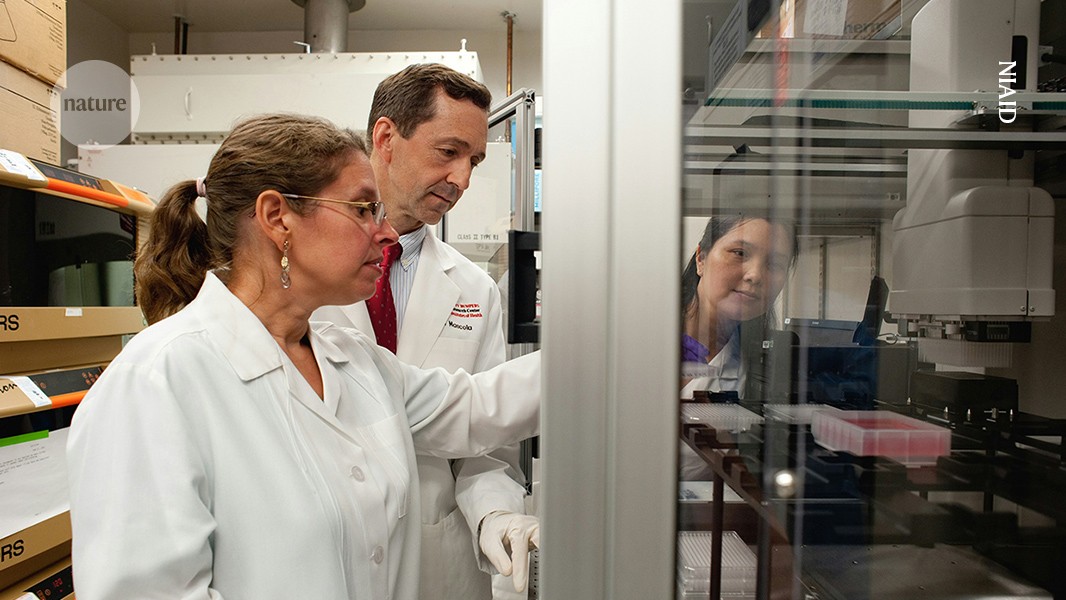
Scientists work in laboratories at the National Institute of Allergy and Infectious Diseases, where some research projects could be transferred to the U.S. Department of Defense.
Credit: NIAID
The National Institutes of Health (NIH) is preparing to redirect hundreds of millions of dollars in research projects from the National Institute of Allergy and Infectious Diseases (NIAID) to biodefense programs run by the U.S. Department of Defense (DOD), according to two NIH officials.
The NIH and the Department of Defense, also known as the Department of the Army, have reportedly signed an agreement outlining the arrangement, the officials told Nature. NIH officials are identifying projects that could be transferred to the Defense Department and hope to complete the process by the end of September, when the fiscal year ends and some funding expires, a third NIH official said. The officials spoke anonymously because they were not authorized to comment publicly.
An NIH spokesperson said: “This partnership is on a project-by-project basis, and all research remains within the scope of the NIH’s mission. There is no one-time transfer of funds.”
Exclusive: NIH ousts infectious disease leader as coronavirus scientists face US charges
A senior NIH official said the proposed arrangement would distinguish civilian public-health research from military biodefense priorities. “We’re trying to move more Army-related research back to the Army Corps,” the official said. “When people hear that NIAID is funding biodefense, they think we’re developing biological weapons and that we’re leaving that area.”
Federal law permits U.S. agencies to share funding under certain circumstances, said Samuel Bagenstos, who served as the senior attorney at the Department of Health and Human Services, the NIH’s parent agency, until December 2025. However, he said it would be inappropriate or unlawful to transfer NIH money simply because the Defense Department needs additional funding. Using NIH funds primarily to address a military budget shortfall could be illegal if the money served a DOD purpose rather than an NIH objective.
The proposed agreement would create a mechanism for transferring funding from NIAID, the country’s leading infectious-disease research agency, to support defense initiatives over a 10-year period, according to the three officials. They emphasized that a final agreement has not yet been completed.
Biosecurity experts warn that moving biomedical research into the military could reduce the transparency and clinical focus traditionally associated with NIH-funded science. “The Department of Defense is simply not equipped to deliver the scientific innovation that we expect and depend on from the NIH,” says Gigi Gronvall, a biosecurity expert at the Johns Hopkins Bloomberg School of Public Health in Baltimore, Maryland.
Leadership changes at NIAID
The proposed funding agreement comes as President Donald Trump’s administration has replaced eight of NIAID’s 10 senior executives and shifted the institute’s priorities away from research into emerging viral threats and toward basic immunology and chronic diseases in the United States. Nature reported in February that NIAID staff had been instructed to remove the terms “biodefense” and “pandemic preparedness” from the institute’s website, according to the agency.
NIAID’s biodefense portfolio includes research on vaccines and treatments for weaponized pathogens such as anthrax, smallpox and plague. It also covers medical countermeasures designed to protect people from nerve agents and radiation exposure caused by nuclear explosions.
Saskia Popescu, an infectious-disease epidemiologist at George Mason University in Fairfax, Virginia, said biodefense depends on cooperation between military and civilian institutions. However, she warned that moving this work away from NIAID could fragment the United States’ ability to prepare for pandemics and other public-health emergencies.
NIH Director Jay Bhattacharyya defended the partnership. “Rather than siphoning funding away from research, this partnership between @NIH and @Dept ofWar focuses on research projects that advance discoveries that improve the health of Americans and military personnel,” he wrote in a post on the social media platform.
Operation Prevailing Edge and biodefense research
Two of the three NIH officials said the reallocation was initiated by NIH leadership. Robert Kadlec, assistant secretary of defense for nuclear deterrence, chemical and biological defense policy and programs, was also advocating for the agreement to be finalized as part of a broader biodefense initiative known as “Operation Prevailing Edge.”
Source: www.nature.com