


NASA Discovers Mysterious Ultrasoft X-Ray Sources in Six Galaxies
Using data from NASA’s Chandra X-ray Observatory, astronomers have discovered a previously unknown type of cosmic object that emits unusually low-energy X-rays and powerful ultraviolet radiation. The discovery could help solve two major mysteries in astrophysics, including the origins of some Type Ia supernovae and the process that strips electrons from interstellar gas.
The findings, published in Nature Astronomy, describe a group of objects known as ultrasoft X-ray sources. Researchers identified 84 of these sources across six galaxies, including the Andromeda Galaxy, M31, and the Pinwheel Galaxy, M101.
What Are Ultrasoft X-Ray Sources?
Ultrasoft X-ray sources are objects that appear in images captured at the lowest X-ray energies but disappear when astronomers examine higher-energy X-ray images. This unusual pattern indicates that they produce far more low-energy X-rays than high-energy X-rays.
Because low-energy X-rays are located next to high-energy ultraviolet radiation on the electromagnetic spectrum, the researchers concluded that these objects also produce exceptionally strong ultraviolet emissions.
“We have never encountered a group of objects that behave like this before,” said study leader Mustafa Muhibullah of the University of Alabama.
Where Were the New Objects Found?
The research team searched publicly available data in the Chandra Archives and discovered ultrasoft X-ray sources in six different galaxies. The sample included both spiral and elliptical galaxies:
- M31, the Andromeda Galaxy
- M101, the Pinwheel Galaxy
- Four elliptical galaxies
The objects were found in regions with active star formation as well as areas dominated by older stars. This suggests that the sources may occur in a variety of galactic environments.
What Could Be Producing the Radiation?
Scientists are not yet certain what powers these mysterious sources. The most likely explanation involves a binary star system containing a black hole, neutron star, or white dwarf that is drawing material from a companion star.
As the material falls toward the compact object, it becomes extremely hot and releases X-rays. Similar binary systems have been observed previously, but none have displayed the same combination of intense ultraviolet radiation and unusually low-energy X-rays.
“These secret X-ray sources are actually some of the most energetic objects in the galaxy, and they have the potential to solve two cosmic mysteries simultaneously,” Muhibullah said.
Could These Sources Predict Type Ia Supernovae?
Some white dwarf systems that pull matter from companion stars may eventually explode as Type Ia supernovae. These powerful stellar explosions are important tools for measuring the expansion of the universe and helped reveal that cosmic expansion is accelerating.
Astronomers have searched for binary systems that could become Type Ia supernovae, but identifying the systems before they explode has proven difficult. Ultrasoft X-ray sources may provide a new way to locate and study these potential supernova progenitors.
“If we could find a way to detect Type Ia supernovae before they explode, that would be very important,” said co-author Jimmy Irwin of the University of Alabama.
How Could They Affect Galaxy Evolution?
The newly discovered objects may also help explain how electrons are stripped from gas between stars in some galaxies. This process can influence star formation and affect the long-term evolution of galaxies.
Hot, massive stars are known to contribute to this ionization process, but they do not fully explain the observed effects. The powerful ultraviolet radiation produced by ultrasoft X-ray sources could provide part of the missing explanation.
Why Were These Objects So Difficult to Detect?
Ultrasoft X-ray sources are challenging to observe for two main reasons. Their low-energy X-rays are difficult for X-ray telescopes to detect, while their ultraviolet radiation can be absorbed by hydrogen and helium gas between the stars.
This gas creates an almost impenetrable barrier that prevents much of the ultraviolet light from reaching Earth. By analyzing archival Chandra observations and comparing images at different X-ray energies, researchers were able to identify the objects despite these observational obstacles.
“By combing through Chandra’s archives, we were able to remove some of the telescope’s blind spots,” said co-author Roseanne Di Stefano of the Center for Astrophysics | Harvard & Smithsonian.
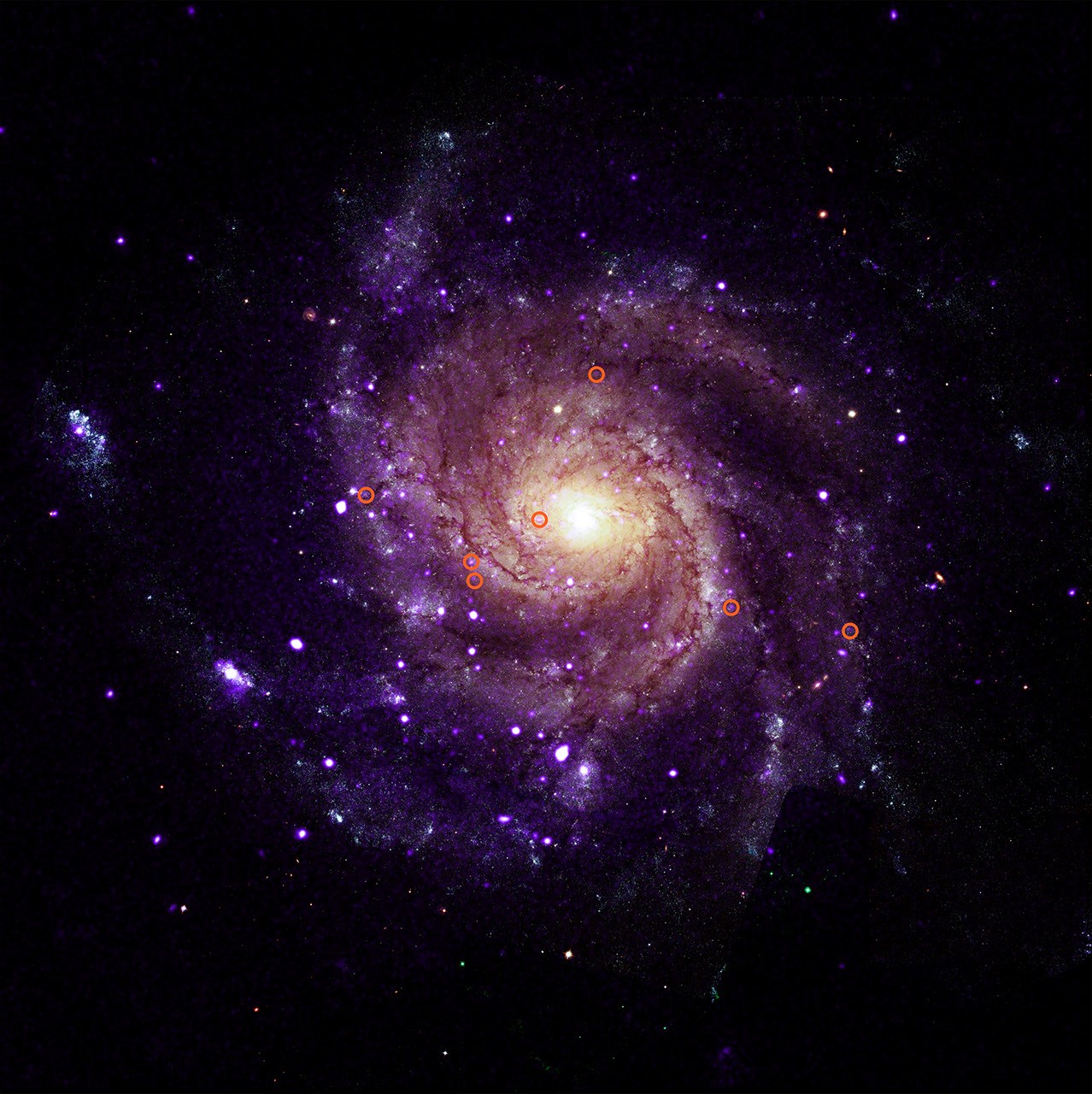
Ultrasoft X-Ray Sources in the Pinwheel Galaxy
A composite image released with the study shows the face-on spiral galaxy M101, also known as the Pinwheel Galaxy. The galaxy has purple spiral arms winding around a golden-yellow central core, with numerous white and purple points of light scattered throughout its structure.
Most of these points are pairs of stars, but seven are the newly identified ultrasoft X-ray sources. An annotated version of the image marks the mysterious objects with red circles.
To casual observers, the sources look like ordinary points of light. However, their unusual combination of low-energy X-rays and powerful ultraviolet radiation sets them apart from every other known class of cosmic object.
Read more from NASA’s Chandra X-ray Observatory
NASA’s Marshall Space Flight Center in Huntsville, Alabama, manages the Chandra program. The Smithsonian Astrophysical Observatory’s Chandra X-ray Center oversees scientific operations from Cambridge, Massachusetts, and flight operations from Burlington, Massachusetts.
Source: science.nasa.gov