


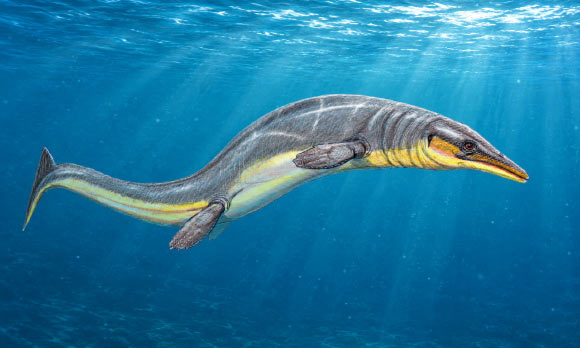
New Mosasaur Species Discovered in Egypt Reveals How Small Predators Hunted in the Cretaceous
Paleontologists have identified a previously unknown species of mosasaur, an extinct marine reptile that lived alongside land-based dinosaurs, from fossils discovered in Egypt’s Dakhla Oasis.
Halisaurus auriculatus lived about 70 million years ago
Named Halisaurus auriculatus, the new species lived during the early Maastrichtian, the final stage of the Cretaceous Period, approximately 70 million years ago.
The species belonged to Halisauridae, a subfamily of mosasaurs that were generally small to medium-sized compared with other members of the group.
“Halisaurinae is a subfamily of mosasaurids characterized by relatively small size and primitive jaw and tooth morphology,” said paleontologist Ahmed Ali Shaker of Ain Shams University and his colleagues.
“Historically, halisaurids have been one of the rarest and least well-known groups of mosasaurs.”
The group currently includes 11 species assigned to four genera: Yinionatator, Halisaurus, Phosphorosaurus, and Pluridens. Their fossils range from the Santonian to the uppermost Maastrichtian stages of the Late Cretaceous.
Halisaurine fossils are known from the Americas, Africa, Asia, and Europe, particularly from low-latitude oceans around Africa.
The discovery provides new information about mosasaur diversity and evolution, including the adaptations that helped these marine reptiles survive in Cretaceous oceans.
Fossils found in Egypt’s Dakhla Oasis
The remains of Halisaurus auriculatus were discovered in 2024 in the Dakhla Shale near the village of Teneida, in Egypt’s Western Desert.
The fossil specimen includes part of a skull, a jawbone, and several vertebrae and limb bones. All of the elements were preserved in three dimensions.
The same fossil assemblage also contained scattered bones of a teleost fish, fragments of a turtle shell, and plesiosaur vertebrae.
A slender jaw and specialized hearing system
Halisaurus auriculatus had an unusually long, slender jaw with more than 20 teeth on each side. It also possessed a highly modified ear structure that has not previously been observed in this reptilian family.
These traits, along with fast-biting but relatively weak jaws, suggest that the mosasaur may have hunted small prey such as fish and squid in darkness or dim underwater conditions.
The unusual ear anatomy may also have helped the animal hear underwater, although the researchers present this as a possible interpretation of the fossil evidence.
Two mosasaur species shared the same ecosystem
Halisaurus auriculatus was found in the same rock formations and general region as another mosasaur, Halisaurus hebae, which some of the same researchers described in 2023.
The two species had substantially different skull and jaw anatomy. The study authors suggest that they may have divided available food resources rather than competing directly, a phenomenon known as niche partitioning.
“Halisaurus auriculatus is distinguished from its peers, including Halisaurus hebae, by its long, slender jaw, numerous teeth, and a unique specialization of the quadrate bone,” the researchers said.
According to the researchers, these characteristics indicate adaptations for rapid bites with relatively low bite force and may point to specialization of the auditory system for underwater hearing.
They added that the features suggest specialization on small prey and niche partitioning among halisaurids living in the same fauna.
Halisaurids were a diverse component of Maastrichtian marine ecosystems in the Tethys and Atlantic oceans, highlighting their ecological importance during the Late Cretaceous.
The findings were published online in Acta Palaeontologica Polonica.
_____
Shaker, A. A., et al. 2026. A new species of mosasaurid, a halisaur from Egypt during the Late Cretaceous. Acta Palaeontologica Polonica 71 (3): 589–604. doi: 10.4202/app.01310.2025.
Source: www.sci.news