


Space Weather Disrupted Railway Telegraphs Nearly a Decade Before the Carrington Event
The famous Carrington Event of 1859 is often described as the first major space weather event to affect modern technology. However, historical records show that geomagnetic storms disrupted telegraph systems more than a decade earlier—and researchers have now corrected the date of one of the earliest reported incidents.
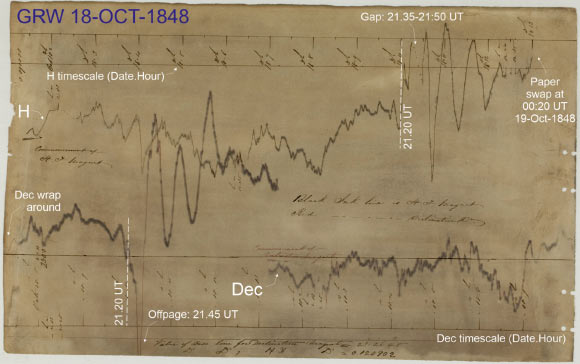
Magnetic field lines recorded at the Greenwich Magnetic Observatory from 11:20 UT on October 18, 1848, to 00:20 UT on October 19, 1848. A strong geomagnetic disturbance began at 21:20 UT. Image credit: Wild et al., doi: 10.1029/2026SW005239.
The 1847 telegraph failure
“Space weather is recognized as a social disaster that has evolved alongside the development of modern human technology and infrastructure over the past 200 years,” Professor Jim Wilde of Lancaster University and his co-authors said.
The Carrington Event of 1859 remains one of the most powerful geomagnetic storms in the scientific record. It caused widespread disruption to telegraph systems and was associated with the oldest and largest solar flare ever recorded.
However, it was not the first reported instance of solar activity disrupting technical infrastructure. One of the earliest documented events was presented to the Royal Society in London in May 1848.
An 1849 report described how a “spontaneous current” affected the Midland Railway’s telegraph equipment on the evening of March 19, 1847, when “a brilliant aurora was seen” over the British Isles. This incident is now considered the earliest confirmed example of space weather disrupting technology in the historical record examined by the researchers.
Was a railway train delayed by space weather in 1841?
An anonymous author writing in Nature in 1871 described a “very severe magnetic disturbance” said to have occurred on October 18, 1841. According to the account, the disturbance interfered with a railway signal near Starcross, preventing the system from confirming that the track was clear. The resulting failure reportedly delayed the 10:05 p.m. train departing from Exeter by 16 minutes.
If accurate, the incident would have been six years older than the 1847 Midland Railway telegraph failure and would have represented the oldest known example of space weather affecting human technology.
However, Professor Wilde’s team identified a problem with the date: the railway line described in the account did not open until 1846, five years after the alleged event.
Historical records point to October 18, 1848
To investigate the discrepancy, the researchers examined old railway timetables, magnetic observatory records, sunspot maps and newspaper archives. They used these sources to determine when the 10:05 p.m. Exeter-to-Starcross train actually operated and then compared the timetable with records of geomagnetic activity.
The evidence pointed to October 18, 1848. On that date, the Greenwich Observatory recorded a powerful magnetic storm, the aurora borealis was visible across Britain, and a large sunspot group was observed in Durham.
The researchers concluded that the 1871 report may have contained a typographical error, with 1848 incorrectly printed as 1841. They identified telegraph engineer Nathaniel John Holmes as the likely author of the original account.
Although the Exeter incident is no longer the oldest recorded example of space weather affecting technology, it remains one of the earliest documented cases of solar activity disrupting critical infrastructure. The 1847 Midland Railway incident is now reconstructed as the earliest confirmed example in the historical record.
Why historical space weather records matter
“Space weather is often discussed as a challenge of our time because of our dependence on technologies such as satellites, communications systems and power grids,” Professor Wilde said.
“What this study shows is that society has been experiencing the effects of space weather on technology almost as long as electrical technology has existed.”
“The Exeter train delay is an interesting story because it sits at the very point where emerging technologies are first beginning to encounter the realities of the space environment.”
“By combining historical archives and scientific observations, we were able to show that this event almost certainly occurred in 1848, not 1841.”
“While this means this is not the oldest recorded space weather effect, it is still one of the first clear examples of solar activity disrupting critical infrastructure.”
“It also shows the value of combining scientific records with contemporary newspaper reports and archival documents when reconstructing historical space weather events.”
Dr. Mike Hapgood, STFC’s RAL Space Visiting Scientist and a space weather expert, described the research as a “detective story” involving a wide range of archived records.
“This highlights the importance of preserving these ancient records, which provide the evidence base needed to interpret past events and enhance future predictions,” Hapgood said.
The research was published in Space Weather.
_____
James A. Wilde et al. 2026. “Did Space Weather Delay the 10:05 PM Train Departure from Exeter on October 18, 1841?” Space Weather 24 (9): e2026SW005239. doi: 10.1029/2026SW005239.
Source: www.sci.news