


Sceye’s Stratospheric Airship Crosses the Pacific and Could Deliver Broadband From 12 Miles Up
Advances in materials science have also benefited lighter-than-air platforms, technologies that “were not discovered or understood in the late 1990s,” Fransen said. One example is graphene, discovered in 2004. The material has helped improve the hull’s strength-to-weight ratio, battery energy density, and solar-panel performance.
Sceye HAPS could carry 551 pounds into the stratosphere
The design could eventually be scaled into a High Altitude Platform System (HAPS) capable of carrying payloads weighing as much as 551 pounds (250 kilograms). According to Helena, a U.S. nonprofit organization with a for-profit investment arm that invests in Sceye, this would provide 25 to 50 times more payload capacity than competing stratospheric platforms such as high-flying drones.
Sceye’s current platform has already completed multiple flight demonstrations with payloads exceeding 220 pounds (100 kilograms). It can also provide up to 1 kilowatt of onboard power to the equipment it carries.
The combination of greater payload capacity and higher power output could enable new missions. For example, a single Sceye platform hovering in the stratosphere could provide mobile broadband coverage equivalent to 500 terrestrial cell towers. That capability could strengthen commercial telecommunications networks while providing emergency connectivity during disasters.
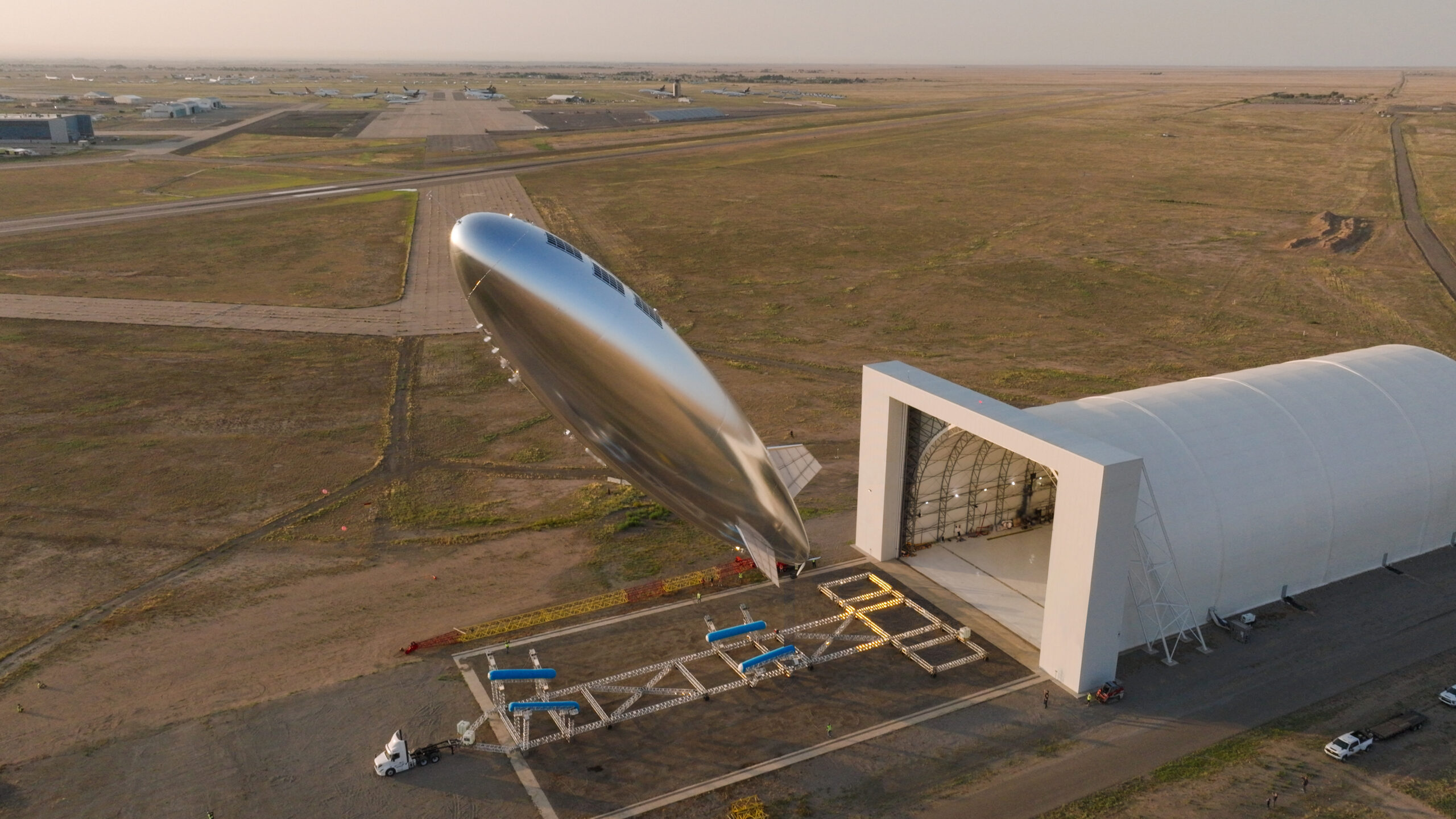
Sceye’s High Altitude Platform System viewed from inside the hangar after liftoff from New Mexico on August 9, 2026.
Credit:
Sceye’s autonomous airship crosses the Pacific
Sceye tested the concept after launching its platform from its New Mexico base on August 9, 2026. The airship traveled more than 9,320 miles (15,000 kilometers) across the Pacific Ocean before arriving in Japan.
The 13-day journey required the airship to navigate strong winds and avoid potentially dangerous weather during typhoon season, said Johnny Truong, Sceye’s chief technology officer.
Truong explained that the stratospheric platform uses an automatic navigation system to fly autonomously between two points while accounting for local wind conditions. Human operators can therefore focus on broader decisions, including monitoring weather forecasts, running simulations of potential routes, and arranging navigation waypoints to make the journey as smooth as possible.
Source: arstechnica.com