


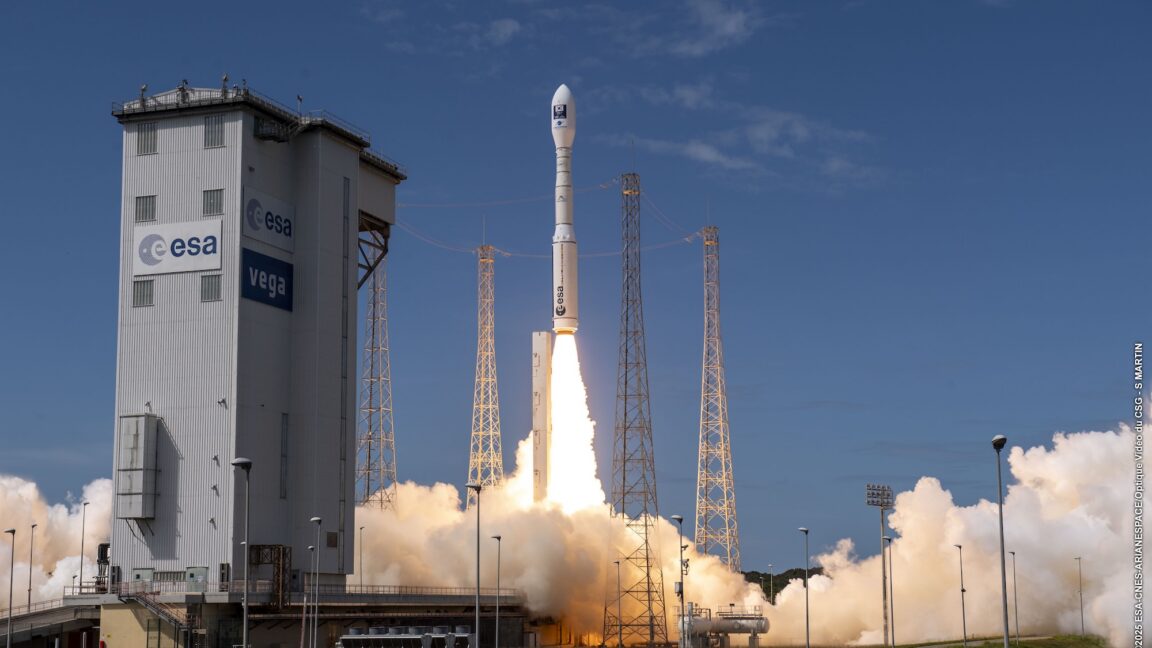
Avio has brought the Vega C rocket’s marketing, sales, and launch operations in-house as ICEYE prepares to work with Nokia on a European low-Earth-orbit satellite network focused particularly on defense and security communications. The Finnish companies aim to begin launching 50 satellites a year from 2028, although they have not disclosed the network’s total size, coverage, throughput, or latency.
Avio takes full control of Vega C operations
Avio oversees the consortium of European companies that builds the Vega C rocket and carries out final assembly of its stages at a factory near Rome. For most of the Vega program’s history, Avio handed the completed rocket to French launch provider Arianespace, which managed marketing, sales, and launch-day operations from French Guiana.
Avio recently assumed those responsibilities, bringing the entire Vega C operation in-house.
ICEYE expands its role in European security
ICEYE has built and launched 84 radar reconnaissance satellites. The spacecraft provide daily aerial imagery of locations around the world, including during darkness and cloudy weather. Alongside its commercial satellite fleets, ICEYE has sold turnkey satellites directly to national governments in Finland, Poland, Germany, Sweden, Portugal, Greece, and the Netherlands.
Last month, ICEYE announced a partnership with Nokia to develop a low-orbit satellite constellation intended to support Europe’s connectivity needs, particularly in the defense and security sectors. Ukraine’s Ministry of Defense later announced a preliminary agreement to cooperate with ICEYE and Nokia on the constellation. The announcement came days after Ukraine reported new restrictions on access to SpaceX’s Starlink and Starshield broadband services.
“Modern warfare has proven that reliable communications is a matter of national security,” said Ukrainian President Volodymyr Zelenskiy. “We all have to rely on our ability to control.”
Satellite network plans remain undefined
ICEYE and Nokia still have a long way to go before they can begin deploying their satellite fleets. Their stated goal is to start launching 50 satellites per year in 2028, but the companies have not disclosed expected network throughput or latency, nor the total number of satellites planned for global or regional coverage.
Depending on the satellites’ altitude, the network would likely require hundreds or thousands of spacecraft. SpaceX currently operates more than 11,000 satellites in its Starlink constellation.
Source: arstechnica.com