



Eagles can hunt surprisingly large prey, including baboons weighing nearly 60 pounds (26 kilograms), according to a new study. The findings raise the possibility that some early human relatives, which were similar in size to baboons, may also have been vulnerable to eagle attacks.
Researchers made the discovery while studying the remains of at least nine adult baboons found in the Sahara Desert of Chad. The animals showed deep claw marks on their bones, suggesting that Verreaux’s eagles (Aquila verreauxii) may have hunted and killed the primates before carrying some of them back to their nests.
Until now, researchers had thought that eagles could not lift nonhuman primates weighing more than 29 pounds (13 kilograms).
The study was published Wednesday, Nov. 18, in the American Journal of Biological Anthropology.
Image credit: Catherine Hobaiter
Evidence of eagle attacks
The baboons weighed an estimated average of 49 pounds (22.2 kilograms), while the largest weighed 58 pounds (26 kilograms). That is roughly the size of some small hominins, including Australopithecus afarensis, the species represented by the famous fossil known as Lucy.
Lucy weighed approximately 62 pounds (28 kilograms) and lived about 3.2 million years ago in what is now Ethiopia, according to the Natural History Museum.
The eagles in the study sometimes hunt from cliff tops in pairs and have claws with a gripping diameter of about 16 inches (40 centimeters). Grip diameter refers to the distance across the eagle’s extended grip.
Eagles may scavenge carcasses, but the researchers said that explanation does not appear to fit the baboon remains. “The intensity of the puncture suggests a lethal interaction with the killer grip,” they wrote.
Eight of the nine baboons were male. The researchers said this pattern suggests that the animals may have been hunted, because scavenged carcasses would not be expected to show such a strong bias toward one sex. However, they acknowledged that “the male sex bias in our sample is puzzling.” Male primates sometimes defend themselves from eagles by charging at them.
Could early hominins have faced similar threats?
There are confirmed cases of eagles hunting and killing hominins. “The only confirmed case is the Taung child,” said study lead author Catherine Hobaiter, a professor at the University of St. Andrews in the United Kingdom who has studied primates extensively. The infant Australopithecus africanus is thought to have been abducted by a large eagle about 2.8 million years ago and weighed approximately 22 pounds (10 kilograms).
Some australopithecines that lived between 1 million and 3 million years ago were in the same weight range as the adult male baboons in the study, Hobaiter said. They may therefore have been vulnerable to eagle attacks, although hyenas and crocodiles would also have posed threats.
Modern small primates can reduce their vulnerability by working together. Primates preyed upon by eagles often live in mixed-species groups and forage together. “That means more competition for food. But the benefits of additional protection seem to be worth the cost,” Hobaiter said.
Hominins may have behaved similarly, with different individuals working together to watch for and deter eagles.
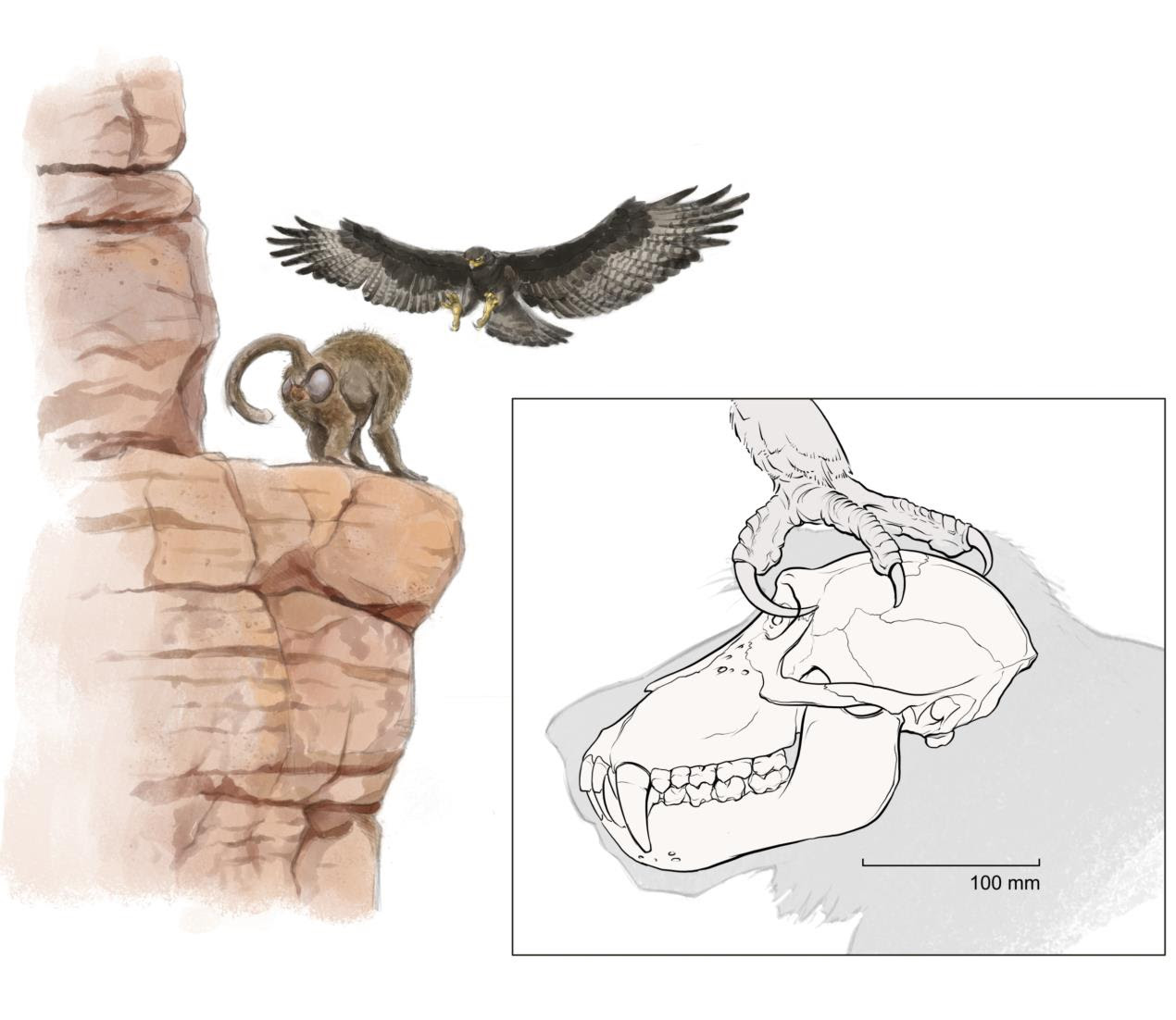
Image credit: Illustration by Javier Lazaro, reprint permission under CC-BY-ND.
Researchers urge caution
Robert Simmons, a researcher at the University of Cape Town’s FitzPatrick Institute of African Ornithology who was not involved in the study, described the discovery as “interesting.” Eagles are “opportunistic,” he said in an email. Older or younger male baboons traveling alone between troops can become prey for individual eagles or pairs of eagles, and a lack of cover in desert environments can leave them exposed.
Simmons said the behavior would be “certainly a rare occurrence.” In an arid desert environment, however, a Verreaux’s eagle may have limited prey available, forcing the approximately 9-pound (4-kilogram) bird to pursue larger and more dangerous animals than it typically would.
W. Scott McGraw, an anthropology professor at Ohio State University who was also not involved in the research, said early hominins may have been attractive targets because of their relatively small size. Infants and young individuals in particular may have been vulnerable.
“Given their limited physical defenses, early hominids, and indeed primates more generally, likely evolved a variety of behavioral adaptations to reduce their vulnerability to raptors and other predators,” McGraw said. Those adaptations may have included living in groups, loudly alerting others and choosing habitats that offered protection from attacks.
Jesus Bautista Rodriguez, coordinator of the Desert Golden Eagle Project, said he was cautious about interpreting the remains as proof that eagles actively killed healthy male baboons weighing more than 20 kilograms (44 pounds).
“In my opinion, there is a good chance that some or all of these individuals are already dead, on the verge of death, severely weakened, or were unable to defend themselves when the eagles fed,” Bautista Rodriguez told Live Science by email.
He also said that more fieldwork is needed to establish how the baboons died and how the eagles encountered them. “The puncture marks and extensive scratch marks observed on the skull and shoulder blades are certainly interesting and consistent with eagle claws and feeding activity,” he said. “Nonetheless, these marks do not necessarily prove that the eagle killed the animal. These marks could also have been produced during handling, butchering, or feeding on an already deceased individual.”
The study was authored by C. Hobaiter, T.J.D. Akpona, G.H. Kopp and N.J. Dominey under the title “Signs of eagle predation on an adult primate weighing 22 kg.”
Source: www.livescience.com