


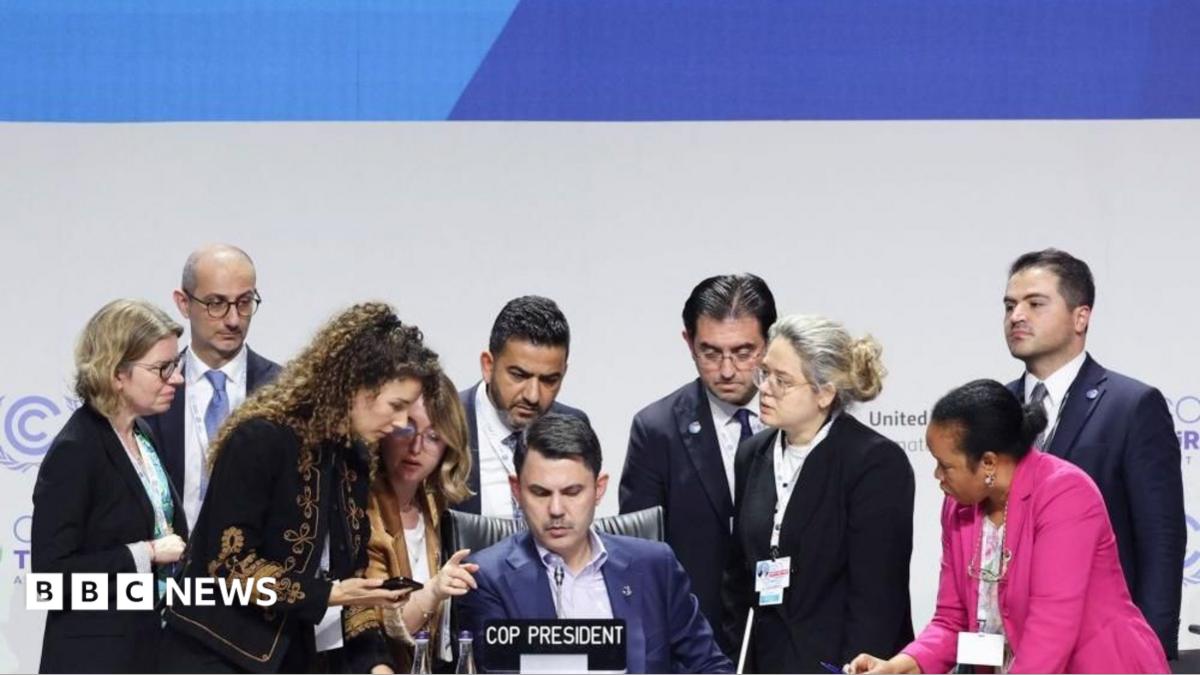
Delegates at COP31 in Antalya, Turkey, confronted worsening climate risks, a widening gap between current policies and the Paris Agreement’s 1.5-degree Celsius goal, and questions about whether the United Nations’ consensus-based process can function in a divided geopolitical environment. Australia led the formal negotiations, while Turkey promoted a goal of increasing electricity’s share of global energy use to 35% by 2035.
Australian government minister and COP31 negotiation chair Chris Bowen described a “red line” in the discussions. He pointed to “the most complex and challenging geopolitical environment in living memory,” while warning that “the effects of climate change are worsening” and that risks are increasing.
2026 could end as the hottest year on record, bringing extreme weather and natural disasters to many parts of the world, from summer heat and drought in Europe to flash floods in Nepal.
The Paris Agreement’s 1.5-degree target
COP31 was the first annual United Nations conference to formally discuss the failure to achieve one of the international community’s major climate goals.
At the 2015 Paris talks, nearly 200 countries agreed to limit global warming to 1.5 degrees Celsius above pre-industrial levels in the late 1800s, with the aim of avoiding some of the worst effects of climate change.
The United Nations says the Paris Agreement has encouraged “almost universal” climate action. In the early 2010s, scientists and policymakers believed there was a serious possibility that global warming could exceed 4 degrees Celsius by the end of this century.
Based on current government policies, however, the United Nations now estimates that warming is likely to be about 2.8 degrees Celsius by 2100.
Climate action remains too slow to meet the Paris targets, and the world is likely to “overshoot” 1.5 degrees Celsius of long-term warming in the coming years.
Many countries say they remain committed to eventually bringing temperature rise back to 1.5 degrees Celsius. Doing so would require major advances in technologies that remove carbon dioxide from the atmosphere, but those technologies do not yet exist at scale.
Limited agreements and process concerns
Although no major agreements were reached, delegates made progress on several issues, including the Just Transition Mechanism. The framework is intended to support workers and communities as economies shift to clean energy.
The COP31 president also said that more than 80 countries support Turkey’s goal of increasing electricity’s share of global energy use to 35% by 2035.
However, the day’s events led some observers to question whether the UN climate process, which relies on consensus, can succeed in a geopolitically divided world.
UN climate chief Simon Stiel said the next meeting would seek advice on possible reforms to the process ahead of COP32, scheduled for November 2027 in Ethiopia.
Speaking to the BBC, Stiel said of the consensus process: “Thanks to him we got through Paris… so it should be fine,” but acknowledged that the day’s outcome was “not good enough”.
Stiel told delegates that the UN climate process had “previously suffered setbacks, but has come back even stronger”. He added: “I have to do that again.”
Source: www.bbc.co.uk