


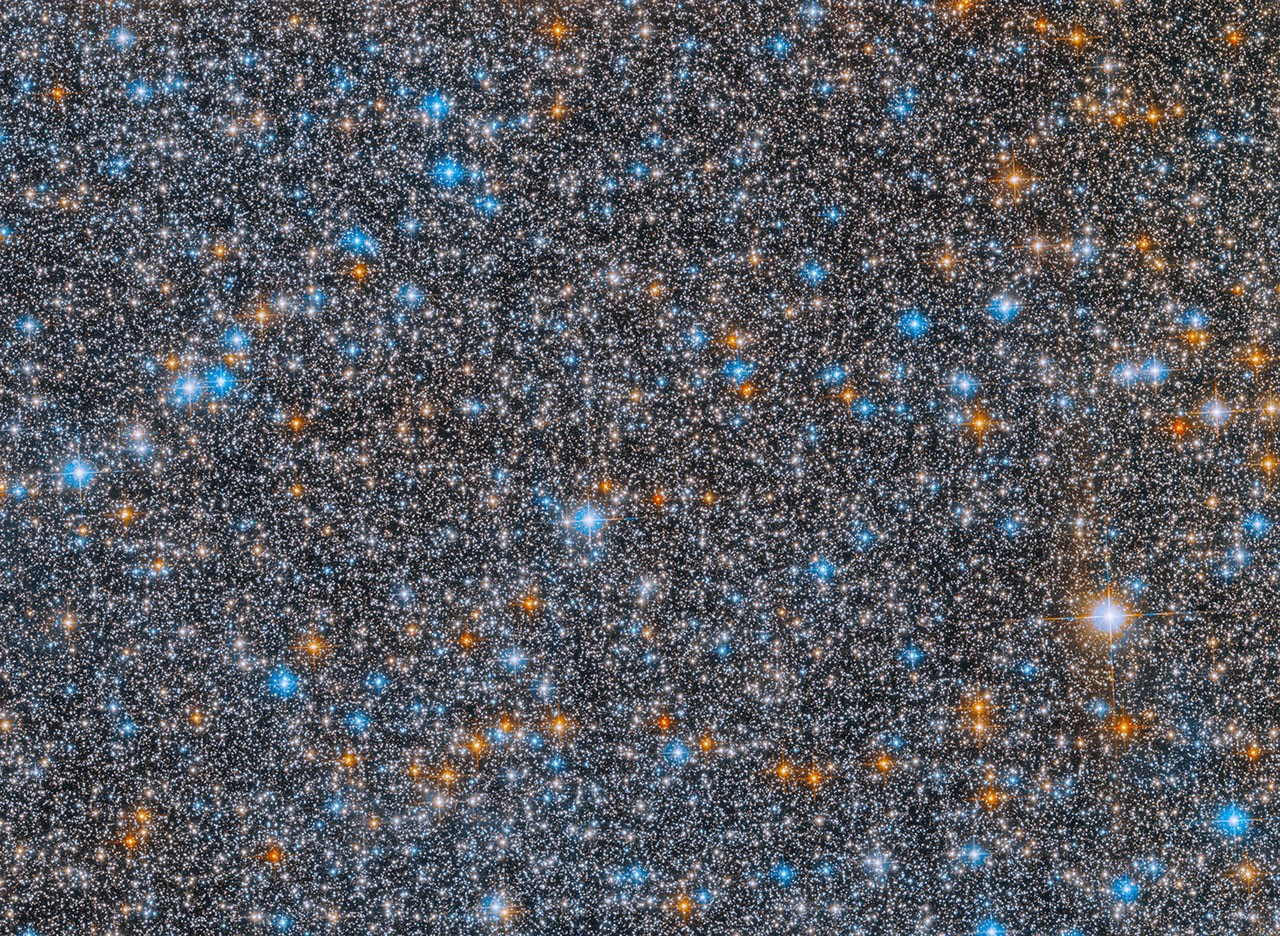
NASA’s Hubble Space Telescope has captured a dense, colorful field of stars in the Milky Way’s Galactic Bulge. The observations will help researchers interpret future data from the Nancy Grace Roman Space Telescope as they study stars, search for exoplanets and investigate black holes, dark matter, and the evolution of galaxies in this crowded region.
Studying the Milky Way’s Galactic Bulge
The Galactic Bulge is a roughly spherical region densely packed with stars surrounding the center of the Milky Way’s disk. Astronomers study it because it contains nearly a quarter of the galaxy’s stellar mass and is close enough for researchers to examine in detail.
Although astronomers can observe the glow of dense stellar regions in other galaxies, those regions are generally too distant and crowded to resolve individual stars. Studying the Milky Way’s bulge offers an opportunity to examine individual stars and learn more about how galaxies form, evolve and interact over billions of years.
Preparing for Roman’s observations
Hubble primarily observes the universe in ultraviolet, visible and near-infrared light. Roman will collect data mainly in near-infrared light, along with some visible light. To help researchers compare the two telescopes’ observations, Hubble examined the range of wavelengths to which Roman will be sensitive. That range overlaps the red end of the visible spectrum and extends into near-infrared wavelengths.
Hubble’s high resolution allows its instruments to measure the brightness, precise positions, motion, age and composition of stars over long periods. These measurements will help astronomers search for potential exoplanets, locate black holes and dark matter, and better understand the environments and evolution of galaxies.
Using microlensing to find exoplanets
A major goal of Roman’s future observations will be to search for exoplanets through microlensing. This form of gravitational lensing occurs when the mass of a nearby object along the line of sight magnifies and distorts light from a more distant object.
The way light from distant stars is magnified and distorted can reveal information about foreground stars and their planets. Hubble’s observations will help researchers characterize stars in the Galactic Bulge before they produce lensing events. Months or years later, when Roman detects a microlensing event, researchers can compare Roman’s data with Hubble’s earlier measurements of the same region, making the event easier to interpret.
These microlensing events occur on the scale of stars and planets. They are much smaller than the large gravitational lenses produced by galaxies and galaxy clusters.
Hubble’s history of observing the bulge
Hubble has observed the center of the Milky Way many times during its lifetime. Earlier studies include the WFC3 Galaxy Bulge Treasury Program, which used Hubble’s Wide Field Camera 3 to measure the brightness, precise positions and motions of stars in this crowded region.
Hubble also conducted the Sagittarius Window Eclipsing Exoplanet Search, or SWEEPS. The survey used Hubble’s Advanced Camera for Surveys to observe 180,000 stars in the galaxy’s bulge.
The new observations were made through observation program 17776, led by S. Terry. The program is designed to support Roman’s searches for exoplanets, black holes, neutron stars and other objects, while adding to Hubble’s continuing record of high-precision observations of stars in the Galactic Bulge.
Media contact
Claire Andreoli
NASA’s Goddard Space Flight Center, Greenbelt, Maryland
[email protected]
Source: science.nasa.gov