



Close Menu
HitechubHitechub
    What's Hot
    Wheels

    What does a night drive look like with one of the most beautiful cars in the world: the Rolls-Royce Ghost

    Space

    “Espace” presented the new lander “Apex 1.0”

    Science

    Why do bumblebees fly?

    Important Pages:
    • About Us
    • Privacy Policy
    • Terms & Conditions
    Facebook X (Twitter) Instagram Pinterest
    Facebook X (Twitter) Instagram
    HitechubHitechub
    Thursday, June 4
    • Technology
      1. AI
      2. Gadgets
      3. View All

      This is the most popular CEO in the world

      Sectors in which “Chat-GPT” is most often used

      AI Pioneer Expresses Concern About Potential for AI to Surpass Humanity

      Artificial intelligence has begun to “swallow” professions

      What’s new in Android 14

      Europeans have about 700 million old mobile phones in their drawers

      Here’s how you can tell if your phone is being tapped

      “Sneaker X” – computer case in the shape of a sneaker

      Russian Gamers Unite to Prevent Nuclear War: Join the Fight Online

      Challenges of Space Travel: Why Journeying to Space is So Difficult

      NASA Astronaut Casts Historic Vote from Space

      Discover the Future of Comfort: What If You Could Wear a Chair?

    • Science
      1. Space
      2. Wheels
      3. View All

      Galaxies in the universe are growing more slowly than they should

      “Espace” presented the new lander “Apex 1.0”

      The largest asteroid sample ever collected has arrived on Earth

      (VIDEO) Incredible flight of the Parker Solar Probe

      Toyota wants to make a new generation battery with a range of up to 1,200 km

      Meet Toyota’s lunar “baby” that could make exploring the Moon easier

      Microlino – Is this the perfect city car?

      Alfa Romeo 4C gets an electric successor

      Discover the Giant Scorpion That Dominated Ancient Britain in the Devonian Period

      Pigeons Utilize Superparamagnetic Immune Cells in Their Livers to Detect Earth’s Magnetic Field

      Webb Telescope Discovers Methane in Interstellar Comet 3I/ATLAS

      Silent Spring: How Rachel Carson’s 1962 Science Book Transformed the World

    HitechubHitechub
    Home » Thriving Complex Colonial Life During the Cambrian Explosion: Unveiling Ancient Ecosystems
    Science

    Thriving Complex Colonial Life During the Cambrian Explosion: Unveiling Ancient Ecosystems

    Share Facebook Twitter Pinterest WhatsApp
    Share
    Facebook Twitter LinkedIn Pinterest WhatsApp

    Small colonial animals known as bryozoans, once believed to have evolved millions of years after the Cambrian explosion, have now been proven to have existed much earlier. Stunning fossils discovered in 520 million-year-old rocks in China reveal that these fascinating creatures have been part of our planet’s history all along.

    Reconstruction of the early Cambrian ocean floor featuring Protomerision Gatehouse and Daingomellission Hexacritia approximately 520 million years ago in the shallow waters of Archaeossias Reef. Image credit: Zhifei Zhang.

    “Bryozoans are small, filter-feeding colonial invertebrates flourishing in the world’s oceans today. However, their origins have puzzled scientists for decades,” said paleontologist Dr. Timothy Topper from Northwest University and the Swedish Museum of Natural History.

    “While almost all other major animal groups first appeared during the Cambrian explosion about 530 million years ago, the fossil record for bryozoans remained elusive until the Ordovician period, roughly 50 million years later.”

    A recent study examined an intricate bryozoan fossil from the early Cambrian Sennudo Formation in China.

    This study reveals two species: Protomerision Gatehouse and a newly identified taxon, Daingomellission Hexacritia.

    “For a long time, bryozoans were the missing link in Cambrian paleontology,” Dr. Topper stated.

    “Aside from bryozoans, every major animal phylum had representatives during the Cambrian. These fossils bring clarity to this long-standing gap.”
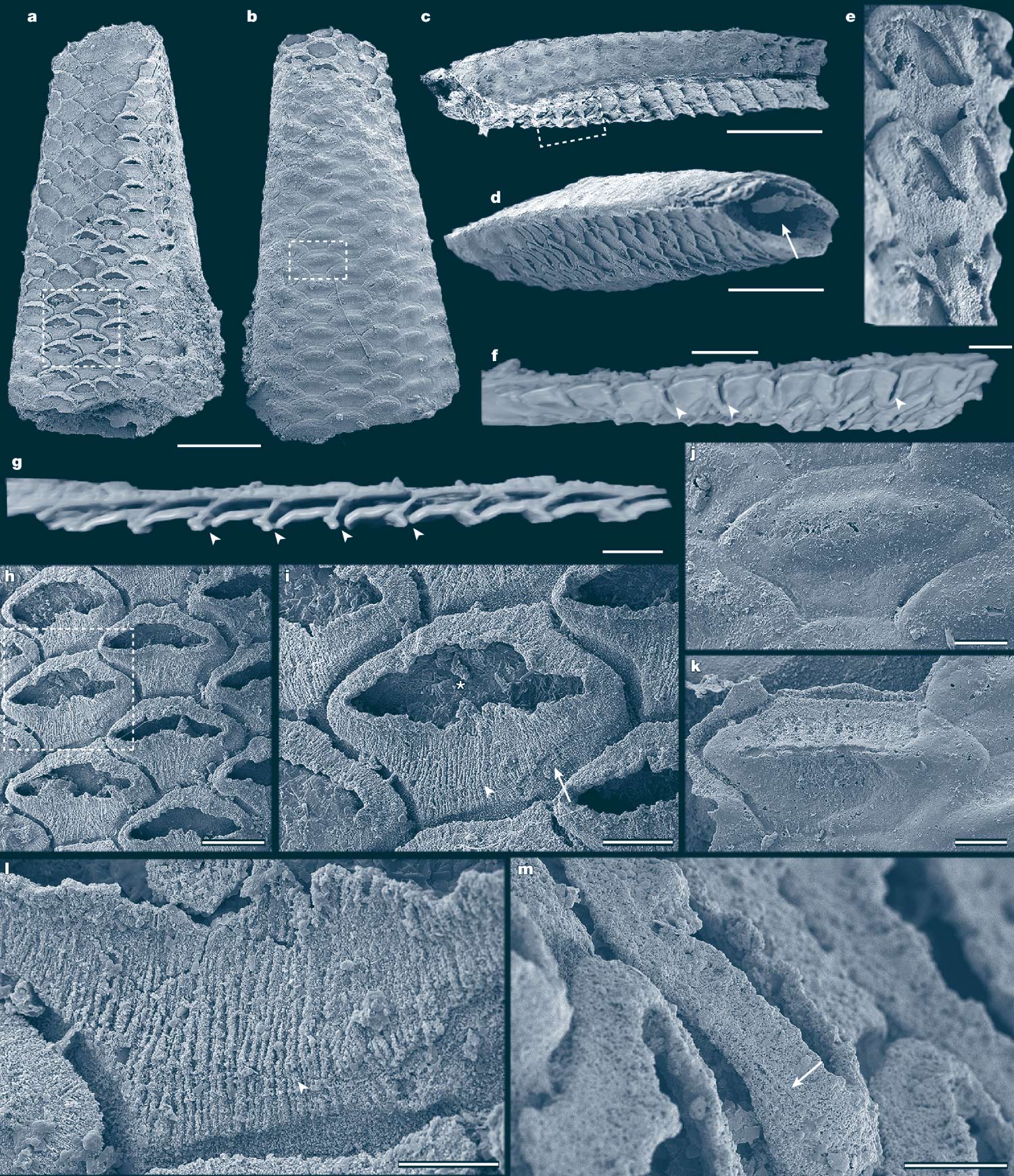
    Specimen of Protomelission gatehousei excavated from the sacrolactoid layer where the membranous sac is preserved.

    Specimen of Protomerision Gatehouse excavated from the sacrolactoid layer where a membranous sac is preserved. Image credit: Song et al., doi: 10.1038/s41586-026-10590-9.

    This discovery is not just a minor addition to the fossil record; it significantly impacts the understanding of the evolutionary tree of life.

    Phylogenetic analysis places both Protomerision Gatehouse and Daingomellission Hexacritia firmly within the Crown Group Stenolaemata, encompassing one of the three primary classes of living bryozoans.

    These fossils indicate an already advanced branch of the Bryonidae family tree, pushing the origin of the entire group back potentially to Ediacaran times, before the Cambrian explosion.

    Furthermore, while some researchers have questioned whether Protomerision Gatehouse is indeed a bryozoan, suggesting it could be a sclerotid isolated from green algae or an unrelated organism, new soft tissue data and detailed comparisons of colony dimensions, shape, and internal structure support its classification as a true bryozoan.
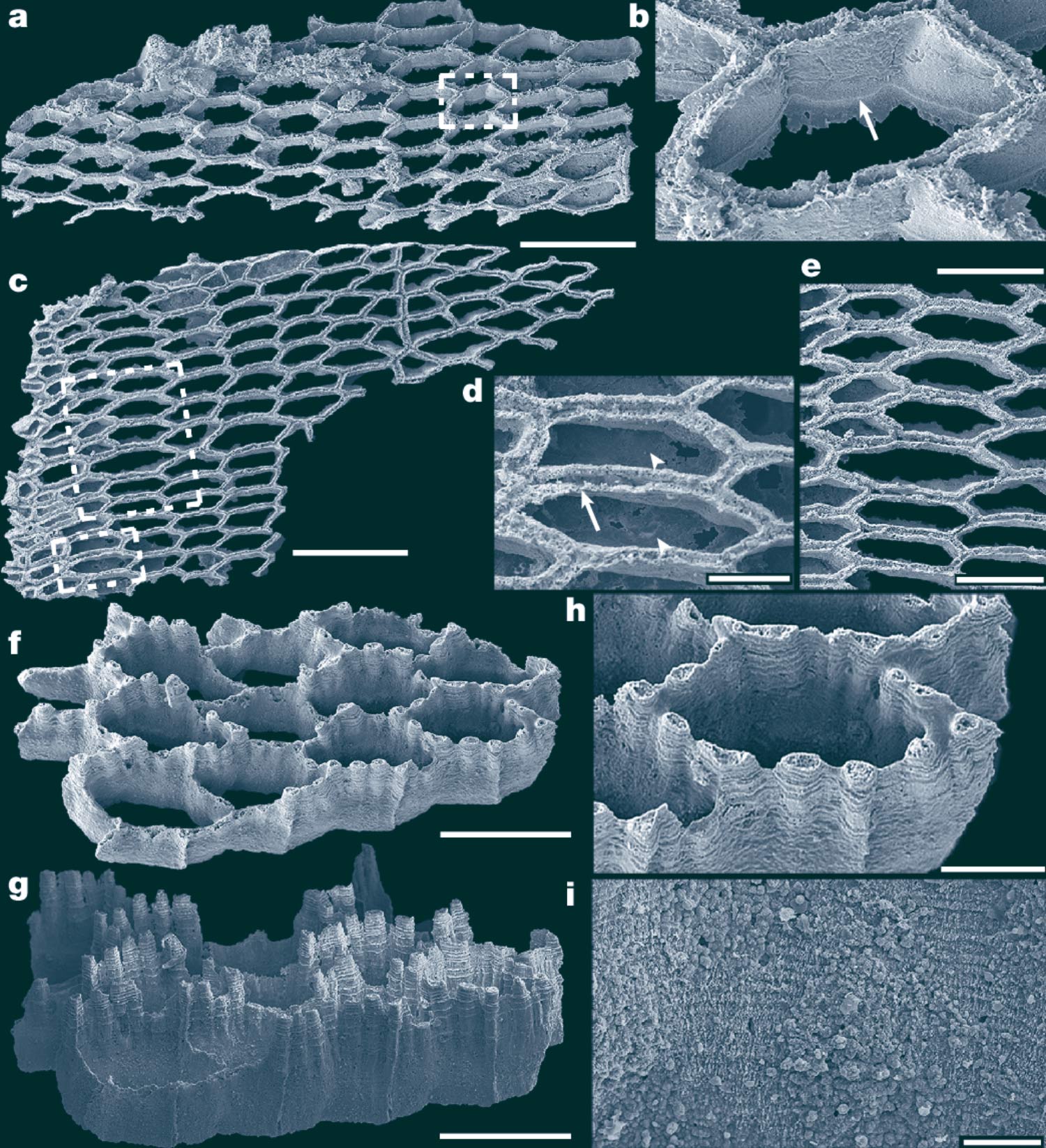
    Specimen of Dayingomelission hexaclitia from the Xiannüdong Formation. Colonies and cysteids are depicted.

    Specimen of Daingomellission Hexacritia, showing colonies and cystids from the Xiannüdong Formation. Image credit: Song et al., doi: 10.1038/s41586-026-10590-9.

    “These fossils represent not just precursors, but complex, modular colonies,” explains paleontologist Baopeng Song of Northwest University.

    “The combination of skeletal structures and internal anatomy provides conclusive evidence that these are genuine bryozoans, indicating that this phylum was already diversifying during the Cambrian radiation.”

    “The findings suggest that bryozoans were more widespread and sophisticated than previously acknowledged in early Cambrian oceans,” he added. “Colonial body plans, consisting of genetically identical polypids cooperating within a shared skeleton, appear to have originated as a fundamental innovation of the Cambrian explosion itself.”

    The team’s paper has been published in the latest edition of Nature.

    _____

    B. Song et al., The high-fidelity modular skeleton confirms the Cambrian origin of bryozoans. Nature published online on June 3, 2026. doi: 10.1038/s41586-026-10590-9

    Source: www.sci.news

    Share. Facebook Twitter Pinterest LinkedIn WhatsApp
    Previous ArticleExploring Earth’s Mysterious Triple Symmetry and Its Impact on Climate Change
    Next Article Clay Minerals Reveal Evidence of Mars’ Warm, Wet Past – Sciworthy Insights

    Related Posts

    Science

    Discover the Giant Scorpion That Dominated Ancient Britain in the Devonian Period

    Science

    Pigeons Utilize Superparamagnetic Immune Cells in Their Livers to Detect Earth’s Magnetic Field

    Science

    Webb Telescope Discovers Methane in Interstellar Comet 3I/ATLAS

    Science

    Silent Spring: How Rachel Carson’s 1962 Science Book Transformed the World

    Science

    New Axolotl Fossil Discovered in Mexico: A Significant Paleontological Find

    Science

    When Food is Scarce: This Single-Celled Organism Becomes a Giant Man-Eater for Survival

    Science

    Unlocking Multitasking: How Science Reveals Your Brain’s Potential with Practice

    Science

    Revealing the Truth: Stonehenge’s Altar Stones Likely Not Transported by Glaciers

    Add A Comment
    Leave A Reply Cancel Reply

    Stay In Touch
    • Facebook
    • Twitter
    • Instagram
    • Pinterest
    Top Picks
    Science

    Eyelash Trimming for Men: The Rising Trend That’s Confusing Ophthalmologists

    Wondering, “Should I trim my eyelashes?” This may sound like a quirky question, but it…

    What does a night drive look like with one of the most beautiful cars in the world: the Rolls-Royce Ghost

    NASA Astronaut Casts Historic Vote from Space

    Space Perspective: A Journey to the Edge of Space

    Hurricane Season Kicks Off: Below-Average Forecast Highlights First Time in a Decade

    Most Popular
    Wheels

    (Video) The smallest Honda gets a new edition – motocompacto

    Technology

    Windows 12 requires more powerful hardware

    Categories
    • AI (13)
    • Gadgets (10)
    • Science (47)
    • Space (9)
    • Technology (37)
    • Wheels (9)
    Our Picks
    Technology

    This is the northernmost photovoltaic plant in the world

    AI

    What the most advances humanoid robot predicts for the human race in 100 years?

    © 2026 Hitechub.
    • Home
    • About Us
    • Privacy Policy
    • Terms & Conditions

    Type above and press Enter to search. Press Esc to cancel.

    We are using cookies to give you the best experience on our website.

    You can find out more about which cookies we are using or switch them off in .

    Ad Blocker Enabled!
    Ad Blocker Enabled!
    Our website is made possible by displaying online advertisements to our visitors. Please support us by disabling your Ad Blocker.
    Go to mobile version
    Hitechub
    Powered by  GDPR Cookie Compliance
    Privacy Overview

    This website uses cookies so that we can provide you with the best user experience possible. Cookie information is stored in your browser and performs functions such as recognising you when you return to our website and helping our team to understand which sections of the website you find most interesting and useful.

    Strictly Necessary Cookies

    Strictly Necessary Cookie should be enabled at all times so that we can save your preferences for cookie settings.