


After five decades of diligent research, astronomers have discovered compelling evidence that Sagittarius A*, the 4.3 million solar mass black hole located at the heart of the Milky Way, is emitting intense cosmic winds. These winds are responsible for creating a vast cavity in the center of our galaxy.
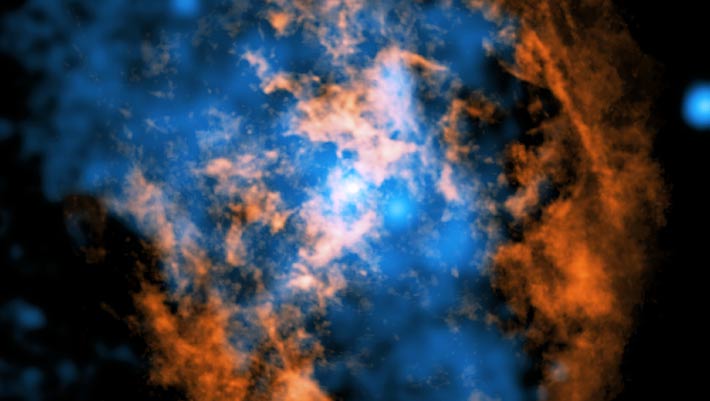
This image highlights winds emanating from Sagittarius A*, our galaxy’s supermassive black hole. The white dot at the center denotes the black hole, with orange data from ALMA showing cold gas and blue from Chandra revealing hot, X-ray-emitting gas. Image credit: NASA / CXC / UMass / Wang et al. / ALMA / ESO / National Astronomical Observatory of Japan / NRAO / Longmore et al. / Miniti et al..
According to theoretical physics models and the widely accepted concepts of galaxy evolution, when matter is consumed by a black hole, it typically produces winds or jets.
Even a minimal influx of gas into a black hole has the potential to generate sufficient energy to push matter away.
Until this recent discovery, the winds from Sagittarius A*, our Milky Way’s black hole, had not been clearly observed.
Astronomers have utilized years of precise observations from the Atacama Large Millimeter/Submillimeter Array (ALMA) to map the cold gas within a few light-years of Sagittarius A*.
After meticulously eliminating the black hole’s intense radio emissions, researchers uncovered a massive cone-shaped void in the cold gas that points directly towards the black hole. This reveals strong evidence of a significant active wind radiating from Sagittarius A*.
“In any non-vacuum environment, a black hole must produce some form of wind,” stated Dr. Mark Gorsky, an astronomer at Northwestern University.
“There is no absolute vacuum in space.”
“These new insights are the first time we have had sufficient clarity to recognize wind signatures.”
“Our analysis showed undeniable confirmation; this is what everyone has been searching for over the past 50 years.”
Over a period of five years, Dr. Gorski and fellow researcher Dr. Lena Murchikova meticulously mapped radiation from carbon monoxide molecules, a standard indicator of cold molecular gases, located approximately 1 parsec (3 light-years) from Sagittarius A*.
By carefully modeling and subtracting the black hole’s rapidly fluctuating radio emissions, they were able to reveal faint and intricate structures within the surrounding gas.
“This demonstrates for the first time that a black hole is actively consuming molecular gas very close to its core,” said Dr. Murchikova from Northwestern University.
“Given the winds are relatively weak, their direction could change over time.”
“This indicates that our black hole shares characteristics with others and that our position in the universe is not unique.”
Information from NASA’s Chandra X-ray Observatory confirmed the presence of hot gas filling the same area, verifying that this outflow originated from a black hole rather than a nearby star.
“Exceptional claims need compelling evidence,” Dr. Gorski emphasized.
“We aimed to ensure we were not merely observing an imaging artifact, and the X-ray images from Chandra corroborated our findings, aligning perfectly with the molecular signatures.”
The ALMA map is approximately 100 times deeper and 80 times sharper than previous carbon monoxide images in the region, establishing it as the most sensitive and highest-resolution map of cold gas within 1 parsec of Sagittarius A* ever recorded.
Researchers estimate that these cosmic winds have been active for at least 20,000 years, but they are relatively gentle compared to the dramatic jets observed in other galaxies.
“Most galaxies spend the majority of their existence in a state of inactivity,” Dr. Murchikova noted.
“We can only observe them during the ‘fireworks’ phase.”
“Studying black holes during these active periods is captivating, but it isn’t their prevailing state.”
“Sagittarius A* has finally provided us a glimpse into the life of this relatively silent black hole.”
The team’s findings will be published in the Astrophysical Journal Letters.
_____
Mark D. Gorski and Lena Murchikova. 2026. Discovery of active winds from the central black hole of the Milky Way galaxy. APJL 1004, L7; doi: 10.3847/2041-8213/ae63cf
Source: www.sci.news