


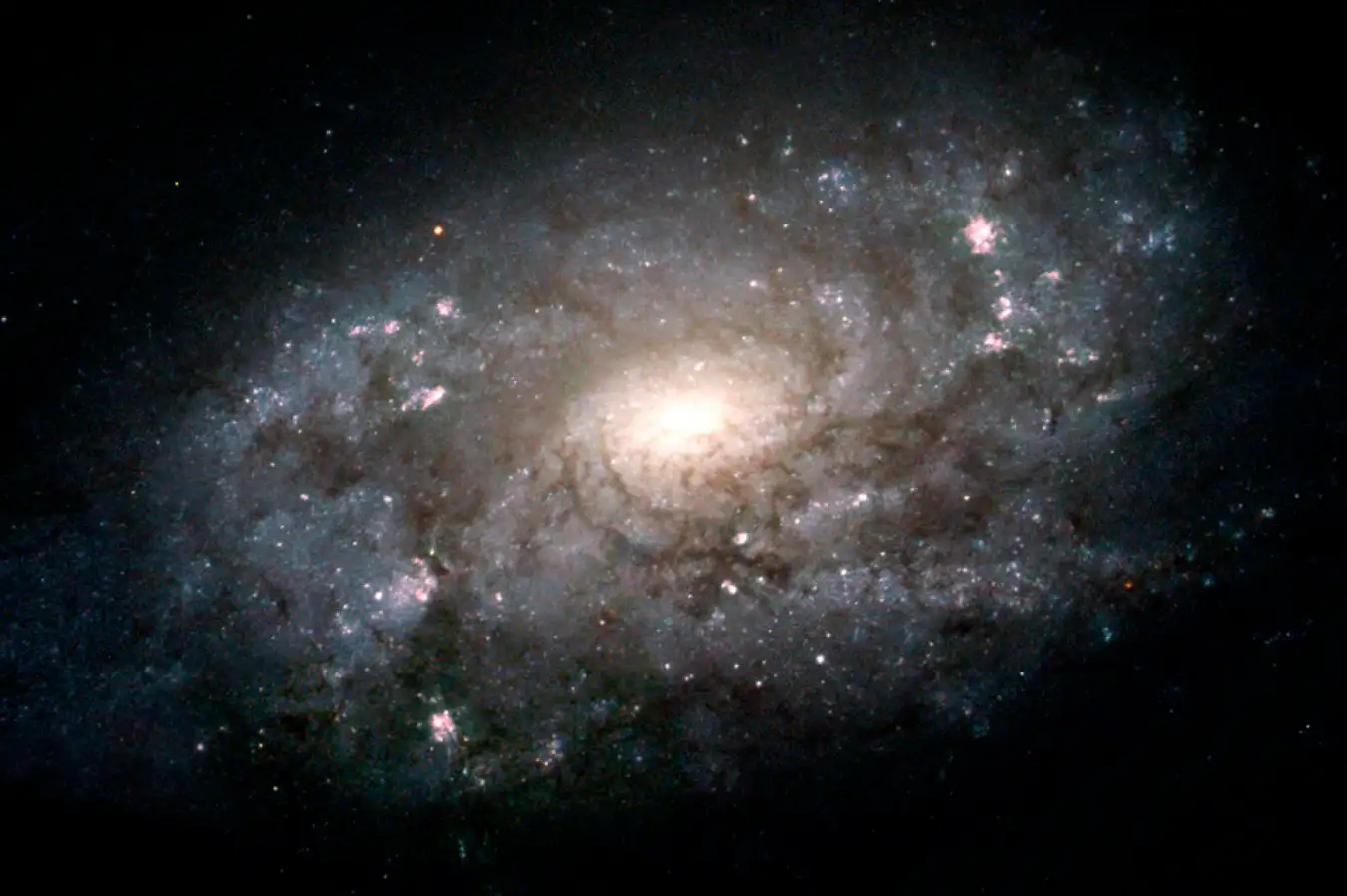
Did the black hole at the center of this galaxy begin before the galaxy formed?
NASA, ESA, STScI, AURA. S. Smart/Queen’s University Belfast
Samuel Butler famously stated in 1878 that “chickens are just the means by which eggs make other eggs.” Similarly, galaxies may simply serve as a mechanism through which black holes generate more black holes, implying that black holes may indeed come first in cosmic development.
Every massive galaxy observed across the universe contains a supermassive black hole at its core, which deeply influences the galaxy’s evolution by consuming its matter. The longstanding cosmological debate revolves around whether black holes formed first, attracting surrounding matter to create galaxies, or if galaxies emerged first, eventually collapsing to generate black holes at their centers.
Interestingly, supermassive black holes appear to defy expectations—they’re remarkably massive, too substantial to have formed less than 500 million years after the Big Bang. To put this in context, on a cosmic calendar where the Big Bang marks January 1st and today represents December 31st, the earliest supermassive black holes would have grown to hundreds of millions of times the mass of our Sun within just mid-January. Current physical theories struggle to explain such rapid growth.
There are four principal theories regarding the formation of supermassive black holes. The first involves the merger of smaller stellar-mass black holes, which develop from the collapse of massive stars. However, this process is too slow, requiring billions of years, and thus insufficient time existed for this scenario to account for the black holes observed in early galaxies. Another theory posits the creation of large “seed” black holes, possibly formed from protostars, dark matter stars, or star clusters, yet these also encounter timeline problems during the early universe. This leaves us with two plausible options: direct collapse, where immense gas clouds transition into black holes without intermediate star formation, and the hypothesized primordial black holes, which are contentious yet vital for understanding black hole origins.
Primordial black holes, thought to have emerged from extreme conditions in the early universe rather than from stars, could range greatly in size and serve as key players in galaxy formation. They potentially resolve the outstanding question of whether black holes predate galaxies. Although their existence remains unproven, if they did exist, they would be crucial in enhancement of supermassive black hole masses during their infancy.
The advent of the James Webb Space Telescope (JWST) has significantly advanced our understanding, revealing supermassive black holes at various cosmic epochs—further back than we ever thought possible. One remarkable discovery involves the distant galaxy known as the Little Red Dot, which has illuminated dozens of newly identified galaxies, observable from an unprecedented distance and era.
Recent findings suggest that the central black holes of these small, distant galaxies possess extraordinary masses, some equivalent to 20 to 70 percent of the galaxies’ total mass—an anomaly compared to typical ratios found in supermassive black holes. One extraordinary case revolves around the galaxy Abell 2744-QSO1, illuminated by gravitational lensing, revealing a black hole with a mass approximately 50 million times that of the Sun, existing at a time when the universe was just 700 million years old.
These revelations point towards either the direct collapse of gas into black holes or their origins as primordial black holes, challenging the notion that galaxies must form prior to their supermassive black holes. This suggests that in this instance, the black hole could be considered the “egg”—the first to emerge.
However, further research is essential to ascertain whether other tiny red dots like QS01 present similar characteristics. Understanding the process behind their formation and the nature of their host galaxies remains crucial to deciphering the universe’s structural mysteries. Celebrating these victories, we cautiously conclude that “the egg was born first.”
Topics:
Source: www.newscientist.com